A bottle of teriyaki sauce has a surprisingly demanding job. Before anyone opens it, the label has to explain what is inside, distinguish one flavor from another and make sense among its neighbors. GK Design International’s packaging for Kikkoman’s Takumi range tackles precisely that little contest for attention. The same consultancy also works on Yamaha vehicles. Dinner and a day on the water turn out to share a design problem: understanding what a customer expects to see.
GKDI, as the company calls itself, occupies an interesting patch of the design business. It is the North American base of Japan’s GK Design Group, with a practice spanning physical products, packaging, graphics, interfaces and research. Its central proposition is cultural understanding: bring knowledge of Japanese brands together with firsthand experience of American consumers. The resulting assignment can be as large as a vehicle’s shape or as compact as a label.
A company built across the Pacific
The American operation started before its present corporate name. GK’s Japanese-language history dates a Los Angeles representative office to 1966, established to serve Japanese industries selling products in the United States. In 1972, the operation became a California corporation under the GK Design International name. That sequence matters. Being close to the destination market was part of the business’s original purpose.
The wider organization has an older origin. In 1952, students at Tokyo University of the Arts gathered around teacher Iwataro Koike; GK takes its initials from Group Koike. Kenji Ekuan helped establish and build that organization. Its ambition included making well-designed objects part of ordinary life. GKDI belongs to that tradition, while operating as a particular American business with its own people and assignments.
The group describes its companies as independent businesses that assemble collaborations according to a project’s needs. GKDI forms teams of American and Japanese designers. For a client, the practical attraction is access to people who understand both the source culture and the destination market. Geography becomes useful when it changes a decision about the product.
One brief: make a splash
The Yamaha connection gives that arrangement physical form. In September 2024, GK Kyoto announced that it and GKDI had worked together on the new JetBlaster series for the 2025 model year. Their contribution covered the design concept, styling, and colors and graphics. The brief aimed at a younger generation, with a sporting, adventurous appearance.

There was a material story underneath the color. GK Kyoto’s announcement describes reinforced polypropylene in the deck, connecting the choice with lower weight, maintenance and new design possibilities. It is a useful illustration of industrial design’s working conditions: the shape depends on what the object can be made from, how it is assembled and how people will use it.
Other mobility work in GKDI’s portfolio includes Yamaha’s Wolverine RMAX models and a Bolt Scrambler design. The former emphasizes cabin comfort and assertive styling; the latter draws on 1960s scrambler cues and Yamaha heritage. Those are distinct emotional instructions. One asks a vehicle to communicate capability and comfort. The other asks a contemporary machine to carry a recognizable memory.
Twelve inches of decisions
GKDI also designed the graphical layout and screen progression for Yamaha’s 12-inch Connext touchscreen on the 275 boat series. The display brings together entertainment, navigation, controls and boat information. This places the consultancy inside the user’s sequence of decisions, beyond the external appearance of the machine.
Yamaha Connext puts mapping, entertainment, controls and boat data on one touchscreen. GKDI’s contribution: graphical layout and screen progression.
The design challenge is easy to imagine: a screen can contain plenty of information and still leave someone hunting for the one thing they need. GKDI describes organizing the display to make a large amount of information readable, including the user’s critical data. It is a practical connection between product design and interface design. Both have to fit the person operating the equipment.
The supermarket is another test track
For Kikkoman Sales USA, GKDI worked on packaging for the Takumi teriyaki sauce range as it added Gochujang Spicy Miso. Its account stresses a simpler, more intuitive presentation, with the Takumi name and vivid colors working together. Here, the place to judge the design is the shelf, where a bottle must remain legible among competing packages.
The consultancy’s packaging service starts with research into markets and competitors, including store visits and positioning maps. It then checks how the proposed design appears on the real container and at the point of sale. That physical check is a useful discipline. A flat image gives a designer control over the view; a curved bottle in a crowded store takes much of that control away.
GKDI’s Amazon Global Selling service-provider listing adds a concrete explanation of the client relationship. Japanese staff can communicate in Japanese while local designers handle the creative work with North American customers in mind. Services include product evaluation, packaging, promotional materials and help with ingredient lists. The business sits where brand presentation, market entry and practical product preparation meet.
That work also connects GKDI with JETRO and regulatory consultancy Eureka Global Solutions. Public reports and a Japanese-language seminar address U.S. food packaging strategy and labeling. For an exporter, the implication is straightforward: deciding what a package communicates and organizing the information it must carry belong in the same development conversation.
The evidence comes before the artwork
“Future hypotheses form the foundation of every design project,” GKDI says in its description of research. Its methods include online surveys, individual interviews and focus groups. The company also produces an annual Color and Graphic Trend Report, informed by observation and information shared across the GK network.
“Future hypotheses form the foundation of every design project.”GKDI · Design Research
There is a habit here that another business can copy: write down the assumption before commissioning the finished design. Which customer is it for? What should that person recognize? What needs explaining? Then choose research that can challenge the answer. A mood board becomes more useful when somebody can explain why its colors and references belong to this customer.
Recent observation continues that pattern. GKDI’s designers visited CES 2026 and discussed how AI was becoming embedded in familiar products, from displays to robotics. Their post focused on how those capabilities fit into daily life. The interesting question for this practice is what the technology asks of the person using it.
Pretty can still get stuck in the snow
The wider GK-Yamaha history supplies a sharp reminder about design’s limits. Yamaha’s account of its early snowmobile development describes styling that drew comparisons with a house slipper. Two GK designers joined the effort and developed a different appearance, with an upward-curving front and a restrained white-and-gray color scheme. North American market surveys responded more favorably.
Yet performance problems remained, including a tendency to burrow into snow. This episode predates GKDI’s 1972 incorporation and belongs to the broader relationship. Its lesson survives the distinction: improved reactions to appearance do not establish that a machine works. Research has to ask the right question, and engineering has to deliver on the impression the design creates.
There is also an unusually specific early number in the group’s history. GK Dynamics records a 70,000-yen design fee for the Queen bicycle, launched in 1955, against an average graduate starting salary of about 13,000 yen a month. That historical fee shows design becoming paid industrial work. It belongs to another era and another part of the organization, rather than serving as a price guide for today’s GKDI assignments.
The people who have to explain the sketch
GKDI’s president, Julio Flores, offers a more personal entry into the business. His California State University, Long Beach speaker biography says he graduated in industrial design in 1997 after switching from mechanical engineering. He found his powersports job by looking it up in the phonebook. A very analog search led to a career developing products for international markets.
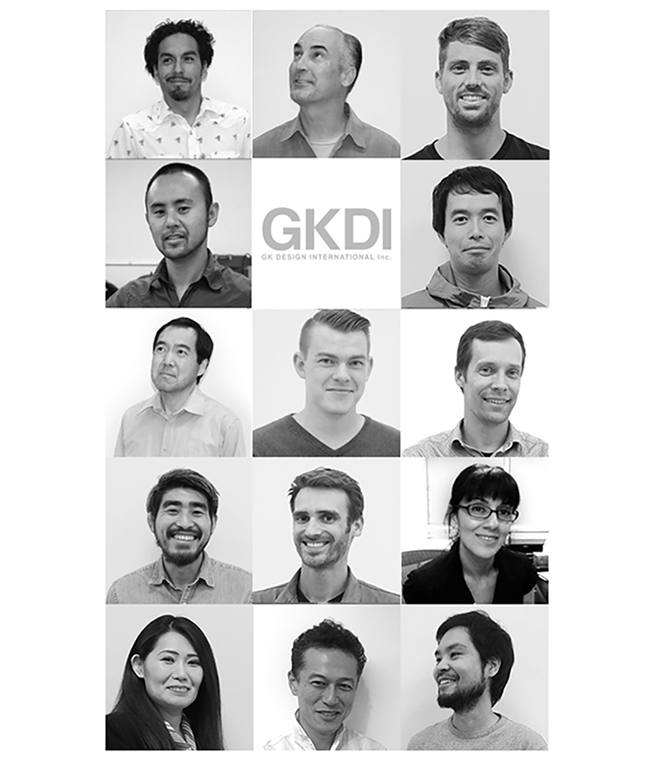
His 2022 university talk concerned communicating design: how presenting and explaining a proposal affects whether it advances. That subject fits a consultancy whose work crosses disciplines as well as countries. An idea has to make sense to the client, the engineer and the person who ultimately uses the product.
The portfolio supplies smaller examples of the same communication problem. GKDI’s logo for the 60th anniversary of Japan Airlines’ Tokyo-Los Angeles route combines references to both places in a vintage passport-stamp treatment, while preserving JAL’s red, white and black palette. The industrial design pages range from Kamui Pro golf clubs to explicitly labeled concepts for a drill and protective helmet. Finished client work and exploratory proposals each have a place in the practice.
The drill concept, for example, carries a hexagonal motif through the grip, vents and chuck texture, with a guard intended to protect the hand and reduce accidental trigger contact. The proposed helmet brings ear, eye and face protection into one arrangement. These examples show how a visual theme can extend through the parts somebody touches. They also give a prospective client a useful distinction to make: a concept demonstrates an approach, while a manufactured product has traveled through additional development decisions.
For a buyer, GKDI is a commissioned design and research partner. Its position is particularly clear when a manufacturer needs American market knowledge alongside product or packaging development. An internal team or a specialist agency can be another route; the reason to consider GKDI is the combination demanded by the assignment. Bring a customer, a use setting and a question worth testing. A sauce bottle and a watercraft may require very different answers, but both benefit from a brief that knows where the product is going.
Inside the work
Explore GKDI’s website, its project portfolio and research practice. Follow the company on LinkedIn and Facebook.
↗ Watch: Yamaha JetBlaster↗ Watch: JETRO packaging seminar · Japanese