The origin of Team Consulting is almost suspiciously English. In October 1986, five engineers met at the Chaise and Pair pub in Barkway, Hertfordshire, and each dropped a five-pound note into a moneybox. The £25 was ceremonial, not venture capital. A month later Andrew Fry, John Targell, Perran Newman, Peter Sharpe and Alan Goodman incorporated the company they had left PA Consulting to build. They wanted high-end technical work without the tariff or management style of a giant consultancy. They called it Team because nobody's surname deserved top billing.
At first, the name covered practically anything with moving parts. The young firm worked on a commercial lawnmower's hydraulic system, a tuna-canning machine, robotic keyboard-test equipment for IBM and automotive projects. The office sequence was equally eclectic: a cottage, a 1960s house with a workshop, a former Victorian abattoir, then part of a Georgian manor. This was not yet a medical-device company. It was five capable people saying yes.
Then came 1991. Founder Andy Fry later wrote that Team came within “a hairsbreadth” of losing the firm, his house and the founders' hopes. The published history does not give a project-level post-mortem or a rescue price. It does give the strategic consequence. Jerry Turner, newly managing director, and the remaining founders decided to focus on medicine and pharmaceuticals - a market accustomed to outsourcing research and development, and one in which engineering could alter a patient's life rather than merely improve a machine.
01 / The useful pivotNarrow the market. Widen the room.
That decision explains the company better than its long menu of services. Team narrowed its customer problem to regulated healthcare, then widened the skills available to solve it. Today a programme can draw on industrial designers, mechanical and electronics engineers, applied scientists, software developers, systems engineers, human-factors specialists, regulatory advisers, quality experts and manufacturing support. More than 150 specialists work in-house, according to the company.
The buyer is not the patient, although the patient is the test. Team sells business-to-business development work to global pharmaceutical companies, established MedTech groups, university spin-outs, start-ups and healthcare providers. Named public clients include AstraZeneca, Novartis, Chiesi, OrganOx, TympaHealth, LumiraDx, leon-nanodrugs and Actegy Health. Engagements can be narrow work packages - a usability study, a technical audit, a test method - or a programme that runs from clinical need to design transfer.
- Find the clinical need and commercial constraint
- Generate, model and prototype the concept
- Test with users; identify use errors and risks
- Verify the system and build the regulatory evidence
- Design for manufacture, transfer and scale
The distinction from a styling studio is regulation. A graceful injector that cannot be validated is a sculpture. A clever diagnostic that cannot be manufactured consistently is a demonstration. Team's ISO 13485 certification dates to 1999; its current scope covers design, development and pre-production manufacture of medical and in-vitro diagnostic devices. That quality system is the connective tissue between an idea, its risk controls and the evidence an authority or client quality team expects.
02 / Proof under pressureA liver that bought surgeons time
OrganOx shows what “multidisciplinary” means when the brochure language is removed. The Oxford University spin-out wanted to keep a donor liver functioning outside the body during transport. The existing process was large, manual and dependent on clinicians. The new system had to circulate blood, oxygen and nutrients at physiological temperature, report the organ's condition, survive road and air travel, set up quickly and keep its critical functions running if a peripheral component failed.
Team helped define and build the metra system across electro-mechanics, sterile fluid circuits, embedded circuit boards, firmware, industrial design, touchscreen interaction, specification and risk management. It delivered a fully autonomous proof-of-principle system in nine months, which OrganOx used to support further fundraising. The path from the first meeting to UK approval for clinical trials took four years. In 2013, public clinical studies reported successful transplants after livers had been kept alive outside the body.
The device later collected engineering and MedTech awards. Team says it has helped save more than 1,000 lives; in 2025 Terumo agreed to acquire OrganOx for $1.5 billion. That price belongs to the client, not the consultancy. It is still a useful measure of the value that can accumulate around an unshowy engineering decision made years earlier.
03 / Design is what the hand doesAn ear clinic escapes the hospital
TympaHealth began with NHS ENT surgeon Krishan Ramdoo asking whether a smartphone and a new otoscope could move hearing care into pharmacies and care homes. The pathway he wanted to compress could send a patient back and forth between wax removal and hearing-test providers for 12 to 16 weeks. The proposed device would combine an ear examination, hearing test and microsuction in one 30-minute community appointment, with images available for remote specialist review.
In 15 months, Team helped develop the concept into a pilot suitable for clinical trials. User studies changed the handle angle so left- and right-handed professionals could work comfortably. Feedback on image quality led to a custom optical system. Electronics, cloud connectivity, industrial design and manufacturing choices had to move together. Team then helped select ISO 13485-accredited manufacturing partners in Singapore.
The result gained CE marking as a Class I device and moved into markets including the UK and US. By May 2026, Team said the product had touched almost half a million patient lives. It won Good Design, iF and Gold UX Design awards, then Silver at the 2026 DBA Design Effectiveness Awards. Those trophies matter less than the underlying move: the whole ear clinic became portable enough to visit the patient.
04 / Subtraction as engineeringThe injector improved when parts vanished
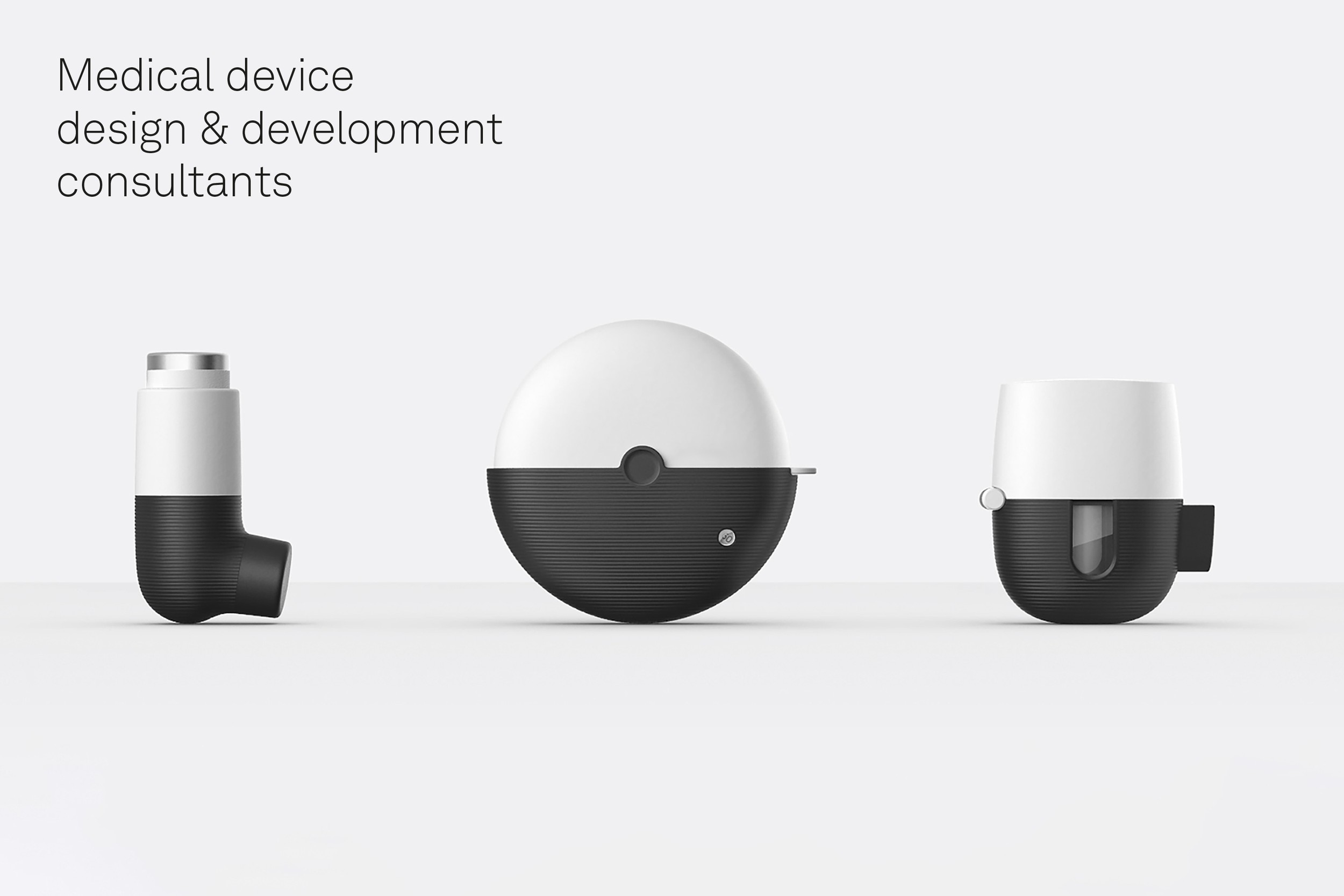
Drug delivery is Team's oldest deep specialism, especially inhalers, injectors and on-body systems. Its work with AstraZeneca offers two versions of the same problem: patients need a therapy, but the device and its instructions can make them anxious or error-prone. In one trainer-pen redesign, the teams simplified the mechanism while preserving the four-step rehearsal of a real injection. Team estimated the new design eliminated roughly 240,000 components for every 10,000 trainers produced.
A later reusable autoinjector platform took another subtractive route. Rather than add batteries and circuitry to the reusable section, the collaborators developed a fully mechanical mechanism paired with a lower-cost disposable cassette. Rapid cycles of user testing were used to make the extra reuse steps understandable. The platform won a 2024 PDA Partnership Innovation Award.
The next year's PDA award went to a digital instructions platform for existing autoinjectors. It supplements the approved paper instructions with formats for different learning styles and can use interaction data to guide updates. In July 2026, a related Novartis web experience - written guidance, animation and virtual injection practice for people with relapsing forms of multiple sclerosis - was nominated for a UX Design Award. Hardware consultancy now includes what happens on the phone before the cap comes off.
A device brief is a four-way negotiation
05 / The company is the long experimentOwnership designed for slow work
Team's business model is ordinary in outline: clients pay for expert time, defined deliverables and development programmes. Rates and project costs are not public. Its ownership model is less ordinary. In 2016, control transferred to an Employee Ownership Trust. Every employee is a beneficiary, and the company describes itself as financially independent and 100% owned by its people.
There is a practical fit between that structure and regulated product development. A programme can take years, clinical evidence cannot be hurried into existence, and the best outcome often carries the client's logo. Employee ownership does not guarantee good work. It does reduce one source of tension: an outside owner demanding a different timetable from the one physics, users and regulators impose.
The culture predates the trust. In 1991, management explicitly rejected the styles its founders had disliked elsewhere and chose respect as an operating principle. Today's careers material adds open communication, staff voice, charity work and environmental measures including renewable electricity, solar panels and travel offsets. The company also works from Abbey Barns in Ickleton - the sort of converted rural campus that makes a circuit-board lab look as if it might serve tea at four.
What a buyer can copy
Choose the regulated niche first. Put users, engineering, risk and manufacturing in the same loop. Fund proof early enough to expose the hard physics. Design the handoffs before they become delays.
Where the model is wrong
For a low-risk consumer object, a cosmetic refresh or cheap staff augmentation, this much quality infrastructure can be expensive and slow. It works when failure, approval and scale genuinely matter.
The competitive set includes Cambridge Design Partnership, TTP, Sagentia Innovation, DeviceLab, healthcare teams inside large consultancies and the client's own R&D organisation. A buyer can also assemble separate design, regulatory, testing and manufacturing vendors. Team's argument is that integration reduces the expensive surprises between them. Its disadvantage is the mirror image: a full multidisciplinary shop is more capability than every brief needs.
In 2026 the company began placing consultants with the London Institute for Healthcare Engineering at St Thomas' Hospital, supporting early-stage ventures on business planning, product development and regulation. It also ran a surgical-innovation workshop with the Royal College of Surgeons of England and LIHE. Both moves bring the consultancy closer to problems before they arrive as polished briefs.
Forty years after the pub moneybox, the useful lesson is not to romanticise £25. Team survived because it changed its mind. It stopped saying yes to every kind of engineering, chose a market where outsiders could be valuable, and built enough adjoining disciplines to follow an idea all the way to a patient's hand. The devices are the visible output. The real product is fewer bad surprises on the road there.