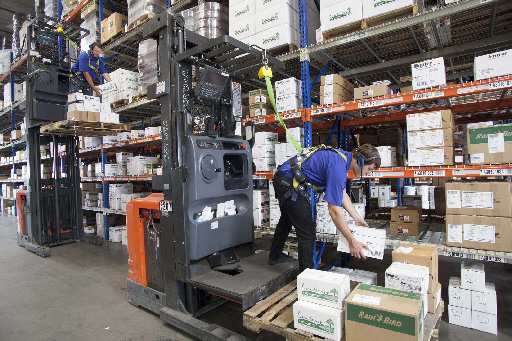
The first problem at Cerrajes was the wireless network. The Mexican furniture-hardware business wanted better control of its warehouse, but its network made connecting handheld devices difficult. Before anyone could admire a dashboard, someone had to make a scanner work. It is a small detail with a large implication: a digital warehouse still depends on what happens between a person, a shelf and a box.
- Netlogistik connects warehouse and transportation software to everyday operations.
- It implements Blue Yonder and SAP, and offers its own Supplynet software.
- Its customer stories reward practical work: connectivity, integration, training and testing.
Netlogistik began Cerrajes’ implementation by correcting wireless connectivity. Handhelds replaced paper records; WEP, its warehouse management system, connected with SAP. Cerrajes had required testing on the warehouse floor. Its published case reports productivity rising 34%, inventory falling 16% and customer service reaching 99%. Those are customer-case results, rather than a forecast for the next warehouse. The sequence is more portable than the percentages.
The people between the platforms
Netlogistik occupies a useful position in enterprise technology. Software vendors build systems; warehouse operators must make thousands of physical decisions. Between them sit configuration, interfaces, process design, training and support. Netlogistik sells that connective work, helping customers diagnose needs, map technology and keep systems running after launch.
Its customers include retailers, manufacturers, distributors and third-party logistics providers. Think of a business with enough products, locations and movements that memory and spreadsheets become expensive habits. The company’s expertise spans warehouse management, transportation, labor, inventory and automation. A buyer can commission an assessment, implement a system, connect existing applications or arrange continuing support.
Casa Ley illustrates the integration problem from another direction. Its published SAP EWM case describes a retailer seeking to consolidate multiple systems and communicate in real time. Training and continuous learning were part of the implementation. The aim was a connected operation that employees could use consistently, with warehouse information available across the business. The software choice and the preparation of its users traveled together.
The distinction is its combination of partner platforms and proprietary products. Netlogistik implements Blue Yonder and SAP while offering WEP through Supplynet. A specialist integrator, a broader consultancy or an internal team represents an alternative route. The choice turns on operational complexity, existing software and who will maintain the connections.
For a buyer, that makes the assessment a working document. Follow a received item through putaway, replenishment, picking and dispatch. At each handoff, identify which application holds the record and which employee confirms the movement. Then ask what happens when the record and the shelf disagree. That exercise gives an implementation team a concrete problem to solve. It also gives the customer a way to judge a demonstration: can the proposed system handle the exceptions its own workers encounter?
Fifteen percent, without more infrastructure
The appeal becomes clearer in a testimonial from Grupo Bimbo. Operations director Fabio Caicedo describes OPS, Netlogistik’s order picking system, as making assigned tasks visible and increasing execution speed. His reported outcome is unusually specific:
“OPS increased operator productivity by 15%, without the need for additional infrastructure costs.”
Fabio Caicedo · Grupo Bimbo Operations Director
The qualification matters. A productivity improvement can come from organizing work differently within existing infrastructure. It need not begin with a new building or another machine. Bimbo’s statement concerns its own operation; it gives a prospective customer a question to investigate, rather than a return to plug into a budget.
The price of putting it to work
WEP handles the familiar warehouse sequence: receiving, putaway, inventory, picking, packing and shipping. Its published pricing lists Professional from $1,105 a month, billed $13,260 annually, and Enterprise from $1,275, billed $15,300 annually. These are starting subscriptions. A complete budget also needs a defined scope for deployment, interfaces, devices and support.
Professional · $13,260 billed annually
Starting software price; total project cost depends on scope.
That makes Netlogistik a combination of software and services businesses. Subscriptions sit alongside implementation engagements, partner technology and managed services. For a customer, the practical exercise is to separate the recurring software bill from the effort needed to make the operation ready.
The calendar met the warehouse
RTA Muebles supplies the less tidy version of the story. During its WEP project, the furniture company was also introducing an ERP and expanding warehouses. Its case study says those parallel changes postponed the planned go-live. Training operators unfamiliar with the technology added another challenge.
The response involved shared goals, a work plan, functional design and employee preparation. Warehouses in Colombia and the United States were described as operating the system successfully. The useful lesson is about dependencies: a launch date belongs to the whole operation. Changing the surrounding systems and physical space changes the implementation, too.
A robot needs someone to translate
Automation multiplies the connections. In January 2024, Netlogistik announced a reseller partnership with SVT Robotics for SOFTBOT. The platform provides a common way to connect automation technologies, reducing the custom development and support required when different systems must communicate.
For a Blue Yonder customer, the proposition is a route from the warehouse system to picking equipment, robots and other automation. The robot is the visible purchase. The interface determines whether it receives the right instruction. Netlogistik’s role extends from installing warehouse software into making the surrounding equipment participate in the same operation.
Why Argano bought the connective tissue
Argano announced its acquisition of Netlogistik on April 29, 2025. The announcement counted nearly 600 employees, including more than 300 certified logistics and commerce experts, and emphasized delivery capacity in Mexico, Colombia and the United States. Its stated intention was to expand supply chain capabilities within a broader operations consultancy.
The connection continued in April 2026, when Argano highlighted Netlogistik in an expanded SAP practice, identifying expertise in Extended Warehouse Management, Transportation Management and SAP BTP integration. The direction is consistent: connect logistics to more of the enterprise, with specialists who understand both the software and the operating environment.
Start where the scanner stops
A reader can borrow the sequence without buying a particular system. Check connectivity on the floor. Trace how an order passes between applications. Give operators time to learn. Test real work before fixing the launch date. When those conditions are missing, another layer of software inherits the same obstacles. Cerrajes’ wireless network is a useful place to remember where transformation begins.