Consider a drawing that changes after a factory has ordered its parts. Engineering knows about the revision. Purchasing has a different record. Quality needs evidence of approval. Somewhere between those departments, a small edit has become a large coordination problem. This is the kind of problem GoSaaS works on: making the information behind a physical product travel intact.
- Implements and connects Oracle applications for product businesses.
- Packages repeatable work into GoStarts and specialist applications.
- Joined Argano in September 2026, bringing PLM and logistics expertise.
The phrase for this connected record is the digital thread. Follow it from design through production and support, and you can see why a cloud project involves more than relocating software. Someone must decide which information matters, who can change it, and how the next department receives it. GoSaaS sells expertise in those decisions, along with tools that keep them from becoming entirely bespoke.
A smartphone question, an enterprise answer
The founding story starts with an unusually reasonable customer question. Why could someone move between smartphones with relative ease while moving enterprise software demanded such an elaborate undertaking? In a 2021 Inc. Studio branded profile, Hassan Ramay recalled that question as the spark behind GoSaaS, founded in 2017.
Ramay and his colleagues built an implementation platform and industry applications before signing customers, according to that account. Co-founder Tom Nelson described GoStarts: reusable enterprise use cases containing industry-specific applications and integrations. The proposition was to spend less project time rediscovering processes that other manufacturers had already solved.
“Oracle can’t solve each industry’s unique needs, so we built add-on software.”
Hassan Ramay · Inc. Studio, 2021

There is a useful distinction here. A semiconductor company and a medical-device manufacturer both need controlled product information. Their exceptions differ. A reusable starting point gives a project team something concrete to test, challenge, and adapt. The practical attraction is spending scarce attention on the exceptions.
Follow the record, not the org chart
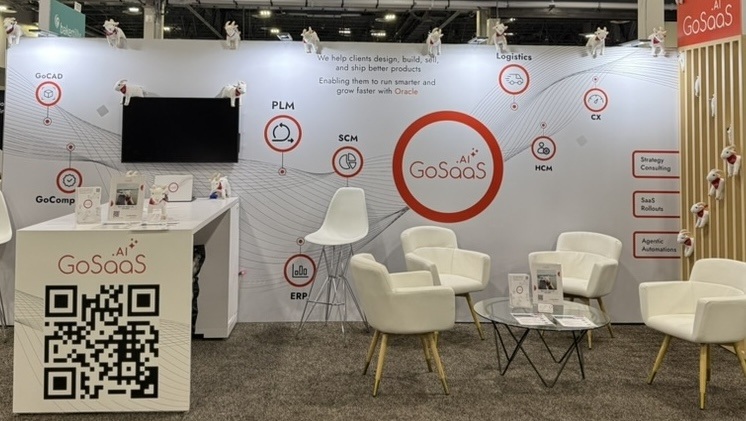
GoSaaS serves high-tech, semiconductor, life-sciences, industrial, and consumer-goods businesses. Its services span Oracle product lifecycle management, supply chain, finance, human resources, customer experience, and logistics. That breadth follows the product: engineering releases it, operations makes it, finance accounts for it, and logistics moves it.
- 01DesignDrawings + parts
- 02ApproveChanges + evidence
- 03MakeMaterials + quality
- 04ShipInventory + logistics
GoStarts makes the approach tangible. On GoSaaS’s quality-management offering, the reusable assets include inspection plans, checklists, workflows, and reporting. Its manufacturing offering describes production definitions and material-tracking workflows, alongside process analysis and training. Buyers are getting a starting configuration, then the work of fitting it to an actual operation.
The market position is that of an Oracle specialist with proprietary software. A buyer can also consider a large systems integrator or another Oracle consultancy. GoSaaS’s distinctive pitch combines product-lifecycle knowledge with applications for recurring industry needs. The sensible comparison is therefore the proposed team, reusable assets, and integration scope.
A useful test for that promise is to bring an actual approval problem to a demonstration. Ask the team to show the ordinary path, then introduce a rejected change, a missing attachment, or an unavailable approver. This is an editorial buying suggestion: the exceptions reveal more about a proposed system than a clean sequence of screens. They also help expose which decisions still belong to the customer.
The same test applies to the reusable assets. Which pieces are already built? Which need configuration? Which require new development? Those questions make competing proposals easier to compare. A shorter implementation only helps if the resulting process is usable, and a familiar workflow only helps if it fits the work. Treat the starting point as a hypothesis to examine with the people who will use it.
The gaps have product names
GoCAD addresses a familiar boundary: engineers work in computer-aided design tools, while product approvals live elsewhere. Its Adapter connects an existing CAD environment to Oracle Cloud PLM. Its Vault provides centralized design-file management. Synchronizing parts, attachments, and workflow status helps keep the drawing and the approved product record aligned.
GoCompliance tackles another boundary, between a finished product and the evidence gathered from its suppliers. Its origin story describes automated supplier-data collection, current product revisions, configurable compliance calculations, and reporting. The present offering also includes managed services. That turns a recurring collection-and-checking task into a defined product and service.
These offerings explain the business model. GoSaaS earns work through enterprise implementation, integration, training, and continuing support, while complementary SaaS applications give customers additional capabilities. Its GoThrive services include health checks, user support, and testing around updates. Go-live leaves plenty of work on the calendar.
Two budgets, and a warning about extra steps
Customer interviews on Clutch put numbers against two older assignments. A laser-products company reported investing about $20,000 in a PLM implementation completed in 2019. The work covered configuration, document migration, quality processes, and training. The customer described a slight delay and advised against adding excessive steps.
An inflight-connectivity business reported about $15,000 for a 2020 automation project, including ten additional attributes in Oracle Agile PLM. That customer reported delivery on time and budget, but noted time-zone friction and urged buyers to settle requirements internally. These are historical project examples, not current prices. The transferable lesson is clear requirements and restraint.
The named customer accounts extend beyond those interviews. Nissha Medical Technologies describes sharing PLM across facilities. TDK-Lambda describes bringing design documentation together across locations. Roche Tissue Diagnostics highlights reporting and archiving in its migration. Together, these accounts make the appeal concrete: shared records that fit everyday work.

After the move comes the next decision
In October 2025, GoSaaS adopted the .ai domain. Its announcement explained the shift toward helping customers use Oracle’s existing AI, extend it through Agent Studio, and build targeted applications on Oracle Cloud Infrastructure. A concrete example is Change Order Cost Analyst, intended to support material-disposition decisions when engineering changes affect inventory.
Argano acquired GoSaaS in September 2026, citing the connection between product development and supply-chain execution. The strategic logic is straightforward: a product decision becomes an operational decision. My reading of the fit is equally specific. Oracle-centered manufacturers with complicated handoffs have a reason to investigate; a simple standalone requirement may not warrant this approach. Start with one real change order. Ask who sees it, what updates, and what remains manual. That is a useful demonstration.