Nanea Reeves likes to take the machine apart. As a child, it was the television, dismantled for the simple pleasure of finding out how it worked and, presumably, giving her parents an unscheduled lesson in patience. Later came computers, websites, mobile games, cloud gaming and virtual reality. The hardware changes. The instinct stays put: open the box, study the pieces, then wonder what else they might do.
That instinct has carried Reeves through several eras of interactive media. She worked on entertainment websites in Los Angeles when a homepage still felt like a minor feat of engineering. At JAMDAT Mobile, she joined a team making games for phones at a moment when the sentence itself sounded faintly comic. The company went public in 2005. Electronic Arts bought it in 2006 for $680 million. A bet that once invited laughter became a business large enough to acquire.
The easy reading is that Reeves predicts the future. The more useful reading is less mystical. She notices when a new interface is awkward but emotionally interesting, then stays with it long enough to learn its grammar. Her career is full of technologies that were unimpressive right up until they were unavoidable.
The career is a map of abandoned assumptions
At Electronic Arts, Reeves became SVP and COO of Global Online. She has described the assignment as building infrastructure for digital revenue, the invisible plumbing beneath a business moving away from boxes on shelves. Next came Gaikai, a cloud-gaming company streaming games before that experience felt routine. Sony acquired Gaikai in 2012 for $380 million and used its technology as a foundation for PlayStation's streaming ambitions.
Then she moved through two different versions of the same migration. As COO of Machinima, she worked inside a video network built around gamers and online creators. As president and COO of textPlus, she returned to a team that included former JAMDAT colleagues and helped run a mobile communications product. Devices, distribution and audience were collapsing into one another. Reeves kept choosing a seat close to the collision.
Reeves's platform-shift map
Across those jobs, Reeves was learning the decidedly unglamorous side of innovation: live services, product operations, distribution economics and the many ways a promising demo can misbehave when asked to serve actual people. Futures are announced on stages. They survive in infrastructure.
Reeves is self-taught. She coded for fun, then for movie websites, then as part of teams whose software had to work at scale. She jokes that she lacks a computer science degree even though the people working for her have one. There is no false modesty in the joke. It doubles as a compact theory of confidence: evidence can come before credentials.
Solitaire, but make it haunted
TRIPP's origin contains a wonderfully unsolemn prototype. Reeves and co-founder Zack Norman built a virtual-reality solitaire game set in a haunted house. It was not the final business. It was a door. Testing the game made the transporting force of VR difficult to ignore. One evening, watching friends react to the medium's intensity, Reeves began asking whether that force could be aimed deliberately toward a chosen state.
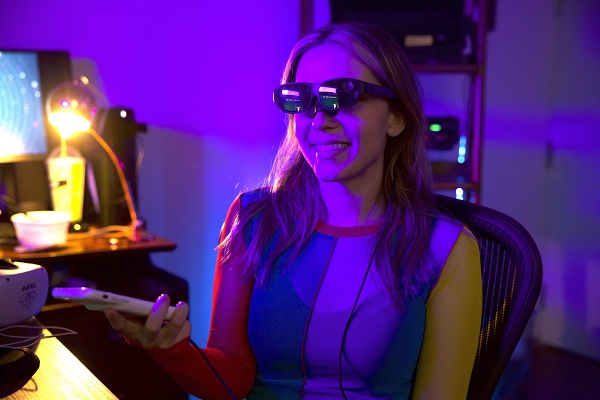
Her raw materials were already on the table: a lifelong meditation practice, years of game design, experience with live digital products and an early investment in Oculus after former Gaikai colleagues joined the company. In 2016, Reeves and Norman co-founded TRIPP. The company began shaping interactive sessions from guided practice, breath, sound, game mechanics and visual environments that need not obey the zoning laws of Earth.
The distinction mattered. Plenty of early VR experiences recreated familiar rooms. TRIPP preferred kaleidoscopic tunnels, floating particles, impossible scale and direct feedback. Reeves called the approach “stimulation rather than simulation.” It is a useful product rule far beyond headsets: when a medium is new, copying the previous medium is often only the first draft.
TIME selected the TRIPP Wellness Platform for its 2022 Best Inventions list. The recognition arrived after a difficult stretch for the company. At the beginning of the pandemic, two term sheets were pulled. Reeves later said she did not know how TRIPP would survive the next six months. She also watched usage rise as families passed headsets among themselves. The contradiction is pure startup: the product can become more relevant at the exact moment the company becomes more fragile.
Reeves's response was not to shrink the idea to a single headset. TRIPP expanded across Meta Quest, PlayStation VR, mobile, augmented reality and Apple Vision Pro. The company acquired the communal meditation app EvolVR in 2022. It later introduced Kōkua, a conversational AI guide designed to create personalized reflections and practices. In her announcement, Reeves emphasized both experimentation and restraint, including a commitment that voice input would not be stored or sold.
Keep the heart in the machine
That phrase, keeping the heart in TRIPP, appears repeatedly in Reeves's writing. It gives her technology optimism a boundary. She is enthusiastic about AI, spatial interfaces and new devices, yet her public product argument returns to trust, agency and the person using the thing. Novelty earns attention. Care earns another session.
It also explains why she talks about games as more than entertainment. In a 2014 TEDxOrangeCoast talk, Reeves argued that playing games can help girls develop spatial reasoning, multitasking and confidence around technology. Her case was autobiographical without becoming nostalgic. Games led her to computers. Computers led her to code. Code led her into rooms where she could help decide what the next platform would become.
The practical lesson is not that everyone should buy a headset or dismantle the family television. It is that curiosity compounds when it is allowed to become competence. Reeves did not wait for absolute confidence before moving. She built it by shipping, operating and learning in public.
The second half of that sentence does the real work. Many executive biographies count exits. Reeves's public biographies certainly have plenty to count, from JAMDAT and Gaikai to the later acquisitions of Machinima and Tapjoy, where she served as a director. But she frames legacy as a team outcome. She wants TRIPP to be career-defining for the people building it, not merely a company that defines her own career.
That philosophy turns up in her advice about investors too. Reeves has said a founder should treat an investor as a core team member, because it is the one key hire that cannot simply be fired. Money is a relationship wearing arithmetic. The lesson carries extra weight from someone who saw early backing arrive, disappear and arrive again.
In 2024, after TRIPP launched Kōkua and its first upgraded Apple Vision Pro experiences in the same week, Reeves announced her victory ritual: sleeping late and taking long naps. It was a charming bit of anti-theater from a founder with decades of theater-ready milestones. The platform scout, having reached another platform, was briefly going offline.
The next screen may barely look like one
By 2025, Reeves was speaking at AWE about Unity development for Apple Vision Pro and the intersection of emotion, AI and spatial computing. TRIPP was experimenting with a guide that could move between immersive worlds, mobile screens and audio interfaces. The company's product had started to resemble her career: one idea expressed across successive containers.
The interesting question now is less whether VR will replace the phone. Platform shifts rarely honor such tidy predictions. The more durable question is which experiences improve when the interface can surround you, respond to you and eventually travel with you without demanding a rectangle in your hand.
Reeves has spent her career near that question's earlier forms. Will people play on phones? Will games stream from the cloud? Will audiences follow gaming personalities online? Each answer looked improbable until the infrastructure caught up with the appetite.
Her advantage is not clairvoyance. It is a tolerance for the ridiculous stage of a useful idea. The flip phone. The server rack. The haunted-house card table. The face computer. She studies what the awkward object makes possible, carries forward what she has learned, and begins again.
Somewhere inside the next inelegant prototype is a behavior that will one day seem completely normal. Nanea Reeves would like to take it apart.