A family rolls through a LEGO factory in a driverless ride vehicle. Cameras hidden in the scenery read a rider’s glasses, hair and shirt. A processor interprets a wave. A life-size Minifigure appears on screen and copies the rider before the vehicle moves on. The trick takes a split second. The development took a full-scale test rig, sensor arrays, onboard processing, software, controls, animation, scenery and the discipline to make all of them agree while real people did unpredictable things.
That gap between a clean illusion and a complicated machine is where Holovis lives. The Hinckley, England, company is variously called an immersive-technology specialist, an audiovisual integrator, a software developer and a creative studio. All are correct, which is more useful than tidy. For Universal, Disney, Netflix, Merlin, Miral, Norwegian Cruise Line and Saudi Entertainment Ventures, Holovis helps turn a drawing or story into an attraction that can survive opening day.
The public sees media, motion and a little theatrical misdirection. The operator sees uptime, throughput, maintenance and a queue that becomes grumpy by the minute. Holovis designs for both. It supplies and integrates screens, projection, audio and controls; creates content and software; tracks bodies and objects; tests the result; commissions it; and stays around to support it. Its actual product is accountability across the handoffs.
The first cave went nowhere
Holovis began far from roller coasters. Co-founder and chief executive Stuart Hetherington was an engineer at MIRA, the British automotive research organization, working on vehicle development and “data suit” technology. He and his then boss, Joe Jurado, built a case for what Hetherington described as Europe’s first VR CAVE - a room-size visualization environment. The proposal did not proceed. His later diagnosis was blunt: they were 10 or 12 years early.
That was the first failure, and it supplied the company’s founding thesis. Hetherington and Jurado started Holovis in 2004 around high-end virtual systems, CAVEs and large-screen visualization. Early customers came from oil, gas and automotive, with Jaguar Land Rover becoming a major account. The company was an integrator: it assembled sophisticated technology so engineers could see products and data at human scale.
What changed their minds was not a sudden love of theme parks. It was the economics of the handoff. As Holovis took on more solution-oriented work, the founders decided they wanted to own more of the value chain. Displays and tracking hardware were not enough. Software, data, creative work and service offered more control over the result and more ways to earn from it. Entertainment gave those disciplines a demanding stage.
“We wanted to own more of the value chain.”Stuart Hetherington, on the company’s shift into software and data
A ride that notices you
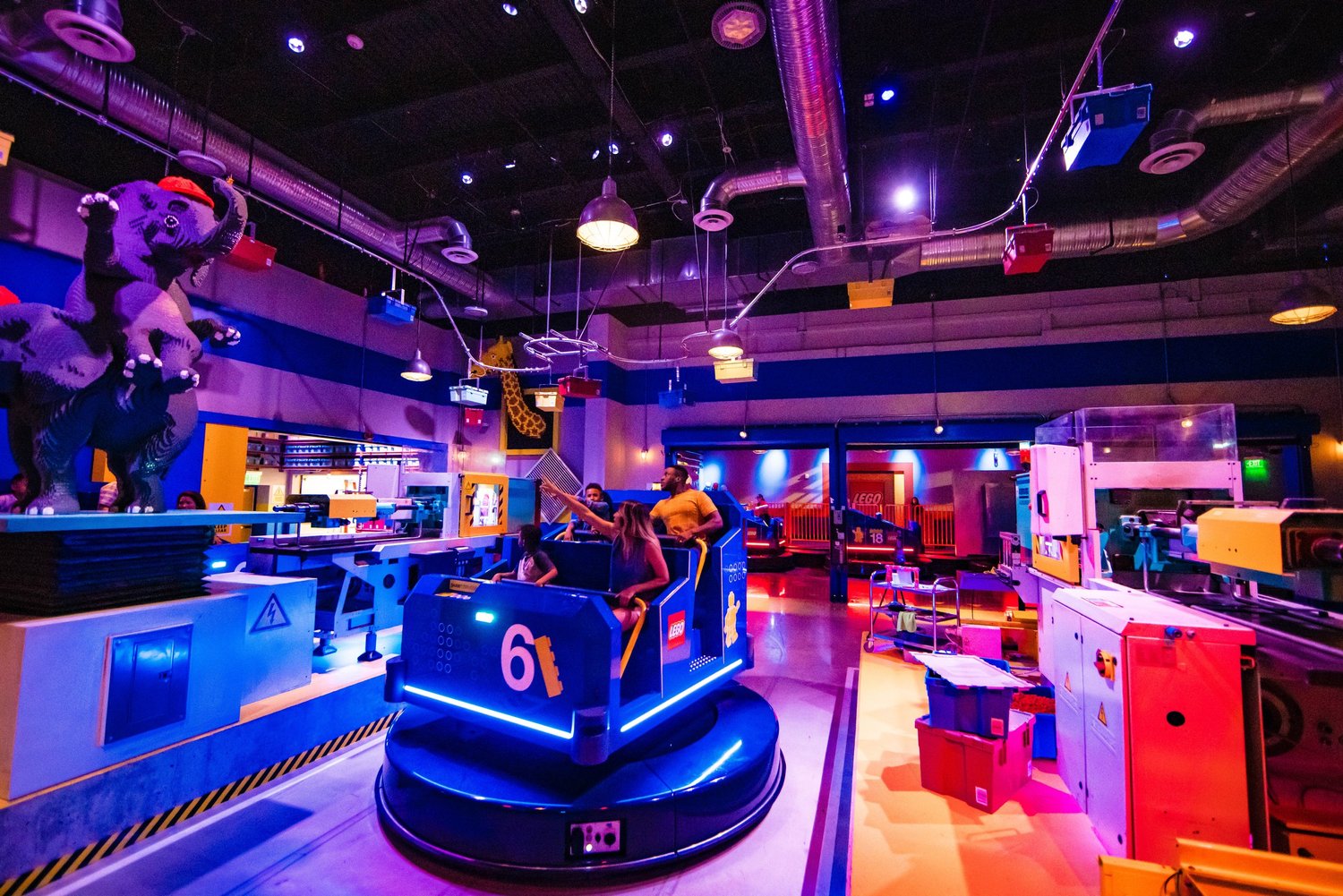
LEGO Factory Adventure Ride is the neatest demonstration of the expanded model. For LEGOLAND New York, and later South Korea, Holovis worked with Merlin Entertainments and ride-system company ETF. Its remit covered AV, scenery, software, control systems and show integration. HoloTrac, the company’s computer-vision platform, reads multiple riders inside a moving vehicle, identifies visible attributes and follows upper-body movement. The attraction then renders personalized Minifigures in real time.
The technical novelty matters, but the testing story matters more. Children lean away, adults block cameras, sleeves change shape and the vehicle refuses to pose for a lab test. Holovis built a like-for-like ride rig at its headquarters to tune sensor placement and processing under conditions closer to the finished attraction. The work won an IAAPA Brass Ring in 2021 in the category for ride products costing more than $5 million. That price band applies to the attraction product category, not a disclosed Holovis fee.
At SeaWorld Yas Island in Abu Dhabi, the unit of complexity grew from a vehicle to a park. Holovis supplied and installed parkwide AV and designed, produced and installed S.E.A. Guardian Games, a connected set of interactives. The visible centrepiece is the One Ocean cylindrical LED display, 15 metres high and 218 metres around. The less photogenic achievement is that content, sound and control remain coherent across a vast indoor venue.
The operator gets a show, too
Immersive companies commonly sell what a guest sees. Holovis also packages what an operator can measure. HoloTrac recognizes people and objects; DeepSmarts collects and interprets the resulting data alongside system metrics. Dashboards can show movement, queue length, attraction throughput, downtime, course use and maintenance patterns. Holovis says an analysis for one unnamed major theme park uncovered more than $900,000 in potential revenue uplift. It is a vendor-reported opportunity, not a published audited saving, but it clarifies the pitch: make the spectacle legible as a business.
Revenue-uplift opportunities Holovis says DeepSmarts identified at one major park
Audiences for every attraction: the guest playing and the operator watching performance
360Golf makes the same idea pocket-size. Each player receives an identifiable ball. Smart tees and cups know whose ball has arrived, strokes count themselves, and extra targets award “SuperShots.” DeepSmarts reports player volume, game duration, scores, course use, uptime and maintenance. Operators can buy a catalogue design or commission a course around a venue, brand or entertainment property.
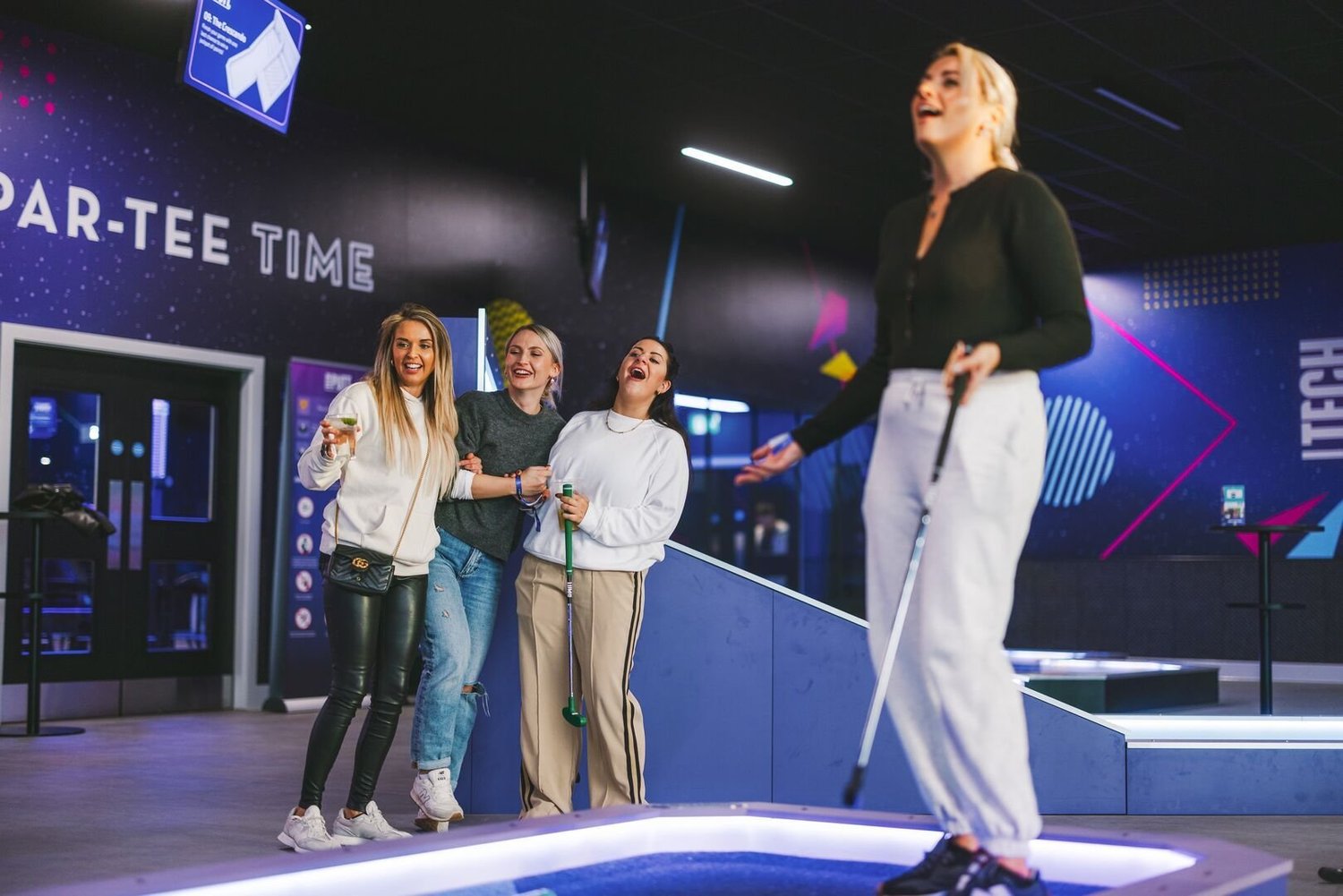
The product appeared at Level X venues in Glasgow and Middlesbrough, then in a second generation across three Butlin’s courses. At the end of 2024, hundreds of trade-show visitors played a demo in Orlando. By early 2025, Holovis said two of its largest courses were being completed as the first of 11 planned installations across the Gulf. In 2026 it disclosed a Netflix-themed course at Netflix House Philadelphia, while its Dallas work included a Sakamoto Days game and Squid Game: Survive the Trials.
A £22.8 million test of the model
Holovis has taken outside money twice in ways that reveal its geography. Road King, a Hong Kong-listed infrastructure and property group, bought 40 percent in 2018 to support expansion in the Far East. In 2021, Holovis formed a 70:30 joint venture with Shanghai lighting specialist Luoman. The pair worked together for nearly three years before Luoman decided to buy control.
The deal closed on September 25, 2024. The announced maximum consideration was £22.825 million for an 85.15 percent stake in Holovis parent Predaptive OD Limited. Luoman’s later annual report recorded RMB213.4 million of combination cost, including RMB197.9 million in cash and RMB15.5 million of contingent consideration. Hetherington retained roughly 14.85 percent and continued as CEO.
This was not a clean victory lap. Transaction reporting said Holovis had lost money in 2023, and a Road King filing cited working-capital pressure and losses during its holding period. Figures summarized from filed UK accounts show a rebound in 2024: turnover of £39.18 million and profit before tax of £1.86 million, with 135 average employees. The more instructive detail is that Luoman did not buy a slideshow. It tested the relationship through a real joint venture, learned the operating requirements and only then committed.
What to copy from the control room
Holovis offers three portable lessons for companies that sell complicated physical-digital work. None requires a dome.
Find the handoff that repeatedly ruins the outcome. Build the capability to carry responsibility across it.
A clever demo is not a Saturday crowd. Reproduce the moving vehicle, human mess and operating constraints early.
Give the end user delight, then give the operator data on throughput, reliability, cost and return visits.
The model also has conditions. Full-stack integration pays when a project is large, bespoke and unforgiving; when many suppliers must synchronize; and when an operator values one accountable delivery partner. It is a poor fit for a small venue that needs a cheap plug-and-play screen, a brand seeking a short-lived social stunt, or a buyer unwilling to fund prototyping, commissioning and support. Owning more of the stack can reduce handoff risk, but it also loads a supplier with construction schedules, hardware exposure and long cash cycles.
The useful boundary: Holovis is most differentiated where failure is systemic rather than cosmetic. If a projector can be swapped without touching story, controls or guest flow, a specialist vendor may be simpler. If one change ripples through all four, integration earns its keep.
Where Holovis sits
The competitive set depends on the brief. Electrosonic and Solotech compete in large AV integration. TAIT joins engineering, automation and live experience. Moment Factory leans into multimedia creativity; Falcon’s Creative Group into attraction design and media. A client can also assemble its own relay team of designer, software shop, ride vendor and integrator. Holovis argues for fewer baton passes, backed by reusable tools such as HoloTrac, DeepSmarts, Pix-Control, high-fidelity audio systems and 360Golf.
Its 2026 expansion gives the strategy a wider footprint: established operations in Hinckley, Orlando, Riyadh, Shanghai and Abu Dhabi, a new Singapore location, and remote engineering recruitment aimed at Manchester, Bristol and Austin. The company says some of its strongest staff arrived from aerospace, automotive, manufacturing, software and live events. That hiring logic echoes the origin story. A theme-park ride is a story, but it is also a vehicle, a control system, a hostile operating environment and a promise to open tomorrow morning.
Holovis will rarely be the name a child remembers after the ride. The Minifigure gets that job. For the company, invisibility is evidence: the cameras noticed, the software answered, the screen performed and nobody stopped to wonder which contractor joined them together.