Stuart Hetherington’s early career involved sending expensive cars towards an unhappy ending. Working in vehicle development and testing at the Motor Industry Research Association, he helped investigate how physical tests could be replaced by simulation. There is a pleasing economy to the idea: build a world inside a computer, learn something useful, and keep more of the cars.
Years later, the company he co-founded would help turn guests into LEGO Minifigures and surround roller coaster passengers with a story before their ride had begun. The route between those jobs is less eccentric than it first appears. Both require someone to make a constructed environment behave convincingly. Both become interesting when the people inside it can respond.
Hetherington is the co-founder and CEO of Holovis, the immersive technology business headquartered in Hinckley, Leicestershire. His career has carried him from engineering research into the machinery of entertainment, without quite leaving the engineering behind. A theme park may be a place to suspend disbelief. The people building it need to be rather more particular.
The room that arrived too early
He enrolled at De Montfort University in 1991 to study Electrical Engineering and Computing, entering through Clearing. That detail gives the eventual founder’s story an ordinary, recognisable beginning: a course, a place at university, a technical education. The imaginary worlds came later.
At MIRA, his work introduced him to immersive visualisation. He and his manager, Joe Jurado, put together a proposal for a CAVE, a room in which projected imagery lets people explore a virtual environment. The planned service for the automotive industry did not proceed. Looking back in 2018, Hetherington described the proposal as roughly a decade ahead of its moment.
A CAVE is an oddly sociable form of virtual reality. Several people can stand inside the same projected model, examine it and discuss changes. For engineers, that means a design can become something to walk around before anyone commits to making it. The room makes a drawing into a meeting place.
The relationship with Jurado outlasted that early proposal. They went on to build Holovis together. By 2004, the business that De Montfort records as Hetherington’s company was established. His former manager had become a co-founder, carrying the technical conversation into a different setting.
A map of connected capabilities, rather than separate careers.
The prototype becomes a place
The early Holovis business worked with immersive systems for enterprise customers, including the automotive sector. Its later attractions work gave those capabilities a public audience. You could use a virtual environment to inspect a proposed machine. You could also use one to take a roomful of visitors somewhere that did not exist.
By 2014, Hetherington was describing how carefully synchronised motion, imagery and sensory effects could persuade riders they had travelled farther than they actually had. His emphasis was on coordination. A large screen alone could only do part of the job; movement and media had to agree with each other.
He was also discussing rides that could respond to a participant’s choices. Game engines and interaction systems allowed content to change during an experience. A repeat visit could lead somewhere different. In that arrangement, the guest becomes a complication worth designing for, rather than a spectator to be moved efficiently past the scenery.
That interest extended beyond the park gate. In 2016, discussing retail, he argued for more meaningful interaction and less intrusive technology. He also acknowledged a practical obstacle: shops often cannot close for a wholesale refit. Even an ambitious digital experience has to contend with someone trying to keep the doors open.
A wooden coaster, rehearsed in a virtual room
Wicker Man at Alton Towers offered a particularly neat return to the CAVE. Holovis worked with Merlin Magic Making to model the site and experience in RideView, its visualisation system. Designers, engineers and other stakeholders could inspect the attraction at full scale, in real time, before the finished experience welcomed visitors.
The company’s work also included developing the preshow with Merlin’s team, making media, integrating audiovisual systems and programming effects. Audio and imagery ran through the queue, preshow, station and other parts of the attraction. The story began before the coaster’s main business of hurling people around.
For Hetherington’s career, the connection is striking. The virtual room that once belonged to the problem of developing vehicles had become a way to rehearse a visitor’s journey. Different customer, different destination, familiar questions about space, timing and what a person will perceive.
“We start by trying to understand the problem and the experience we are trying to create.”
Stuart Hetherington, 2018
The guest who refuses to keep still
At the LEGO Factory Adventure Ride, the company faced a different problem: recognising the people in a moving vehicle well enough to show them an animated version of themselves. Holovis developed the attraction for LEGOLAND New York and subsequently delivered it for LEGOLAND Korea.
Hidden sensors and software identify visual characteristics, including clothing colour and glasses, and follow hand and upper body movements. At a key moment, a life-sized LEGO Minifigure reflects the guest’s appearance and actions. The effect is easy to describe, which is usually where the engineering trouble begins.
Holovis built a comparable ride testing rig at its headquarters to develop and test the system. People move unpredictably. A piece of scenery can be placed precisely; a visitor is under no obligation to cooperate. The rig let the team work through the behaviours that an attraction would have to accommodate.
These are company achievements, made by teams. Their relevance to Hetherington lies in the business he has assembled around such problems: creative work, software and physical installation brought together to produce an effect that can be understood in a glance.
speakers in the supporting infrastructure of SeaWorld Yas Island, Abu Dhabi, where Holovis delivered park-wide audiovisual systems.
At SeaWorld Yas Island, Abu Dhabi, which opened in May 2023, the scale was architectural. Holovis supplied audiovisual systems across the park and an interactive game. Its work involved a cylindrical LED display, digital screens, speakers and the supporting communications infrastructure. The visitor sees an environment; the delivery team has to make a very large collection of components behave together.
A colleague’s test of an idea
George Walker, who joined Holovis as vice president of creative development in 2022, offers a useful outside view of its chief executive. He had met Hetherington about ten years earlier while working as creative director for Ferrari World. Their connection developed well before his appointment.
Walker described a company where he could develop ideas, and a CEO who understood the work required to turn them into something real. His compact description of the team’s attitude was “get it done”. It is a small phrase, but more revealing than another promise about the future.
The collaboration also puts a person beside the corporate story. Hetherington’s work depends on relationships with people whose specialisms differ from his own. An engineer can understand the mechanism of an illusion; the creative director still has to give visitors a reason to care about it.
After the deal, still at the desk
A joint venture with Shanghai Luoman Lighting Technologies began in 2021. An acquisition followed in 2024. In June 2025, Hetherington explained that the companies had spent nearly three years testing their working relationship before proceeding. The courtship had involved actual work, which is a useful way to discover whether a partnership can survive the paperwork.
He remained CEO, with the existing vice presidents continuing to run daily operations and strategy under his leadership. He described the addition of architectural and outdoor lighting capabilities, plans to expand teams and software development, and projects in which the group would participate as an owner and operator.
Those were stated ambitions at that point, rather than a completed itinerary. They did, however, mark a further change in the founder’s work: helping lead a business within a larger group while maintaining the capabilities and relationships it had already built.
Holovis’s 2026 expansion announcement continued the emphasis on people. It described growth in show integration, remote opportunities aimed at Manchester, Bristol and Austin, and Singapore as a planned international location. It also welcomed technical experience from adjacent fields, including automotive. The industry that helped form Hetherington remained part of the recruitment conversation.
Back in Leicestershire, facing the next intake
In February 2024, Hetherington stood in front of school and college students visiting Holovis during Leicestershire Innovation Festival. On the screen behind him were the words “The Holovis Story” and “Innovation in Business”. An audience accustomed to being entertained was being invited to consider how entertainment gets built.
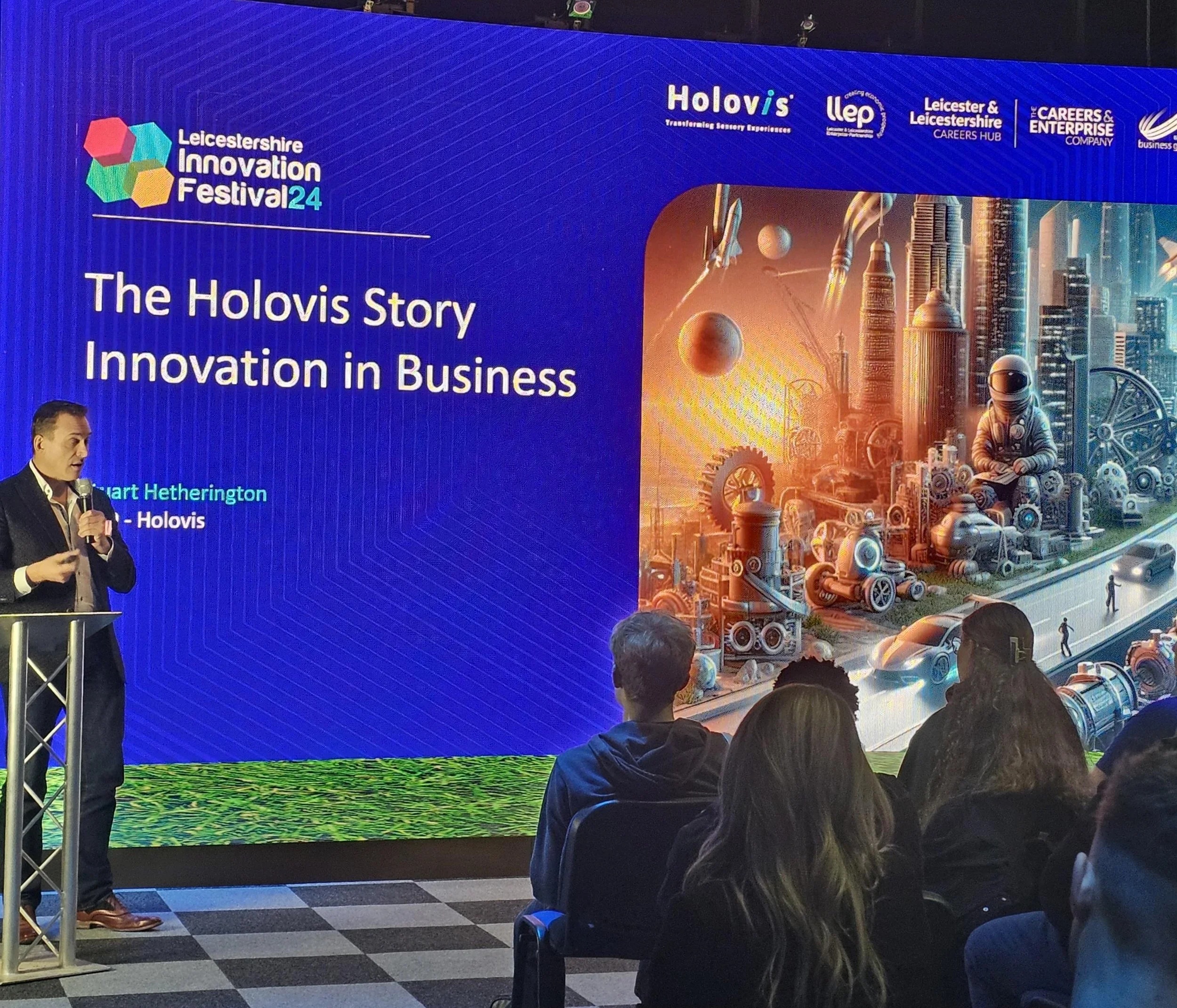
The visit included practical thinking about developing concepts, overcoming obstacles and taking ideas further. Hetherington participated as both a founder and a member of the local innovation board. Students could tour the facility and see work being designed and built. The business was offering them something more concrete than a motivational slogan.
His university connections continued. In March 2025, De Montfort announced him for an SXSW discussion with its vice chancellor, Katie Normington, and Professor Andrew Chitty, focused on immersive experiences, research and future skills. The education that started in 1991 had become a continuing professional relationship.
It makes a fitting place to leave him: explaining the work to people who might eventually do it. Hetherington’s career connects university study, industrial testing, a proposal that stalled, an enduring partnership and attractions built for crowds. Inside those crowds, somebody raises a hand and watches a LEGO figure raise its own. Somewhere behind that apparently casual gesture, a team has thought very carefully.