Justin Barad’s first operating room was made of pixels. Long before the white coat, the orthopedic drills, or the letters after his name, he was a school-age programmer with the ordinary ambition of an unusual teenager: he wanted to build video games. He learned to code in middle school, found his way into internships at Activision, and came away with a game credit. It looked like the beginning of a straight line.
Then Barad began asking whether software might be useful somewhere beyond entertainment. The question took him from computer science toward bioengineering at UC Berkeley, then to medical school at UCLA. A mentor had offered a piece of advice whose simplicity concealed a formidable amount of homework: if you want to invent something, first understand the problem. Barad took the suggestion with alarming seriousness. He became a doctor.
Medical school led to orthopedic residency at UCLA, a pediatric orthopedic fellowship at Boston Children’s Hospital and Harvard, and a medical-innovation fellowship at Stanford Biodesign. By the time he returned to software, roughly a decade of clinical training had passed. The detour had delivered precisely what his mentor prescribed: a problem sturdy enough to build a company around.
The route that became the idea
- Middle schoolProgramming
- High schoolActivision
- CollegeBioengineering
- 2010-16Surgical training
- 2016Osso VR
The problem hiding in plain sight
In training, Barad saw an awkward mismatch. Surgical techniques and medical devices were becoming more numerous and more complex. The methods for learning them still relied heavily on observing experts, reading technique guides, attending expensive laboratories, watching video, and waiting for a relevant case. The stakes discouraged improvisation, while the supply of practice was stubbornly finite.
He has recalled moments when members of a surgical team searched online for guidance around a procedure. The image is not a rebuke to clinicians. It is an indictment of the cupboard they were expected to open. Modern medicine had gained robotics, advanced imaging, and an expanding catalog of devices. Its practice room had not kept up.
Games, meanwhile, had spent decades refining practice. They let a player attempt, fail, receive feedback, and attempt again. Difficulty can rise in measured steps. Performance can be observed rather than politely assumed. Barad’s useful insight was not that surgery should become a game. It was that procedural learning could borrow the game designer’s loop.
“If you want to invent something, you really need to understand the problem you’re trying to solve first.”The advice Barad says stayed with him
The eBay phase of medical simulation
The instrument that brought his two lives together was an Oculus Rift DK1, an early developer headset. Its demonstration software offered a Tuscan villa. Pleasant, certainly, but Barad was more interested in hands. He tracked down a pair of discontinued motion controllers on eBay and connected them to the system. Once he could reach for a digital object and manipulate it, the villa acquired an unexpected annex: a possible training room.
Barad built an early prototype himself. Then he met Matthew Newport on the internet. The two did not have the benefit of a long friendship, shared office, or cinematic garage. Barad did have money left from his bar mitzvah. He used some of it to pay Newport to improve the prototype. The pair would become co-founders.
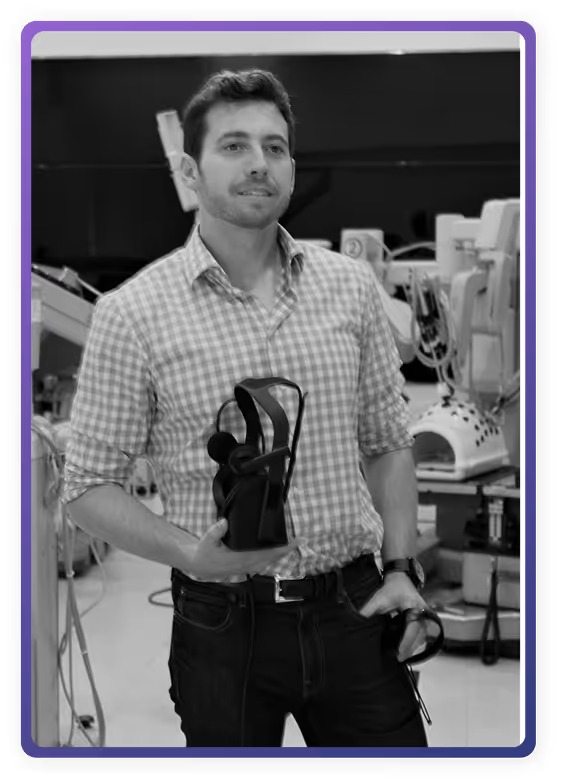
The machine had to do more than look persuasive. A virtual procedure needed clinical accuracy, clear sequencing, realistic tools, and useful measurement. It also needed to work without the elaborate installations associated with older simulators. Portability was part of the argument. If practice still required a rare room in a distant building, the bottleneck had merely acquired better graphics.
The prototype earned recognition and drew investor interest. Osso VR was formally founded in October 2016. Its name, from the Latin for bone, nodded to the founders’ first clinical territory. Orthopedics would be the opening chapter, not the boundary.
A company learns to repeat itself
Repetition was Osso VR’s product, and scaling repetition became its business. The company created a growing library of modules, added collaborative sessions for geographically separated teams, and developed analytics intended to make technical performance visible. Medical-device companies used simulations to introduce equipment. Academic programs used them to supplement training. Hospitals, pharmaceutical teams, and eventually nursing programs entered the mix.
Recognition arrived in tidy annual installments. Osso VR won the U.S. Department of Education’s EdSim Challenge in 2017. TIME included its virtual-surgery system among the 100 Best Inventions of 2019. The company announced a global training partnership with Johnson & Johnson Institute, published validation studies, and accumulated a reported $109 million in funding by 2022. Barad was named to Modern Healthcare’s Top Innovators list in 2023.
The library also changed the texture of the work. A conventional course gathers people, equipment, instructors, and time in one expensive place. A software module can travel, but only after a peculiar coalition has made it: clinicians who can identify the meaningful decisions, artists who can make anatomy legible, engineers who can make interaction reliable, and educators who know when a prompt helps or merely interrupts. Barad’s job became partly one of translation. The surgeon had to explain what mattered to the game maker; the game maker had to show the surgeon what software could measure.
Money and medals are convenient shorthand. A more revealing measure is the widening definition of the learner. Osso’s early public identity was surgical and orthopedic. By its tenth year, the company described training across 15 specialty areas, and its work had extended to nursing procedures and other clinical skills. The virtual room had become less like a specialized cabinet and more like a campus.
One of Barad’s favorite memories came not from a financing or an award, but from a pharmaceutical training launch in Brazil. He described clinicians moved by the curriculum, a team working hard in a new country, an unreasonable quantity of pão de queijo, and a few VR TikTok dances made during downtime. The anecdote has the advantage of sounding like actual work: earnest, exhausting, slightly cheesy in both senses.
“I knew it probably wouldn’t work - most startups don’t - but I felt like this was something that was bigger than me, and somebody had to try.”Barad on leaving the expected surgical path
Changing chairs without leaving the room
In February 2024, after more than seven years as chief executive, Barad announced that Osso VR would split the CEO and co-founder roles. He became Chief Strategy Officer. His wording captured the peculiar permanence of founding: a company can appoint another chief executive, but it cannot appoint another person to have started it.
The move placed Barad closer to clinical strategy, product direction, and the argument for immersive training, while another executive took on the operating seat. The title change also made room for the rest of his working life. He continued practicing pediatric orthopedic surgery in Los Angeles, remained part of UCLA Biodesign’s innovation community, served in health-technology leadership at the Consumer Technology Association, and joined the board of Finnish orthopedic-device company Bioretec in 2025. In 2026, Bioretec named him chair of its remuneration committee.
There is a useful symmetry here. Early in his career, Barad crossed from technology into medicine because he believed proximity would improve invention. Later, he crossed from day-to-day management toward strategy because distance can improve judgment. Neither move amounted to leaving. Each was a change in vantage point. Founders often speak as though endurance means occupying the same chair forever. Barad’s version is more architectural: preserve the purpose, then rearrange the room around what the next stage requires.
The clinical work matters to the story because it keeps the original instruction current: understand the problem. Companies naturally acquire abstractions. Customers become segments, procedures become content, and learners become usage. A practicing surgeon has less opportunity to forget that the final scene happens away from the headset.
The game after the game
In 2026, as Osso VR marked ten years, the company said more than 150,000 healthcare professionals had trained on hundreds of modules across more than 30 countries. Barad’s own note was less victory lap than ledger. He listed wins and losses, friendships and failures, elation and hopelessness. He credited colleagues, users, investors, researchers, family, and friends. The founder’s memoir, compressed into a social post, retained some egg on its face.
That candor fits a person who once described research work involving the collection of rat flatulence. He volunteered the detail in a podcast and offered himself as an authority on the subject. Plenty of founders labor to make their biographies gleam. Barad’s is more persuasive with the odd jobs, secondhand controllers, and snacks left in.
His central aspiration has remained steady: make high-quality procedural practice available regardless of geography, and make readiness something that can be assessed. The ambition is global, but its unit is small. One learner repeats one difficult step. A team rehearses together before it must perform together. A new device is encountered in pixels before it appears in a consequential room.
Barad did, in the end, return to video games. He returned with a bioengineering degree, an MD, an orthopedic residency, a pediatric fellowship, and an excellent reason to care about the tutorial. The straight line was overrated. The long way gave him the plot.