At ten years old, Heather Gervais shared a local penny-paper route with her three siblings. The raw materials were modest: a stack of papers, a set of front doors, four children and the certainty that every copy still had to arrive. Yet a paper route is an operations problem wearing sneakers. It asks who carries what, which house comes next, where time disappears and whether the team can improve tomorrow.
Decades later, Gervais is still studying the route. The papers have become medical information, diagnostic services and virtual-reality training modules. The customers are clinicians, hospital systems and life-sciences companies. The consequences are more serious, but her public career keeps returning to the same absorbing puzzle: how do you move useful knowledge through a complicated system until it reaches the person who needs it?
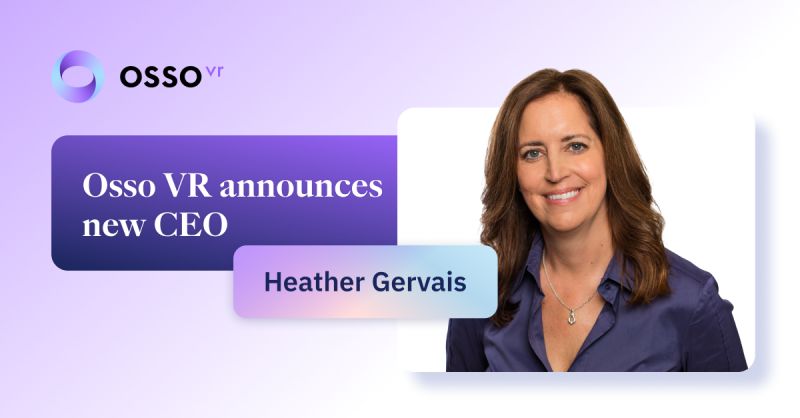
Since August 2024, she has answered that question as chief executive of Osso VR, a company that builds immersive procedural training. Before taking the top job, she spent nearly two years as its chief revenue officer, refining how the company went to market. Before Osso came Everly Health Solutions and PWNHealth. Before those came athenahealth and Epocrates, where she worked at the busy intersection of clinicians, pharmaceutical companies, software and commercial strategy.
The operator in the headset
Virtual reality invites theatrical language. Step inside the future. Enter another world. Transform everything. Gervais speaks more like the person expected to distribute the headsets on Monday morning. Who gets one? Is the content easy to find? Will the user feel comfortable? Can an administrator control access? Does the experience fit a regulated workplace? What evidence shows that anyone learned?
This is not a lack of imagination. It is imagination with a deployment plan. Modern standalone headsets have removed many of the cables and expensive computers that once made VR an office curiosity. But cheaper hardware does not abolish friction. In her public remarks, Gervais repeatedly pairs the technology's promise with the mechanics of adoption: thoughtful rollout, useful training material, secure device management and an experience valuable enough to justify the first awkward minute inside a headset.
“There’s truly no substitute for hands-on learning when it comes to building confidence.”Heather Gervais
The point is rehearsal. A clinician can watch a procedure, read about it and discuss it. Simulation adds a different verb: do. A learner can repeat a sequence, receive feedback and try again without making the real encounter the first full-speed attempt. Osso's work began in orthopedic training, then widened across specialties. Under Gervais, the commercial horizon has expanded further toward cardiology, nursing, health systems and pharmaceutical education.
That widening makes sense when seen through Gervais's résumé. She did not arrive in VR through entertainment or game development. She arrived through healthcare commercial operations, carrying an intimate knowledge of what happens after a clever product meets a cautious buyer, a crowded workflow and a budget meeting. Her job is to ensure the demonstration is not the climax. The useful routine is.
Before the virtual operating room, the pocket reference
At Epocrates, the interface was not a simulated room but a medical-reference app. Gervais joined in 2010 and rose through client services and commercial operations. A 2012 filing listed her as senior vice president of commercial operations, reporting to the chief executive. When athenahealth acquired Epocrates, she helped steward the integration from the Epocrates side.
Her interest was not merely in placing information on a screen. She talked about reaching clinicians at specific “moments of care,” when treatment decisions were actually being made. That phrase is a small window into her style. A product category is abstract. A moment has a person, a need and a clock. Find the moment, and the strategy becomes less foggy.
The industry noticed. The Healthcare Businesswomen's Association named her a Rising Star in 2011 and a Luminary in 2016. PharmaVOICE included her among its 100 honorees in 2013, placing her in the Strategists group. The profile accompanying that recognition described a leader attracted to inefficiency because inefficiency can be fixed. It also supplied the childhood paper route, an unusually good origin story because it does not strain for grandeur. Some executives claim they were born to disrupt an industry. Gervais apparently learned to divide a neighborhood.
Her degree from La Salle University also reads like a compact explanation of the career that followed: finance, marketing and computer information systems. The combination gives her three languages for one problem. What does it cost? Why will someone choose it? How does the machinery work? Many technology failures occur in the blank space between those questions.
Her writing from the Epocrates years shows the same impatience with novelty for novelty's sake. In 2013, she argued for a more focused and measurable approach to pharmaceutical marketing, with technology used to connect education and decision-making rather than simply add another digital channel. The tools have changed dramatically since then. The demand for relevance has not.
A dozen years later, her case for VR in pharmaceutical settings follows that thread. A sales representative could carry an immersive demonstration without hauling complicated equipment. A clinician could experience the operation of a device rather than inspect a diagram. A learner could repeat a protocol and expose the missed step before it mattered. None of these uses succeeds merely because the view is three-dimensional. The experience must answer a real question better than the tablet, binder or training room it hopes to supplement.
This is why Gervais's progression from commercial leader to CEO feels coherent. Revenue work, done properly, is field research. It reveals where buyers hesitate, where users struggle and where a confident product presentation collides with an inconvenient reality. Moving into the chief executive role gave her a larger surface on which to apply those lessons: product direction, partnerships, team design and the choice of markets where immersive practice earns its keep.
Candor, town halls and a little fun
Process people are easily caricatured as worshippers of the spreadsheet. Accounts from Gervais's colleagues complicate the picture. One recommendation praises a leadership style combining intellect, hard work, boundary-pushing, blunt honesty and fun. Another recalls a period of anxiety and cost-cutting at athenahealth, when Gervais maintained an open-door policy and convened regular town halls so that uncertainty could be discussed rather than allowed to breed in corridors.
That is process, too. A town hall is an information system with chairs. An open door is a feedback channel. Culture becomes less mystical when leaders create predictable places where a question can travel and receive an answer.
“I think it’s important to have fun while you are working hard.”Heather Gervais
The line comes from an earlier stage of her career, but it fits the present assignment. Healthcare technology has no shortage of seriousness. It also has procurement cycles, implementation calls, version changes and headsets that must be charged. A sense of humor will not solve those things. It may keep a team companionable enough to solve them together.
Gervais has named close collaboration with Osso's leadership team as central to aligning growth with operational execution. Founder Justin Barad moved into the role of chief strategy officer, giving the company a physician-founder focused on strategy and an operator-CEO focused on expansion. It is a partnership built around different vantage points: the clinical case for a better rehearsal and the organizational work required to deliver it widely.
The next door on the route
The latest chapter is broader than surgery. Osso has introduced nurse training, worked with healthcare information partners and pursued health-system adoption. Gervais has discussed pharmaceutical applications ranging from sales-team education to demonstrations that let clinicians experience a device or treatment workflow instead of merely viewing it. The headset, in this telling, becomes less like a futuristic portal and more like a portable practice room.
The risk with any immersive technology is that the apparatus becomes the story. Headsets photograph well. Implementation does not. Yet implementation is where Gervais appears most at home. She emphasizes content that earns attention, hardware ordinary people can operate, security that satisfies regulated organizations and analytics that turn training into something more accountable than attendance.
Her own leisure ambitions, recorded in a 2013 profile, are charmingly specific: visit every continent, attend the Super Bowl, World Series, Stanley Cup championship and Masters, and play Pebble Beach. Golf was listed as a hobby, along with decorating. These are plans made by someone who likes both a difficult course and the arrangement of a room. One requires reading the landscape; the other requires deciding where everything belongs.
That may be the most useful way to understand Gervais's work. She is arranging the room in which innovation has to live. The technology can be impressive, but it must have a place in the workflow. The data can be abundant, but it must clarify performance. The ambition can be global, but the next learner still has to put on the headset and begin.
A penny paper delivered to the wrong porch is not improved by an elegant strategy memo. Neither is a sophisticated training platform that nobody can comfortably adopt. Gervais's career has moved from paper to pixels to simulated procedures, but its logic has stayed remarkably steady: follow the route all the way to the door.