In 1994, the future of virtual reality at Washington State University had an unusually approachable parts list: a View-Master, a computer screen and duct tape. Sankar Jayaram had an idea for studying how people worked inside vehicles. He needed someone outside the university to see what he meant. The equipment available to him required a little persuasion of its own.
He modified the toy viewer, attached it to the screen and demonstrated the result to PACCAR, the truck manufacturer behind Kenworth and Peterbilt. A presentation at the company’s technical center followed. PACCAR supported two graduate students to develop a more substantial proof of concept. The makeshift viewer had done its job. “It worked,” Jayaram later recalled.
There is something pleasing about a technology career that starts with an object many people remember from childhood. The View-Master already offered a small lesson in perception: two images could suggest depth. Jayaram was asking a practical question about that experience. Could an engineer use a simulated space to understand a real task before committing to the real machinery?
The demonstration also establishes a useful scale for his story. Start with one person trying to see one thing more clearly. The later settings become larger, the hardware more elaborate and the business relationships more complicated. But the original transaction is wonderfully plain. A professor has a problem worth investigating. A manufacturer recognizes it. Two students get the chance to work on it.
A modified View-Master. A screen. Support for two graduate students.
Two engineers, one long conversation
Jayaram grew up in Kolkata and studied mechanical engineering at IIT Kharagpur. There, in the 1980s, he met Uma, who came from Durgapur. Both went on to earn doctorates at Virginia Tech. Their relationship became a marriage and a working partnership, with virtual reality running through the research and businesses they built together.
At Washington State, where he joined the faculty in 1993, that partnership helped establish the Virtual Reality and Computer Integrated Manufacturing laboratory. Its name has the sturdy, unromantic ring of a place where things must fit. The work included engineering design and manufacturing, supported over the years by companies and federal agencies. A simulated environment had to earn its place by helping with an actual engineering decision.
Jayaram’s professional recognition reflected that background. In 2013, he became a Fellow of the American Society of Mechanical Engineers for contributions that included virtual assembly simulations, three-dimensional technologies and CAD interoperability. He also helped establish a virtual environment systems track at an ASME conference and served as an associate editor for virtual environments in its computing journal.
That combination matters. The sports entrepreneur had spent years in a discipline concerned with how parts, models and people relate in space. A drawing must communicate. A model must correspond to something. An interface must allow someone to do useful work. The spectacle would come later; the habits of engineering were already there.
The partnership could accommodate a joke, too. During their 2018 return to WSU, Jay described a division of labor: “I define the product she has to implement.” Uma was on stage with him. The laughter belongs in the story as much as the job titles. Two people who had built companies together could still make a university audience smile about the arrangement.
“I define the product she has to implement.”Jay Jayaram, alongside Uma, at WSU in 2018
The spectator gets restless
In 2009, Jayaram watched a Seattle Seahawks game on television and wished he could experience the stadium from home. His interest was personal. He was also a committed Washington State football supporter, and the question of where a fan could look was becoming a question he could work on professionally.
His company, 3D-4U, developed a way to capture panoramic views and let the viewer choose among them. Instead of waiting for a director to change the camera, a fan could pan, zoom, pause or switch perspectives. The technology reached WSU’s Martin Stadium in 2012. Television screens, controllers and three-dimensional viewing equipment brought that choice into the stadium’s suites; a mobile application extended the idea.
A sporting event contains more than the broadcast can show at once. The camera follows the ball while a supporter may be watching a particular player. A replay arrives when the producer chooses to run it. The spectator’s curiosity and the program’s schedule are not always in agreement. Jayaram’s work addressed that ordinary mismatch.
This gives the career a motive more recognizable than a technology forecast. A fan wants to feel closer to the game. An engineer considers which part of that feeling can be built. A company has to make the answer usable. The three roles place different demands on the same person, and each can catch something the others miss.
The fan supplies the impatience. The engineer supplies the means to test it. The entrepreneur has to persuade other people that the test deserves another season. No headset can resolve all the compromises of watching sport, but choosing a view is a concrete place to begin.
A broadcast truck is a stern examiner
Live production offered its own examination. Jayaram later recalled an Apple Cup assignment with frozen equipment and water dripping into the production truck. A concept that behaved well in a laboratory had to survive the weather and the timetable of a football game. Kickoff was unlikely to wait for a satisfactory debugging session.
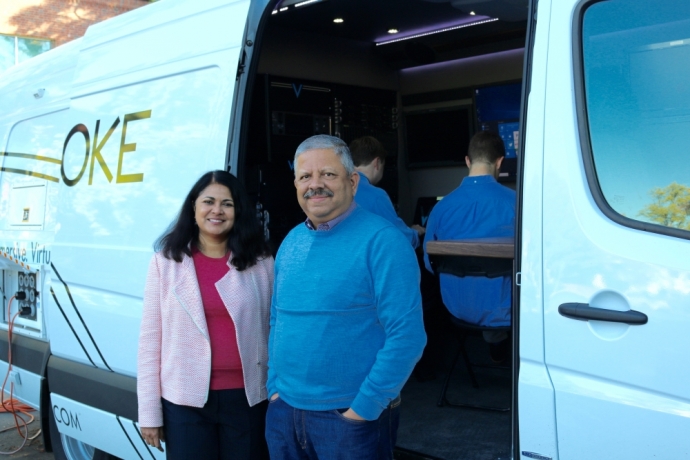
VOKE, co-founded by Jay and Uma, developed stereoscopic panoramic capture for live sports and music. Its system offered multiple viewpoints, along with the ability to pause and rewind. It also supported ordinary two-dimensional screens. In November 2016, Intel acquired the company. The purchase put the Jayarams’ work inside a much larger sports technology operation.
Jay became chief technology officer and chief product officer at Intel Sports. In 2018, the virtual reality technology developed through their work was used at the Winter Olympics in PyeongChang. WSU’s account of the project also followed former students into the operation, working on production, code, cameras and applications. A university laboratory had become part of an international event through both its ideas and the people it trained.
The distinction is useful when thinking about research leaving a campus. Technology can travel in a patent, a camera or a piece of software. It also travels in the judgment of someone who learned how to make the system work. The Olympic project makes that second route visible.
By then, Jayaram had already worked through several business settings. Alongside VOKE, he and Uma co-founded Integrated Engineering Solutions and Translation Technologies, companies addressing engineering software and exchanges between CAD systems. The sequence resists a tidy story about abandoning engineering for entertainment. The engineering questions kept finding new places to operate.
Golf supplies the geometry
Quintar was already active in 2020, when Jayaram appeared as its CEO in a University of Washington lecture. Its public launch followed in June 2021. His co-founder was Jeff Jonas, another Intel Sports veteran, whose background included Sportvision and familiar broadcast graphics. They assembled colleagues with experience at Turner Sports, NBA Digital and Magic Leap.
The partnership joined two kinds of experience: understanding spatial technology and understanding how sports gets presented. A graphic in the wrong place can be worse than no graphic at all. For someone looking through a phone at a real course, the software has to know the relationship between the device, the playing surface and the information it is displaying.
The PGA TOUR supplied a sustained setting for that work. Quintar began working on its AR app during the 2020 FedEx Cup Playoffs. In 2022, an expanded agreement made Quintar the TOUR’s official mobile augmented reality developer and gave the TOUR a minority equity stake. Fans could point an iPhone toward selected holes and see shot trails and measurements placed over their view.
By 2023, Quintar supported 12 TOUR events that year, and a collaboration with AT&T had brought customizable statistics into a G League experience. These were specific uses, with a particular audience and a particular place. For Jayaram, the choice of a view was acquiring another dimension: the choice of information within it.
Then came PGA TOUR Vision, developed by Quintar for Apple Vision Pro with the TOUR and other partners. It launched in February 2024, beginning with Pebble Beach’s seventh hole. Three-dimensional course models carried live shot trails, while windows provided tournament information and video. Work & Co led user experience and design; Virtual Eye supplied rendered models; ShotLink supplied live shot data.
By THE PLAYERS Championship that March, coverage had reached all 18 holes. The following month, Quintar announced an $8.2 million Series A led by SeventySix Capital and Cowles Company, with Centre Court Capital participating and Mustafa Ghouse joining the board. The sequence gives the work an understandable rhythm: build an experience, extend it, find support for what comes next.
- 1994WSU laboratory
- 2016VOKE joins Intel
- 2021Quintar launches publicly
- 2024PGA TOUR Vision
The next question is where
Jayaram has also been candid about the limitations of immersive devices. In 2020, he discussed the weight, price, field of view and other constraints of headsets. He raised a social concern as well: sports and entertainment are often enjoyed with other people, and isolation inside a headset can work against that pleasure. It is a practical observation from someone who had spent years building the experience.
Quintar’s current public description reaches beyond a particular sports app toward shared spatial understanding. The ambition is to let people, devices and AI systems connect digital information to the same physical environment. In August 2026, Jayaram demonstrated the company’s spatial AI work in a conversation with Robert Scoble, discussing live content, positioning and experiences across different screens and emerging wearables.
The vocabulary has changed since the View-Master demonstration. The underlying difficulty still has a human scale. Someone is looking from somewhere. The system must understand that position well enough to place something useful in their view. A statistic hovering beside the wrong player is a very elaborate way to be unhelpful.
It would be easy to let the latest device dominate this story. Jayaram’s career offers a longer perspective: tools become lighter, data becomes richer and new screens arrive, while the task of making an experience intelligible remains. That task connects the truck manufacturer, the football spectator, the laboratory student and the golf fan.
The duct tape deserves its place at the beginning. It held a demonstration together long enough for another person to understand the idea. Decades later, Jayaram is still working on that act of making something visible. The materials have improved considerably. The reason to put them together remains familiar.