At his IIT Delhi convocation, Kshitij Marwah had an explanation ready for his father. His place towards the end of the line, he said, was a matter of alphabetical order. It was a convenient account of an inconvenient academic record. For a young engineer, he already had a useful appreciation of presentation.
The anecdote belongs to a childhood and education in Delhi where the respectable professions loomed large. His family included lawyers and mathematics professors. Computers interested him; the conventional machinery of study interested him less. At 19, he won Google's Product Prodigy award. Grades and invention were giving different answers about the same student.
That difference would follow him into a career spent moving between engineering, photography and design. Marwah founded Tesseract in 2015 to make mixed reality products in India. By 2019, Reliance had acquired a majority stake. The neat business summary conceals the more interesting question: how does a person trained to work with abstractions learn to make something that fits in a box?
Marwah's answer involved leaving, returning, and taking other people's skills seriously. The camera needed an algorithm. It also needed a battery, a body, a wireless connection and someone who knew how to make the packaging. A university can teach you quite a lot. Eventually, somebody has to know a supplier.
Six months with a camera
After college, he spent six months travelling around Europe and taking photographs. The standard reward for an engineering degree is supposed to be a job. He gave himself a different assignment: look. Photography offered a reason to pay attention to what lay outside the classroom, and a way to connect his technical interests with images.
A friend's suggestion led him to apply to the MIT Media Lab. In early 2011, an interview call reached him while he was in the mountains in northern India. He got in. At the lab, the mixture of disciplines delighted him. Photography no longer needed to choose between art and science; people with different training could work on the same problem.
He wanted to bring that experience back. As head of the MIT Media Lab India Initiative, he helped organise design workshops in Mumbai, Delhi and Bengaluru. The first Mumbai workshop selected 200 students from roughly 3,000 to 4,000 applications. The appeal was the chance to make something together.
A workshop changes the usual arrangement of expertise. The engineer cannot settle every question by pointing to an equation. The designer cannot stop at a drawing. Each has to explain something to the other. For Marwah, this was a way to get India's existing talent into the same conversation, rather than wait for a new institution to supply it.
The photograph that could change its mind
In MIT's Camera Culture group, led by Ramesh Raskar, Marwah worked on computational photography. His collaborators included Gordon Wetzstein and Yosuke Bando. Their 2013 work on compressive light field photography explored how a conventional camera could capture information useful for multiple viewpoints and refocusing after the shutter had closed.
An ordinary photograph commits to a focus at the moment of capture. Light field photography records additional information about the direction of incoming light. That makes it possible to choose a different focus later. The photograph gains a little room for reconsideration, a privilege generally denied to the photographer who notices a mistake on the train home.
The system, called Focii, combined a patterned film beneath the camera lens with computational reconstruction. The research demonstrated a way to retain high resolution while collecting that richer visual information. Marwah was the lead author of the paper presented at SIGGRAPH in 2013. A patent on light field photography also names him alongside Wetzstein and Raskar.
His INK2013 demonstration in Kochi brought the idea to an audience beyond the research community. The attraction was easy to grasp: take the picture, then adjust what it reveals. It was an early expression of a recurring ambition in his work, to give familiar devices capabilities that people could understand without first learning the mathematics.
The future needed a box
With Tesseract, Marwah moved from research into the awkward physical world of products. The first 360-degree camera, Methane, had to capture spaces for people who wanted to inspect them remotely. A walkthrough of a property is a straightforward promise. Delivering it requires a number of less glamorous promises to be kept inside the device.
The team tried arrangements with several cameras. A four-camera version introduced parallax problems and complicated calibration. Reducing the count to three and then two did not solve the problem. A single camera rotating on a particular axis proved workable. More hardware had looked like progress; testing sent the team in the other direction.
Then came the battery configuration, circuit boards and milling. Mumbai fabricators could turn around boards in fewer than three days. An industrial park behind the office could handle the milling. Packaging came from Dharavi, with a leather finish and gold embossing. Near the end, the aluminium body weakened the Wi-Fi signal. The handsome shell had acquired an opinion about radio waves.
This part of Marwah's career is especially revealing because it resists the tidy language of invention. A prototype can prove an idea and still fail as a product. Packaging protects it in transit. A dependable circuit keeps it running. Manufacturing knowledge sits with people whose names rarely appear on a conference slide. Marwah's return to India put those people inside his account of how technology gets made.
The geography mattered too. He and his colleagues went looking across Bengaluru, Mumbai and Gurgaon for people willing to work on unfamiliar hardware. The search gave the company a practical network of manufacturers. It also gave his belief in building locally a test: could the parts become a device that someone elsewhere would pay to use?
“This is a long-term game.”
Kshitij Marwah, 2018
A phone was already in the room
Methane reached customers in property, travel and logistics, including CommonFloor, Housing, MakeMyTrip and Delhivery. The business also sold to customers abroad. The next problem was participation. Enterprise cameras were one market; people creating and viewing their own immersive content were another. Tesseract developed the compact Quark 360 camera and the Holoboard augmented reality headset.
The Holoboard used a smartphone. In 2018, its reported price was around ₹10,000. That design choice brought the phone's existing computing power into the headset. Instead of asking a customer to assemble an entirely unfamiliar collection of equipment, Marwah's team could start with an object that was already part of everyday life.
The headset was modular, with options for hand tracking and understanding the surrounding scene. In Shanghai in 2018, Tesseract won the gold award at Asia Hardware Battle. The competition had received more than 600 applications across nine countries, with 15 startups reaching the final. The judges considered functionality, business potential and design as well as technical innovation.
Marwah had also been recognised by MIT Technology Review's India Innovators Under 35 programme in 2017 and Forbes India's 30 Under 30 in 2018. The latter placed him in design. That category suits the thread running through his work: choosing what a person should be able to do, then making the technical pieces serve that choice.
A smartphone-powered route into augmented reality.
From a workshop to a wider stage
In May 2019, Reliance acquired a 92.7 percent stake in Tesseract. Holoboard appeared in the augmented reality platform announced at Reliance's annual general meeting that year. Marwah said the company would continue working independently after the acquisition. The startup had entered a very different corporate setting, with a route to customers far beyond its original enterprise buyers.
An acquisition makes for a clean date on a timeline. It also changes the founder’s responsibilities. A small hardware company must attend to every component. A company inside a large group must also fit its products into other businesses, services and plans. The camera founder's problem expands from getting a device to work to getting an experience to travel.
By 2020, Tesseract was presenting JioGlass. Marwah's public response thanked the team for its work. In later years, his hiring posts sought cloud engineers, Android developers, computer vision specialists and people building augmented reality software. The mix of jobs shows how far the task extended beyond designing something worn on the face.
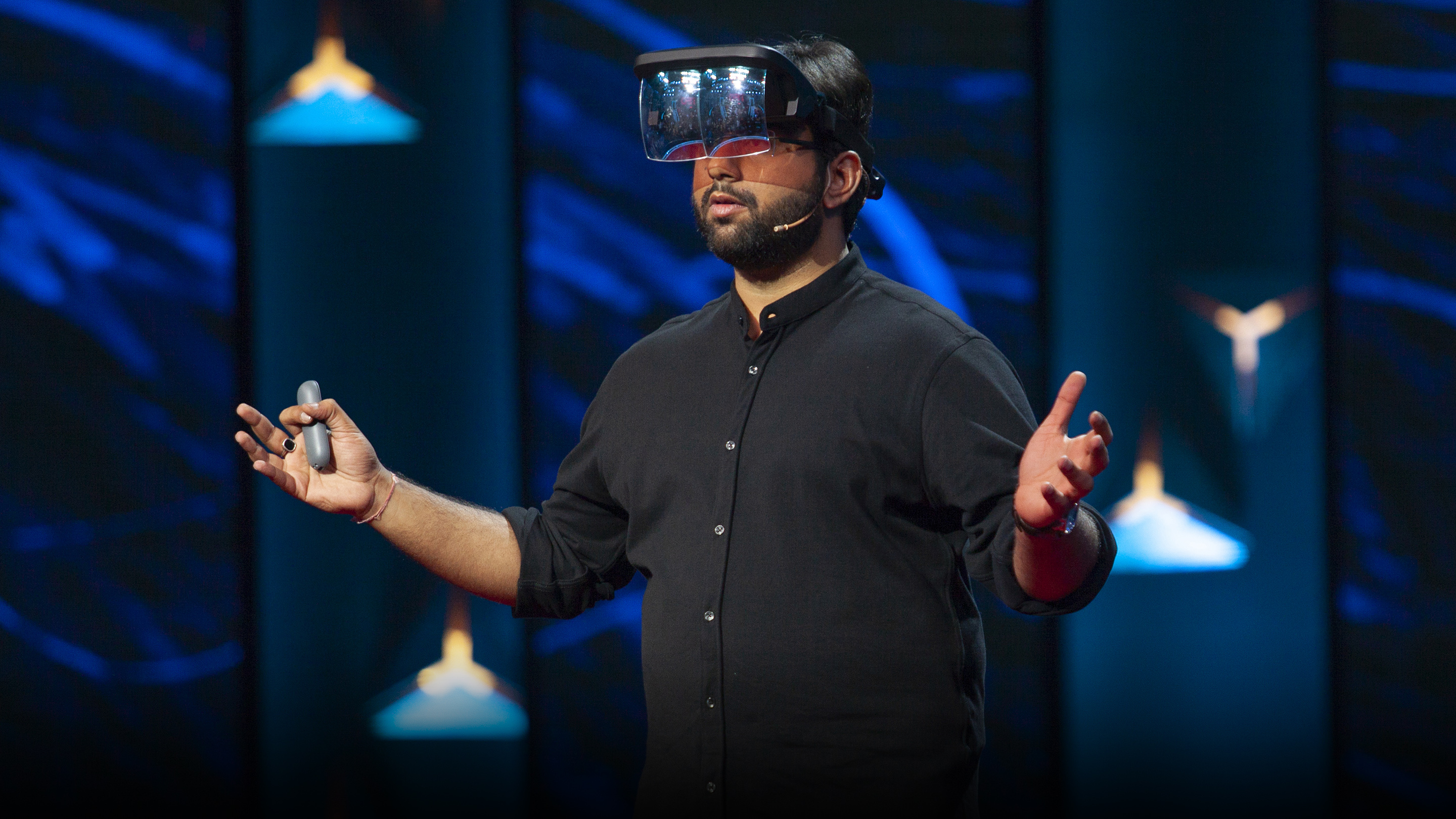
His 2019 TED Talks India appearance put the human purpose of the hardware back in view. He demonstrated a headset for seeing and interacting with holographic content. Storytelling and learning were the subjects. The device was a means of giving digital objects a place in the user's surroundings, where looking and reaching could become part of the experience.
The room keeps getting larger
Marwah's favourite way of explaining mixed reality has often involved cricket: watching from home while feeling closer to the stadium. It is a useful example because the desire already exists. No one needs a lecture on spatial computing to understand wanting a better view of the match. His pitch starts with an experience, then introduces the machine.
The work continued through JioDive and immersive streaming, and towards voice and agentic AI. In 2026, Marwah described Tesseract's integration into Jio Platforms as Jio Reality Labs, with work spanning AI glasses, homes and humanoid robots. He also recorded the company's full merger into Reliance Intelligence that year. The range of projects had grown from the cameras and headsets of the original mixed reality startup.
He now describes interests in further AI research, startup investment, advisory work and building companies. The vocabulary has moved from cameras towards systems that can see, listen and act. The underlying attraction remains recognisable: making technology participate in an ordinary setting, rather than asking people to organise their lives around a technical demonstration.
There is something pleasingly material about the path that got him here. A photographer became a camera researcher. A researcher assembled workshops. A workshop organiser became a founder who had to find circuit boards and packaging. Each step brought another kind of person into the work. The future, in this telling, has a long list of collaborators.
The convocation story offered a quick explanation for a place in a queue. The products demanded a slower explanation, delivered in components, tests and things people could hold. Marwah's career makes that second explanation worth following. Somewhere between the image on a screen and the box that carries a camera, an idea has to learn how to come home.