Muhammad Younas remembers waiting for hours at job fairs while studying at the University of Texas at Austin. At the front of the queue was a recruiter with a few minutes to spare. Behind him were more people waiting for the same opportunity. He handed over his résumé and watched employers collect applications in a large box. For an aspiring engineer, it was an untidy system: plenty of effort going in, precious little conversation coming out.
He recalled that scene in a 2021 conversation with recruiting interviewer William Tincup. The memory helps explain the business he eventually co-founded. vFairs would bring employers and candidates together online, allowing people to meet without first making a pilgrimage to a crowded exhibition hall. A résumé box is an admirably simple database. Retrieving anything useful from it is where the romance fades.
The frustration also gives his story a human starting point. Before the event platform, before the conference appearances, Younas was someone trying to get a fair hearing. His later work would concern the mechanics of that hearing: who gets access, how people connect, and whether the encounter produces anything worth the time spent arranging it.
Lahore, Austin, and a product inside a job board
Younas graduated from Lahore University of Management Sciences in 2005, having studied computer engineering. A Fulbright Scholarship took him to graduate study at UT Austin, where he also received the David Bruton Jr. Fellowship. His route into business ran through technical training, then IBM in Austin, and later Bayt.com, the Middle Eastern employment website, where he became chief commercial officer.
He has given his university considerable credit. “LUMS was a true game-changer for me,” he said in a university profile. He linked the education both to securing the scholarship and to acquiring the technical and entrepreneurial skills needed to build internationally. The connection remained practical: fellow LUMS graduates Aatir Abdul Rauf and Arfeen Godil also appeared in the vFairs leadership team.
The product's roots reach back to 2012, when virtual job fairs were a side project at Bayt.com. Younas saw uses beyond the job board's own events. Organizations with geographically scattered audiences could use the technology under their own branding. He volunteered to take charge, white-labelled the product, and began selling it for companies' events. vFairs was founded in 2016. The dates describe two stages: an internal experiment, followed by a business built around a broader opportunity.
The early application made sense for someone who had stood in those Austin queues. Hiring fairs contain a surprisingly elaborate choreography: employers need suitable candidates, candidates need access to the right employers, and everyone needs enough information to decide whether another conversation is worthwhile. Moving the room online gave Younas a chance to rearrange that choreography.
First, take your own medicine
Younas did more than sell software to organizers. The team ran virtual job fairs itself, experiencing the work from the customer's side of the screen. In his 2023 SaaSOpen talk, he described operating hundreds of these events. The exercise brought in revenue and gave the company direct experience of what organizers were buying.
There is a useful humility in that arrangement. A software demonstration can end just as the awkward questions begin. An event cannot. People arrive, want answers, expect introductions, and leave with an opinion. Operating the product made the team responsible for those outcomes. It also gave prospective buyers something more concrete than an attractive interface: examples of the work already being done.
His first $100,000 deal, as he tells it, grew out of another ordinary conversation. An existing virtual-fair customer also ran physical events and was unhappy with its supplier. Its next event was only months away. vFairs offered to build a minimum viable product around an agreed set of requirements in less than three months. The customer agreed. A question about the rest of someone's job had opened the door to a new part of the market.
That episode captures his method better than a sweeping claim about innovation could. The expansion began with an identifiable customer, a specific irritation and a date on the calendar. There was a person waiting for a solution. Younas's company offered to have one ready.
The first deal of that size came from an existing customer’s need for in-person event software, Younas recalled in 2023.
The software founder with a hospitality brief
Customer support occupies an unusual amount of space in Younas's public account of building vFairs. He describes the company as belonging partly to the hospitality industry. The choice of word is revealing. Hospitality involves helping people through an experience, including the bits they had hoped would take care of themselves. Anyone who has organized an event knows how many such bits there are.
In September 2022, Younas reported that vFairs had reached $30 million in revenue without an outbound sales team. He described a business drawing demand through search, paid advertising, referrals and customer recommendations. He also said it had become profitable within its first six months. These are figures from that talk, a picture of the company at a particular moment.
The commercial logic is straightforward. An organizer who feels well supported has reasons to return, recommend the platform or introduce it to another department. Support can therefore influence the next sale as well as the current event. In an industry organized around deadlines, the experience of getting help becomes part of the product people remember.
Younas made the management implications explicit in a 2021 essay. As vFairs grew, he wrote, it concentrated on expanding and training staff who worked with customers after the sale. Customer conversations helped shape features. Senior management's decisions were meant to teach the priorities through example. A culture, in this account, is visible in the people a company trains and the work it chooses to fund.
“We are also in the hospitality industry.”Muhammad Younas · SaaSOpen, 2023
A global company needs somewhere to belong
The geography of Younas's career did not disappear when he became a founder. Based in Toronto, he built a business with a substantial connection to Lahore. In 2017 he established a vFairs engineering and project management campus there. His university's alumni account later credited him with creating employment for more than 200 Pakistanis, including a sizable number of LUMS graduates.
That investment sat alongside a commitment to remote work. In October 2021, Younas wrote that vFairs had operated with a remote-first approach from the beginning and then had more than 250 employees around the world. He described a workplace in which people could control their schedules while coordinating across time differences of ten or twelve hours.
His description was reassuringly specific. The company used tools including Slack, Zoom, Google Workspace and Asana. Daily and weekly huddles helped colleagues see what others were doing and where help was needed. Slack's general and random channels carried congratulations, memes, travel photographs and arrangements for local meetings. Even a company selling digital gatherings apparently needed somewhere for people to boast about their holiday.
The physical campus and the distributed organization fit the same larger pattern. Work could cross borders while still maintaining local connections. Younas's educational network supplied colleagues; Lahore supplied an engineering and project management base; remote collaboration allowed teams elsewhere to participate. The company's own organization became another practical test of its belief that distance need not prevent useful contact.
From the crowded room to the useful meeting
By 2026, Younas's public work covered in-person, hybrid and virtual events. His Saudi Event Show speaker biography described a decade of vFairs, with more than 50,000 events and 100 million attendees across those formats. Those are company platform totals, rather than the audience of any single event. They also show how far the work had moved beyond the first virtual hiring fairs.
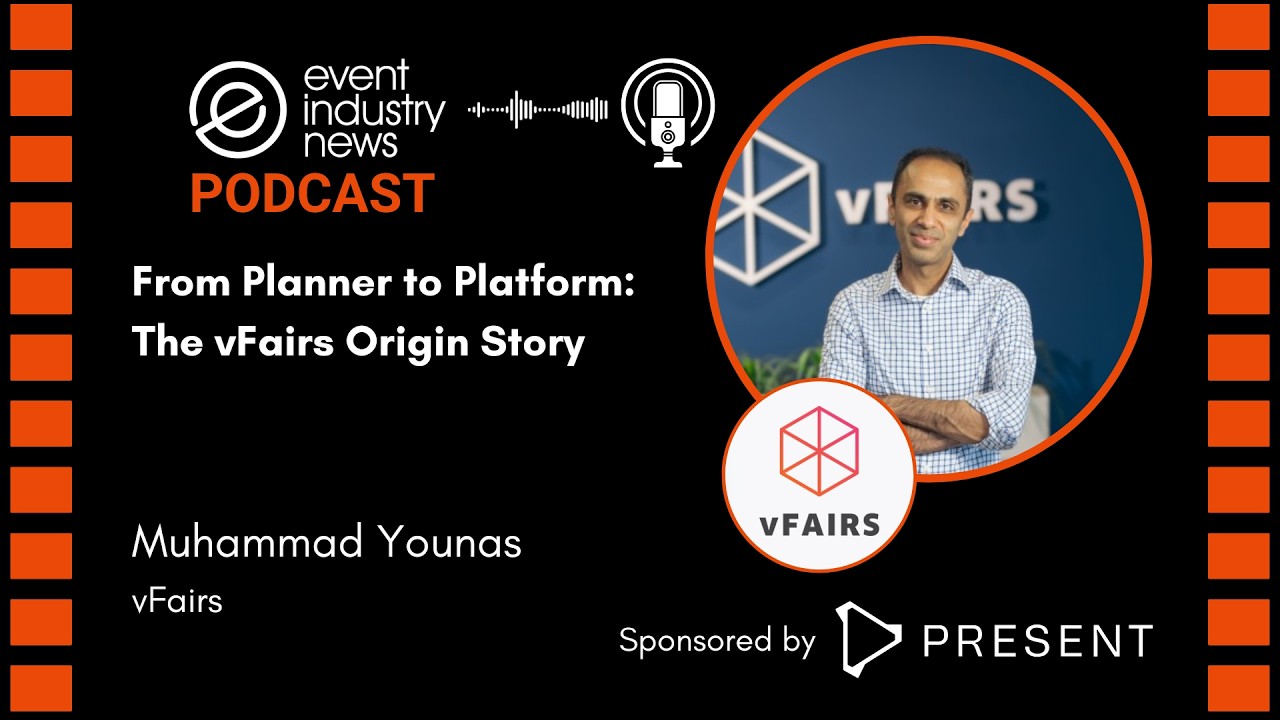
He had taken on another role too: host of Epic Events, interviewing people who organize gatherings for a living. A featured July 2025 episode brought in HubSpot's Katherine Tooley to discuss creating in-person events that connect people and inspire action. Hosting a show places him on the asking side of the table, with room to hear how other event professionals approach their jobs.
His September 2026 Saudi Event Show agenda included sessions on artificial intelligence and on measuring success beyond attendance. The measurement theme returns to the original job-fair problem. A room can be busy while the people inside struggle to reach the right person. Counting the room gives an organizer one answer; understanding the encounters inside it requires more work.
A June 2026 interview with James Dickson covered the company's development into hybrid and physical events, support teams across markets, connections to marketing and customer-management systems, and plans for AI features. The format had changed since the earliest job fairs. The recurring concerns were familiar: dependable operations, useful connections and a customer who can get assistance.
Do the work before you automate it
In a September 2026 conversation with Eric Rozenberg, Younas offered advice that sounds particularly apt for an engineer now working amid enthusiasm for AI. Understand a process by doing it manually first. Follow the customer journey, learn where the difficulties lie, establish something that works, and then decide which parts automation can improve.
He also argued that event planners would face more pressure to connect their work to business results. The planner's remit, in his view, was becoming more strategic. Delivering the gathering would remain necessary, but explaining what it accomplished would matter increasingly. A full registration list offers little comfort when someone asks what the expenditure achieved.
This is where the early memories, the product experiments and the later management advice meet. The student wanted a worthwhile conversation. The founder learned by operating events. The CEO kept returning to support and outcomes. Across those settings, Younas has paid attention to the gap between arranging an encounter and making it useful.
It is a demanding place to build a software business. People remember waiting, being overlooked and being passed along. They also remember someone answering, understanding the problem and staying until the job is done. Younas began with a queue he thought could work better. His company still depends on what happens when somebody reaches the front.
Keep the conversation going
Explore vFairs, follow Muhammad Younas on LinkedIn, or listen to Epic Events.