The first time Lalit Mangal got his hands on a computer, he had already arrived at college. Until then, the machine was an abstraction. At IIT Roorkee it became a companion, the unusually obedient sort that did precisely what it was told and punished every vague instruction. He learned programming, worked on projects for the institute website, and discovered a preference that would keep organizing his career: give a stubborn human problem to software and see whether the machine can make cooperation easier.
His appetite for building had two models at home. Mangal grew up in India with a father who worked as a government officer overseeing roads and public infrastructure and a mother who practiced law and came from an entrepreneurial family. He has described the combination as an education in diligent study, hard work, and risk. It is a neat inheritance for a product founder: respect the load-bearing details, then accept that a new route still has to be attempted. College supplied the instrument. He joined IIT Roorkee's Information Management Group, the student team responsible for the institute website and intranet, and worked on ad-hoc networks and mobile computing. The campus computer was therefore more than a subject. It was a place to make something other people could use, fail in public at a manageable scale, and return with cleaner instructions.
The problems grew, but the instinct stayed recognizable. At Oracle India, Mangal worked as an engineer. In 2007, he joined Sumit Jain and Vikas Malpani to create CommonFloor, a property-search business with an extra social layer. It helped apartment associations administer buildings and gave residents a shared place for the small negotiations of communal life. Search mattered. So did the awkward business of getting neighbors, owners, vendors, and information into one useful system.
CommonFloor grew across Indian cities and eventually merged with Quikr's real-estate vertical in 2016. For Mangal, who led product and technology, the outcome created something founders rarely buy for themselves: a pause. During that break, he wanted to attend conferences in other countries. Time and travel kept vetoing him. The absurdity was hard to ignore. Events devoted to spreading knowledge still rationed participation according to location.
A hunch before the emergency
The origin of Airmeet is often filed under pandemic entrepreneurship, which gets the dates backward. Mangal was thinking about virtual gatherings years earlier. At a 2016 startup expo in Bengaluru, he watched exhibitors stand in crowded booths and repeat the same pitch through the day. The format consumed feet, voices, and patience with impressive efficiency. A professional event was supposed to concentrate discovery. Too often it concentrated inconvenience.
By mid-2019 he was calling investor Subrata Mitra to explain why real-time online communication would split into specialized products. A generic video call could distribute faces and speech. A conference needed movement, encounters, stages, lounges, and the freedom to choose another conversation. Mangal brought in Manoj Singh, a former CommonFloor colleague who had led operations, and Vinay Kumar Jaasti. Their shared history mattered. Mangal had decided that if he built another company, he wanted complementary founders he already trusted.
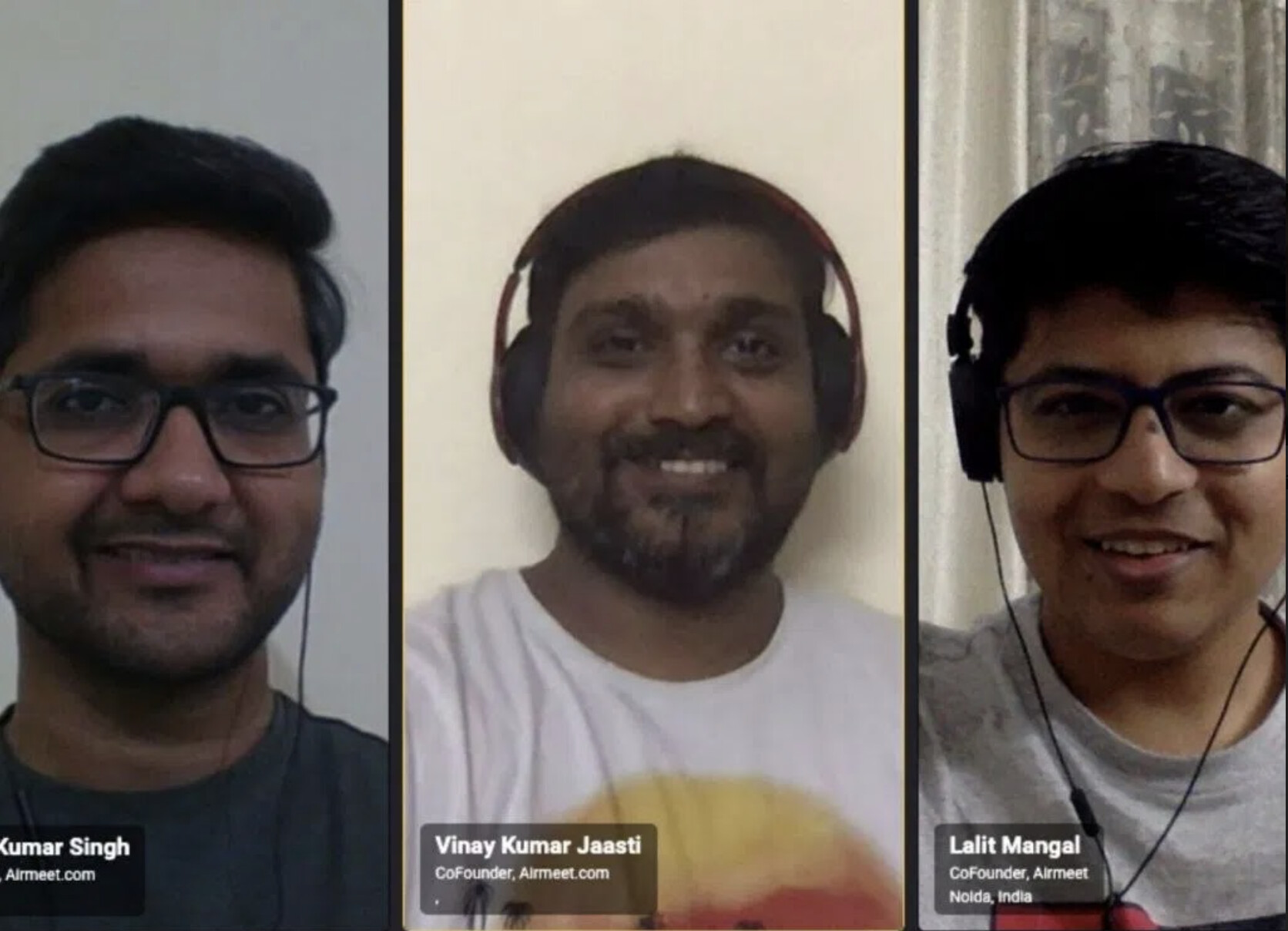
Airmeet's first event arrived in November 2019. It drew more than 40 participants, and the company reported that over 75 percent stayed through it. The number was small enough to watch closely and large enough to expose friction. Feedback loops followed. The team was already remote-first, so distance was neither a slogan nor a temporary accommodation. It was the operating condition in which they had to develop empathy for organizers and guests.
The CEO at the controls
Mangal hosted the first 20 events himself. This was product research with a live audience and no polite distance between creator and consequence. During one event, his power failed. He vanished for roughly ten minutes. The speaker kept the room going with audience questions until the host returned. Mangal remembered the episode as embarrassing and useful. His lesson was mercifully practical: events can survive imperfection, while preparation improves their odds.
That anecdote tells us more than a tidy success metric. Live software has a theatrical cruelty. It reveals the missing backup, the confusing control, and the brittle handoff in public. By hosting, Mangal placed himself where a customer usually stands. The roadmap could no longer treat anxiety as an edge case.
His framework for the event itself is similarly plain. An event bundles three things: content, connections, and camaraderie. Digital delivery can widen access to speakers and knowledge. It can also make professional introductions more intentional. Camaraderie remains the stubborn member of the trio, more dependent on bodies sharing air. The product question becomes specific: improve what software can improve, and stop confusing a livestream with a gathering.
The virtual table became one answer. Participants could sit in a small video group, leave, and join another. It sounds almost embarrassingly simple, like a door. Doors are important. Conventional conferencing software tended to give the host power and the audience a mute button. Airmeet tried to return some choice to the guest. The attendee could browse the room rather than merely endure the feed.
When the market arrived all at once
Then 2020 made the niche universal. Conferences disappeared from convention centers and reappeared in browsers. Airmeet launched its beta in February, raised a $3 million seed round in March, and announced a $12 million Series A in September. Mangal said platform usage had grown 2,000 percent in a quarter without advertising. The accident of timing was enormous. The underlying thesis had been patiently assembled before the emergency.
Scale changed the nature of the work. A product built for community gatherings was also used for university fairs, industry summits, film-festival meetups, webinars, and large conferences. Airmeet reported that by 2021 more than 120,000 organizers had streamed 150 million minutes of video. In February 2022, it announced a $35 million Series B and said recurring revenue had grown 24 times since the Series A.
Capital for a larger room
Funding is easy to print and harder to interpret. The more revealing continuity was in Mangal's language. He spoke about relationships, trust, and preserving a human touch as customer engagement moved online. Those are soft words attached to hard engineering constraints: latency, encryption, capacity, browser compatibility, and a hundred small interface decisions about who may speak next.
The perfectionist learns to leave room
Mangal has called himself a perfectionist. He has also described repeatedly listening to a conversation between Joe Rogan and Naval Ravikant, absorbing its long-term perspective and loosening perfection's grip. The pairing is instructive. Founders need the irritation that notices a crooked detail. They also need enough patience to avoid treating every crooked detail as an emergency.
His favorite leadership advice is to surround yourself with people who understand what you do not. It is modest only until it changes how responsibility gets distributed. At Airmeet, the co-founders took distinct roles built on prior knowledge of one another. Mangal concentrated on strategy, product design, and development. The arrangement made humility concrete: expertise belonged where it could do the most work.
There is curiosity in the way his attention has moved since the surge in virtual events. In 2024, he discussed AI agents that could help organizers research speakers, compare vendors, forecast logistical risks, build event pages, and scout useful attendee matches. By 2025 and 2026, his published work ranged across webinars as growth systems and the reshaping of B2B discovery by AI search. The topic keeps shifting from the event as a date on the calendar toward the event as a continuing source of relationships, content, and market knowledge.
A career built around the invisible queue
Seen from a distance, CommonFloor and Airmeet belong to unrelated software categories. One concerns property; the other concerns events. Up close, both notice an invisible queue. Residents wait for information, approvals, and one another. Conference attendees wait for access, introductions, and their turn to participate. Mangal's work begins where people have quietly accepted the wait.
This may be the most transferable part of his story. The useful startup clue is often too ordinary to announce itself as a market. It looks like a missed conference, a weary exhibitor repeating a pitch, a neighbor unable to find the right notice, or an audience trapped behind a mute icon. Someone has to become sufficiently annoyed, then sufficiently patient, to redesign the room.
Airmeet's future will be shaped by habits that continue to change: how often people travel, how companies sell, what audiences expect, and what AI can do before and after a live session. Mangal's aspiration has remained steadier. He wants distance to lose its power over who participates. The screen is merely where that argument currently happens.