BlueJeans began with a sentence every enterprise software founder wants to hear: “Why does none of this stuff talk to the other stuff?” In 2009, a corporate video call was less a conversation than a customs checkpoint. Cisco and Polycom room systems occupied expensive conference rooms. Skype lived on laptops. Phones lurked on the edge. Each had its own protocol, hardware assumptions and administrative rituals. Krish Ramakrishnan and Alagu Periyannan saw the mismatch and built a neutral cloud bridge.
The pitch was not better-looking video. It was permission to stop caring which camera, codec or device sat at the other end. BlueJeans could pull desktops, mobile devices, standards-based rooms and phone callers into one meeting. In a market full of islands, it sold the ferry.
Rejected once, useful twice
The first version almost remained a slide deck. Accel's partnership passed on the founders' broad plan in early 2009. Instead of polishing the same pitch, the team narrowed the first release and lowered the capital required to build it. The revised proposal won backing later that year. That detail matters because BlueJeans' best habit was not merely persistence. It was editing.
The edits continued after launch. The company initially emphasized Skype compatibility, but customers gravitated toward BlueJeans' browser endpoint. The founders imagined line-of-business buyers would lead adoption, then discovered central IT still controlled the gate. They adjusted the product and sales motion without discarding the larger thesis: video should feel as ordinary as audio. The deliberately casual name made the ambition legible. A meeting ought to fit like denim, not require an operator's manual.
room systems
JEANS
Skype + phone
Commercial service opened in June 2011. Within 75 days, BlueJeans had 4,000 subscribers from 500 companies. By 2015, it said it handled more than one billion meeting minutes a year for 25 million users at 5,000 companies. Facebook, Red Hat, Viacom and LinkedIn appeared among named customers. Universities, public agencies and global enterprises bought the same underlying relief: keep the room equipment, let outsiders join, and give IT a view of what is happening.
The product became a small city
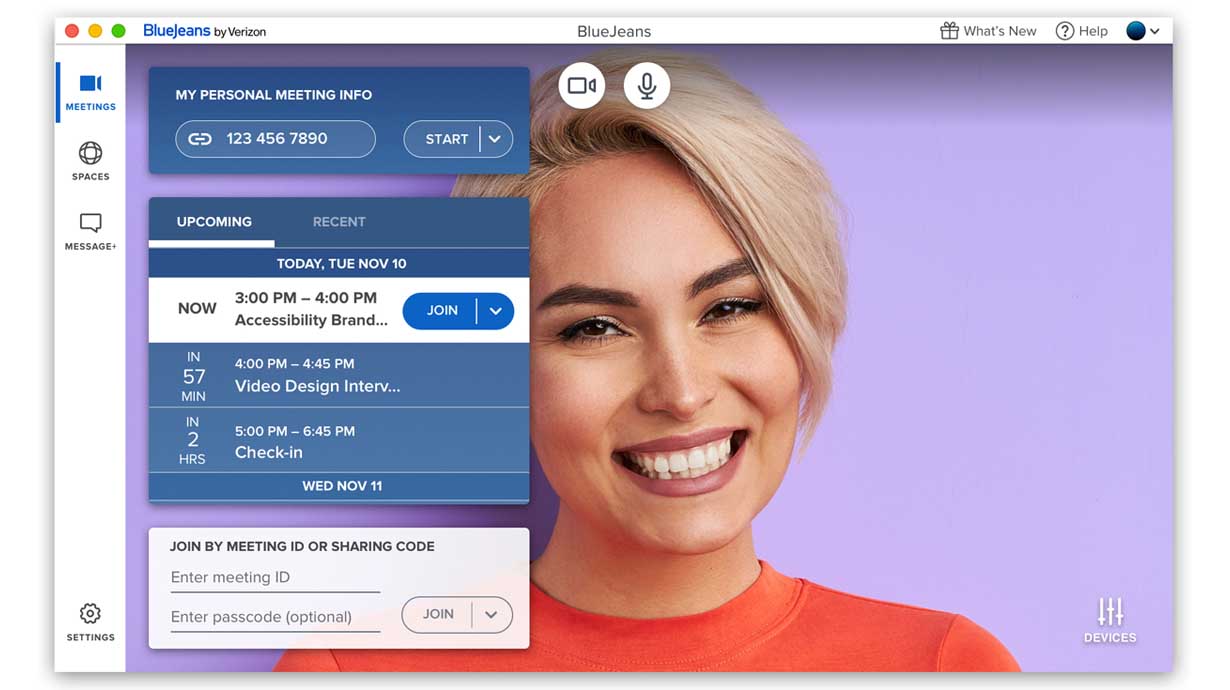
Meetings remained the center: video, audio, screen sharing, recording, browser access and administrative controls. Around it grew Events, first called Primetime, which let a host turn a one-way broadcast into a two-way conversation. Rooms reached back into conference hardware. Command Center gave administrators analytics and call-health data. Smart Meetings carved recordings into chapters, highlights, assignments and follow-ups. Telehealth offered a HIPAA-ready visit flow. Gateway let legacy SIP and H.323 room systems join Microsoft Teams.
That portfolio explains the company better than the phrase “Zoom rival.” BlueJeans was built for organizations with procurement rules, old hardware, multiple offices and a stranger joining from somewhere inconvenient. Its customers were not purchasing a rectangle of faces. They were purchasing fewer failed joins, longer life for installed equipment, security controls and a support number when the CEO's town hall went sideways.
Dolby supplied another useful distinction. Its spatial-audio work placed voices in the sound field and reduced background noise, especially in huddle rooms. Poly devices, Microsoft Teams interoperability, Amazon's Alexa for Business and carrier distribution through Airtel expanded the partner map. In 2018 BlueJeans said demand for Rooms with Dolby Conference Phone had risen 63 percent in its first six months. Interoperability was no longer one feature. It was the company's worldview.
“It sold the relief of keeping what you already owned.”The overlooked BlueJeans value proposition
What it cost - and what it returned
BlueJeans used familiar enterprise SaaS plumbing: subscriptions per host, room or event, with larger tiers for capacity, recording, analytics, interoperability, branding and support. Near the end, the public menu ran from a free Basic plan to Pro at $12.49 per host each month and Enterprise at $16.66, with annual discounts and custom contracts above that. The company had raised roughly $175 million across its well-documented institutional rounds, including $76.5 million in 2015 led by NEA.
Then came the improbable timing. Verizon announced its acquisition on April 16, 2020, when pandemic lockdowns had turned video from office accessory into civil infrastructure. The price was never officially disclosed; contemporary reports put it below $500 million, while one later industry account used $400 million. Verizon spoke of putting BlueJeans on its global networks and 5G roadmap, with uses in telemedicine, distance learning and field service. The founders and key managers joined Verizon. On paper, a powerful network had bought a proven application at the moment demand exploded.
Founders narrow a rejected plan and secure initial backing.
Commercial launch turns incompatible endpoints into one cloud meeting.
Events launches; reported reach passes 25 million users.
Verizon buys BlueJeans for an undisclosed price reported below $500 million.
The phased sunset concludes after less than four years inside Verizon.
The bridge met the bundle
What failed first was the position. BlueJeans had been valuable because communications were fragmented. But Microsoft Teams tied meetings to identity, calendars, chat, files and Office contracts. Google Meet lived beside Gmail and Calendar. Cisco controlled a large installed base. Zoom became a verb by making the first join feel obvious. BlueJeans still connected things; its rivals increasingly owned the place where work began.
This is not proof that the product suddenly stopped working. It is evidence that product quality and strategic gravity are different forces. An analyst quoted after the shutdown argued Verizon never used its subscriber scale and sales reach to make BlueJeans ubiquitous. Inside a carrier measured in tens of billions, a conferencing product could be sensible and still too small to command oxygen. By 2023, Verizon was concentrating on 5G, wireless, cloud and networking. BlueJeans became “non-strategic.”
The sequence was clinical. New sales ended in August 2023. The free Basic tier and trials went first. Most service was scheduled to finish that December, with the overall sunset concluding in the first half of 2024. Verizon's annual filing recorded a $179 million pre-tax charge related to the shutdown. The call ended without the theatrical “leave meeting” button.
Steal the wedge, add a deadline
BlueJeans leaves a surprisingly practical operating manual. Find expensive objects customers cannot replace and make them useful together. Sell risk reduction to the person who owns the mess. Instrument usage closely enough to notice when the buyer, endpoint or workflow differs from the pitch. Expand from the compatibility layer into the jobs around it: administration, events, records and follow-up.
The builder's five-line version
- Map the stranded assets your customer cannot afford to discard.
- Build the neutral connector nobody incumbent is motivated to build.
- Charge for reliability, visibility and preserved investment - not novelty.
- Use behavior, not the founding deck, to choose the next product.
- Become a daily destination before your integration partners absorb the workflow.
There are conditions where this playbook fails. It does not work when standards mature quickly, replacement costs fall, or a platform bundles the connector free. It struggles when switching is easier than integration, when consumers choose the tool before IT can standardize it, or when the acquiring company cannot give the product sustained executive attention. Middleware buys time. It does not automatically buy loyalty.
BlueJeans was early, well-funded and technically credible. It also changed its mind when evidence demanded it: after the rejected pitch, after browser use beat Skype positioning, after IT proved more important than expected, and again as Events and Rooms widened the business. Those turns built a real company and a meaningful exit. The mistake was subtler. The bridge never became the city before cities appeared on both shores.
A good company can still occupy a bad square
BlueJeans fits in the market between unified communications and enterprise collaboration, but that label hides the awkward geometry. It competed for the meeting itself while depending on calendars, identity systems, office suites, networks and room hardware owned by larger companies. Every successful integration made BlueJeans more useful; every improvement by an integration partner threatened to make it less necessary. This is the middleware bargain in miniature.
The company tried to move outward. Events created a reason to buy BlueJeans for a staged experience, not only compatibility. Smart Meetings tried to own what happened after the call. Rooms and Dolby reached into the physical workplace. Telehealth gave a regulated industry a purpose-built flow. These were rational adjacencies, yet each ran into a specialist or a bundled incumbent. Zoom had webinars and rooms. Microsoft owned the work graph around Teams. Cisco could pair Webex with its hardware. Google could place Meet inside a calendar event with almost no new procurement.
For customers, the practical legacy is less dramatic. BlueJeans extended the life of conference rooms, normalized joining from almost anywhere and helped make enterprise video feel like a service instead of a piece of equipment. Many of its once-distinctive ideas - browser entry, room interoperability, spatial audio, live captions, meeting analytics and automatic follow-up - now read like a checklist. That is an achievement with an irritating punch line: a pioneer can win the argument while losing the account.
For acquirers, the warning is sharper. A product bought for strategic possibility needs a named route to habitual use: bundled with connectivity, placed in front of an installed customer base, or made essential to a vertical workflow. “We have distribution” is not a route. It is a fact awaiting an operator. Verizon had the network, sales force and business customers. The public record shows ambitious possibilities, but no comparable evidence that BlueJeans became the default layer across them.