The phone system was supposed to help a software firm do its work. Instead, it had become another piece of work. In Utah in 2006, six software entrepreneurs faced an unappealing choice: keep the troublesome system they had, or buy a replacement they considered expensive and complicated. They built their own. Consulting clients noticed. A private irritation had acquired a market.
- The job: move business telephony into the cloud, with control over where calls go.
- The audience: companies and institutions; about 20,000 customers by early 2018.
- The deal: $342 million announced cash consideration, plus up to $15 million in contingent retention payments.
- The sequel: Jive’s technology became part of GoTo Connect. The standalone brand retired in 2020.
Jive Communications is an oddly useful company to study because its name no longer tells you where to buy its product. Search for the old business and you arrive at a newer one. Yet the underlying proposition remains easy to recognize: a customer should be able to reach your business without knowing which building your employees happen to occupy.
01 An irritation with six owners
The founders were John Pope, Mike Sharp, Matthew Peterson, Brent Thomson, Andrew Skeen and Stephen Todd. Their original system replaced an analog, site-based arrangement with cloud-based telephony. Their consulting clients were having similar difficulties. Once those clients wanted the fix, the founders had evidence that the problem extended beyond their own desks.
Sharp later described their confidence rather neatly: “So, being the over-confident software guys that we were”. There is an attractive lack of ceremony here. The opportunity arrived wearing the clothes of an office expense.
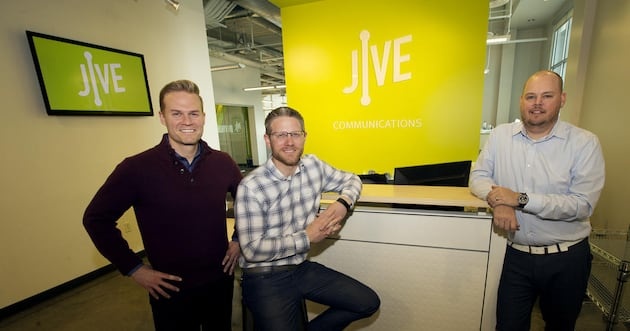
In a 2017 interview, Peterson said the six founders worked unpaid for three years. Pope described a workplace built around fiscal responsibility, problem solving and individual drive. That account captures the founders’ preferred character for the business: useful work, measured spending, customers first. It also suggests a cost easily omitted from a startup story. Someone paid for those early years in time and foregone wages.
02 The valuable thing was the route
A hosted PBX puts the business’s phone-switching functions with a service provider rather than leaving the customer to manage a switch at each site. Jive sold that service through its own cloud platform. Extensions, greetings, queues and voicemail became settings that could be managed across locations. The familiar desk phone could stay; the machinery deciding what happened next moved elsewhere.
The practical appeal becomes clear in a GoTo customer account from Durham Travel, an Ontario agency that switched before the pandemic. Its old analog setup was poorly suited to remote work. With GoTo Connect, three agents could operate in a sequence: try the first, then the second if the first was busy, then the third. Transfers and online voicemail followed the employees home.
call
01
02
03
“Whether we’re working in the office or at home, it makes no difference,” said agency president John Wood. The service had removed a location constraint from an existing way of working. Customers could still call the business; employees could still share responsibility for answering.
By the acquisition announcement, Jive had approximately 20,000 customers worldwide. LogMeIn said roughly 90 percent were businesses with 1,000 employees or fewer, while naming Mozilla and Hickory Farms among larger customers. That places Jive squarely in the business communications market: a service for organizations whose phone arrangements have become too complicated to leave to chance.
03 Growth had a bill attached
The audited accounts put some numbers around the operation. Annual revenue rose from $55.3 million in 2015 to $67.2 million in 2016 and $80.7 million in 2017. Software subscriptions supplied $72.8 million of the 2017 total. Equipment and other product revenue supplied the rest. The recurring service was the economic center of the company.
Growth did not mean profitability. Jive recorded a $14.3 million net loss in 2017, compared with $4.9 million the previous year. Sales and marketing spending reached $44.3 million in 2017. The financial picture complicates the comfortable bootstrap legend: a working product and rising sales can coexist with expensive expansion.
For buyers, the model exchanged ownership of phone-system infrastructure for subscription spending. The useful question was how that recurring bill compared with the hardware, maintenance and administration it displaced. Moving an expense from one column to another does not make it disappear.
04 A meetings company buys a dial tone
In February 2018, LogMeIn announced the acquisition on terms of $342 million in cash, subject to adjustments, with up to $15 million in additional contingent employee-retention payments. The deal closed on April 3. Those payments belong to the purchase story; counting them as venture funding would turn a sale into a fundraising round by clerical magic.
The strategic fit was unusually legible. LogMeIn had collaboration products including GoToMeeting and join.me. Jive brought cloud telephony, contact center capabilities and mobile applications. LogMeIn’s acquisition presentation described Jive’s platform as distributed and multitenant. The buyer was acquiring both an installed customer base and technology it could put beside its existing meetings business.
The acquisition bought a missing piece: the business call before the meeting begins.
In April 2019, GoTo Connect brought Jive’s phone system together with GoToMeeting’s web, audio and video conferencing. The launch offered new Jive customers the combined product at no additional cost. A year later, LogMeIn retired Jive as a standalone product and brand. Its explanation was commercial rather than mysterious: customers could get Jive’s voice capabilities and meetings in the combined application.
05 Five minutes beats a service ticket
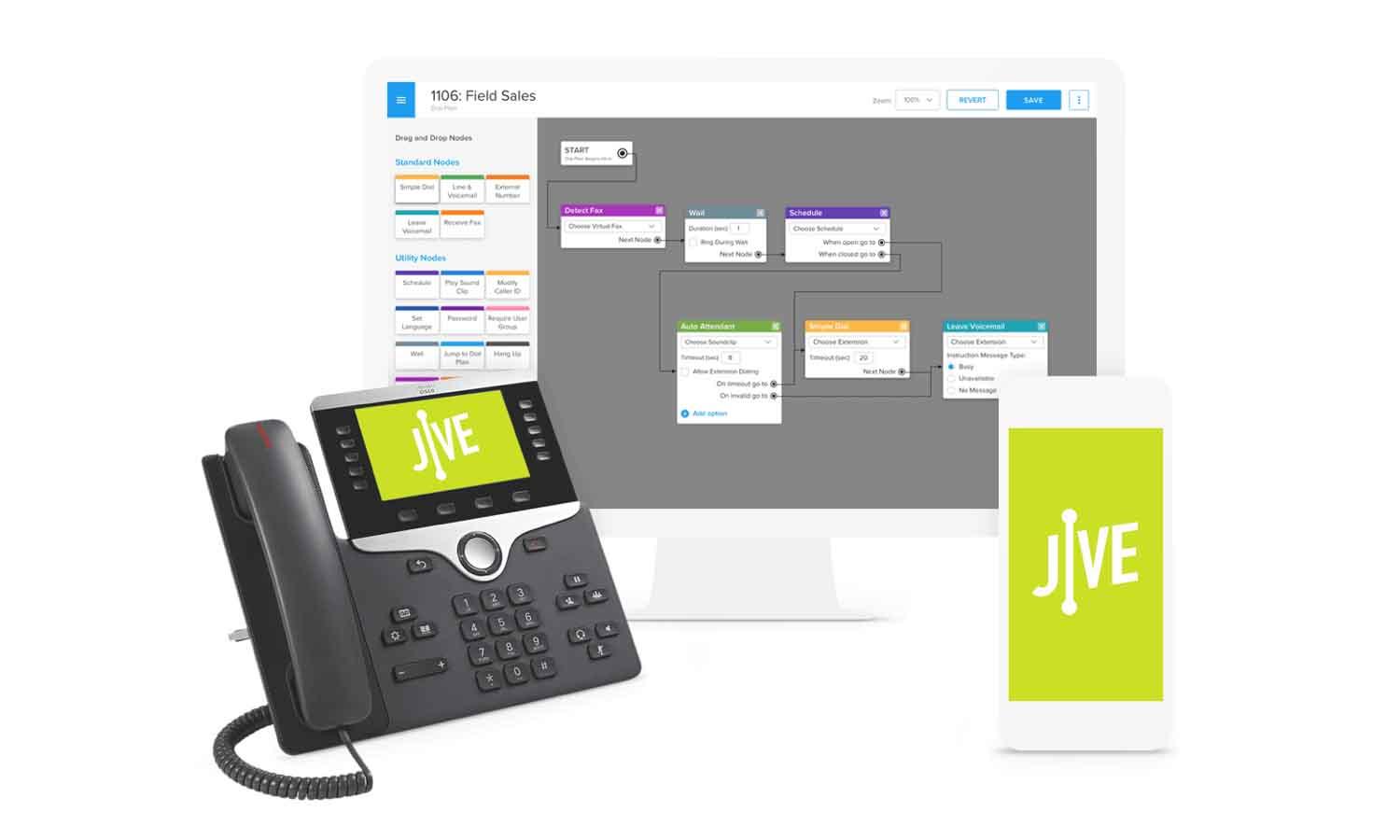
The University of Advancing Technology offers a revealing account of what prompted a customer to change its mind. Its earlier provider made administration tedious, had SIP-trunk and internet-provider difficulties, and failed to deliver expected recording and monitoring features. GoTo Connect’s visual Dial Plan Editor let university leadership change call flows directly. CEO Jason Pistillo reported creating a conference line in five minutes.
Migration still involved work. The university needed a day or two to resolve firewall configuration for phones on a separate network segment. That detail deserves as much attention as the five-minute conference line. A simple control panel can sit on top of a network that needs careful preparation.
Jive also worked with physical-phone suppliers. Its June 2017 Cisco partnership brought Cisco Multiplatform Phones to the cloud voice service. Against alternatives such as RingCentral, 8x8, Vonage and Nextiva, the meaningful comparison concerns administration, devices, support and the communication tools a team actually uses. Jive’s eventual combination with GoToMeeting gave it a particular route into that wider bundle.
06 The receptionist is the latest extension
The successor has moved further into customer communications. GoTo introduced AI Receptionist in March 2025 for automated answering, routing and routine questions. In May 2026, it announced CX Complete, combining its phone system, AI customer experience tools and channels including text, web chat and WhatsApp. These are GoTo offerings built after the Jive brand’s retirement.
The direction became especially concrete on September 28, 2026. GoTo announced expanded integration with athenaOne to automate appointment booking, rescheduling and cancellations for healthcare practices. Clinical decisions remain with the provider. The old question was where to send a call. The newer question is which routine task software can finish before a person picks up.
07 Draw the call before buying the phone
The current US GoTo Connect pricing page asks buyers for a custom quote across Phone System, Customer Experience, CX Complete and Contact Center plans. Historical Jive rates are a poor shopping guide. A useful proposal should spell out user counts, equipment, taxes, messaging allowances and add-ons alongside the monthly subscription.
The operating conditions matter too. GoTo’s network guidance estimates about 100 kbps in each direction per call, with other devices competing for capacity. Broadband quality, routers and firewall settings can spoil the experience before a clever routing rule gets its chance. A business with unreliable connectivity needs to resolve that dependency as part of its plan.
There is a small, copyable lesson in all this. Sketch what happens when a customer calls: during opening hours, when everybody is busy, after closing and when an employee works elsewhere. Then ask a vendor to demonstrate those routes. Jive began by making an ordinary inconvenience visible. Its enduring contribution was giving the people running a business more control over the next ring.