The first machine in Colin Nederkoorn's business education was not a computer. It was a telex. It sat in his family's Singapore home, followed in time by a fax machine, and it announced that commerce had no respect for bedtime. His father brokered ships. Calls arrived from distant ports at inconvenient hours. Cargo did not care where the office ended and the house began.
One story stayed with him. A tanker carrying cooking oil reached Israel on the Sabbath and could not unload until the oil had been blessed. An idle ship could cost tens of thousands of dollars a day. Somewhere, a rabbi had to be found. To a child watching from Singapore, international business looked less like polished strategy than a series of peculiar, urgent problems connected by telephone.
Nederkoorn absorbed both the global scale and the tinkering instinct. He took apart the family computer, broke it, panicked, then figured out how to put it back together. He looked for loopholes in floppy-disk copy protection. He later described the impulse with disarming economy: he liked solving problems and doing things people thought he should not do. A tidy child might have preserved the machine. A future product founder wanted to know where the screws went.
The scenic route to software
At sixteen, he moved to England. Then came the United States and Rensselaer Polytechnic Institute in upstate New York. He began in electronic media, decided artistry was not his comparative advantage, and switched to management with a concentration in information systems. Accounting and finance proved useful. A class devoted to writing software specifications without actually building much software proved useful in a different way: it clarified what bored him.
After graduating in 2004, Nederkoorn followed the family trade to Houston. As a shipbroker, he negotiated freight for petrochemical cargo headed from the Gulf Coast to China. He found ways to scratch the technical itch at work, tending Linux and office servers. Then Apple moved the Mac to Intel processors, and he spotted a puzzle. In 2006, he created an online contest offering a crowdfunded prize to anyone who could make Windows XP run on the new hardware. More than $13,000 accumulated. A programmer solved it. The contest later helped inspire Brandon Kessler's ChallengePost.
The route was not a ladder
His passage into technology was gloriously inefficient. A co-working space in Boston led to support work, then a small Rails consultancy and a taste of product management. When the consultancy folded after a client stopped paying, Nederkoorn and a roommate got on bicycles. They rode from San Francisco to Boston - roughly 4,000 miles over 57 riding days. He applied for jobs along the way. The ride became an excellent interview story, though one suspects the headwinds supplied more management training than the interviews did.
A product job at Thrive took him to New York. Thrive was acquired by LendingTree. Next came ChallengePost, the company partly inspired by his contest, where he became head of product and met head of engineering John Allison. Before staking their livelihoods on each other, the two ran a small experiment at Startup Weekend. Their app, Plugs and Wifi, helped people find cafés with both amenities. The product did not matter much. The experiment answered the larger question: they enjoyed working together under pressure.
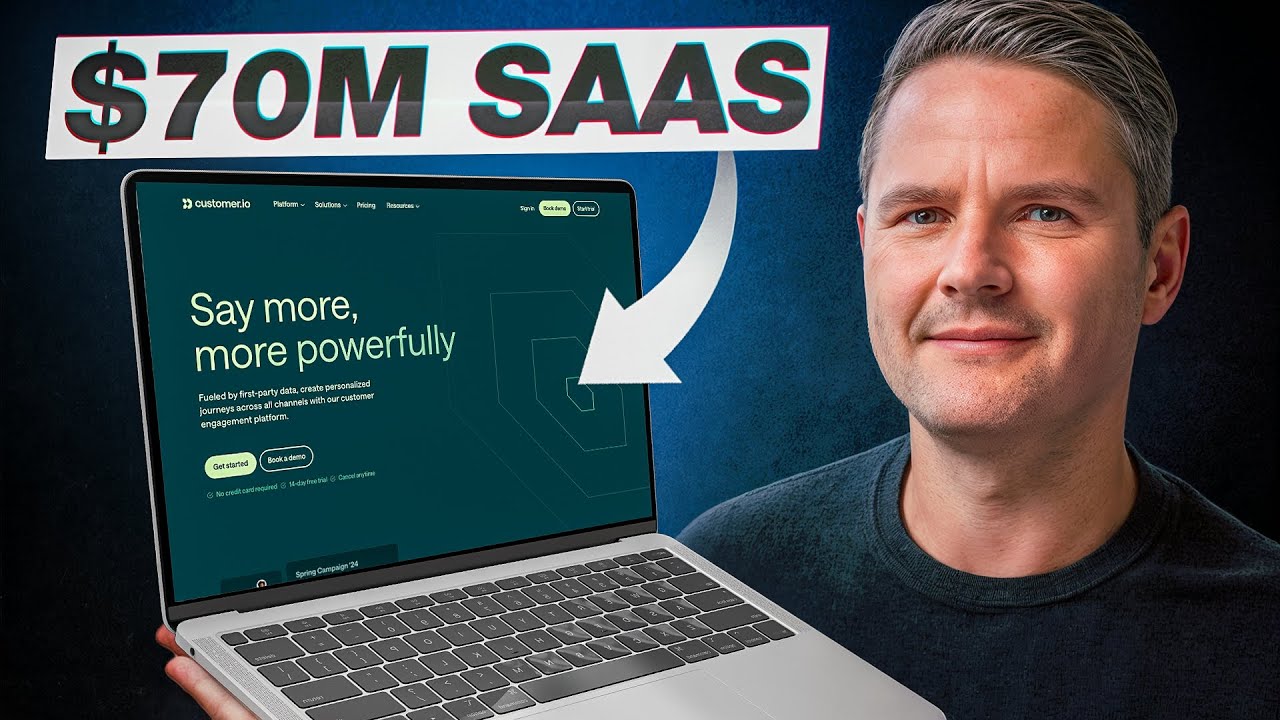
Five customers and a useful complaint
Nederkoorn and Allison began customer research around analytics. Their first thought was to show companies a richer, person-level account of activity inside an application. Interviewees kept pointing to the flaw. They already possessed dashboards that described what people had done. What they lacked was a way to act on that knowledge. Could the data trigger a timely message and perhaps change what happened next?
That complaint became Customer.io. In April 2012, five companies entered its private beta at $10 a month apiece. Fifty dollars in monthly recurring revenue did not fund two New York salaries. Friends, family and angel investors supplied early checks, buying the founders time to work full time. Allison wrote database queries by hand. The product made promises faster than the infrastructure could keep them. Yet the idea had the satisfying click of two pieces meeting: observe behavior, then make a useful response possible.
Early growth came from direct conversations and word of mouth. Nederkoorn contacted people in forums and on Twitter with nothing immediate to sell. One early conversation took six years to become a deal, after the person he had met became a chief marketing officer elsewhere. This was sales as composting: unglamorous, difficult to hurry and unexpectedly fertile if left alone.
The company reached about $1 million ARR in 2014 and went fully distributed that year, well before remote work became a corporate mood. Email remained the only channel for roughly the first three years. Then came push notifications, SMS, Slack and webhooks. A visual workflow builder arrived in 2020. Acquisitions in 2022 brought in-app messaging and email-development tools. Data Pipelines followed, extending Customer.io into customer data infrastructure.
Capital without a costume
Nederkoorn resisted the theatrical division between founders who bootstrap and founders who raise venture capital. Both camps could confuse the source of money with moral character. Scarcity could make a bootstrapped company value cash above time; abundant funding could encourage spending unmoored from benefit. Customer.io used investment when it needed runway, operated profitably when it could and coined a word for the middle: fundstrapping.
In 2021, the company said it had raised less than $4 million while reaching $20 million ARR. It then opened a crowdfunding round, arguing that customers and supporters who helped create the company's value should have a chance to share in it. About 2,500 people invested. In March 2022, after finishing the prior year profitable at $29.9 million ARR, Customer.io raised a Series A led by Spectrum Equity with Oregon Venture Fund participating.
The first figure is five customers at $10 per month, annualized. Later figures are company-reported milestones.
The financing philosophy mattered because the company needed time to correct itself. Nederkoorn has publicly catalogued mistakes: unreliable servers in Quebec; a distributed database that created trouble; an early JavaScript framework that eventually demanded a rewrite; delayed investment in sales; a customer-success function built only after larger accounts began leaving. His version of endurance is not stoic repetition. It is the willingness to keep the mission while replacing the machinery.
The question survives the milestone
In September 2025, Customer.io crossed $100 million in annual recurring revenue. The company reported more than 8,000 customers and 64 billion messages sent in the previous twelve months across email, push, in-app, SMS and webhooks. The beginning and the milestone make a pleasing pair: five tiny accounts became a platform operating at a scale where the units begin to sound imaginary.
Nederkoorn's note marking the occasion was less victory lap than renewed customer interview. He asked, “What do you wish was possible?” He also made a pointed promise about the fashionable technology of the moment: Customer.io would not add AI merely to check boxes. In a later discussion of the company's approach, he described a deliberate first move. Rather than rush isolated writing assistants into the product, the team worked on a context layer so AI could understand the customer behind a request.
It is consistent with the original insight. Data gains value when it helps someone act. AI gains value when it understands enough context to act well. The vocabulary changed between 2012 and 2025; the product argument did not.
Away from the company, the documented details are pleasantly terrestrial. Nederkoorn cooks, sails and coaches youth soccer. He once spent thirteen days growing a sourdough starter for a first loaf. There is a familiar pattern in that hobby: cultivate something living, monitor it, resist the temptation to call slowness failure. Even his leisure appears to have unit economics.
His stated ambition is to build a large independent company that endures beyond him. That sentence contains none of the usual founder fireworks. It also explains why the long route matters. The shipbroker's son learned that the world runs all night. The bicycle rider learned that distance yields to repeated motion. The product manager learned to listen for the complaint beneath the requested feature. Customer.io's story joins those lessons into an operating system: ask, build, repair, continue.
A hundred million dollars in recurring revenue is an arresting number. Fifty dollars is the more revealing one. It is small enough to invite embarrassment and real enough to demand responsibility. Nederkoorn and Allison treated it as the beginning rather than a verdict. Thirteen years later, the wager looks obvious. At the time, it was five companies, a rough product and a pair of founders willing to stay with an unfashionably patient idea.