The virtual-events company that bet the problem was never the format - it was the experience.
THE PLATFORM. Airmeet's virtual-events product, built to turn passive webinar audiences into active, networking communities. Remote-first, Delaware-registered, globally distributed.
When Airmeet's beta shipped in February 2020, virtual events were a niche. Weeks later they were the only kind of event there was. That accident of timing built a wave of competitors - and, when offices reopened, sank many of them. Airmeet is one of the platforms still standing, and it survived by answering a question most of its rivals never asked: why is a webinar so boring?
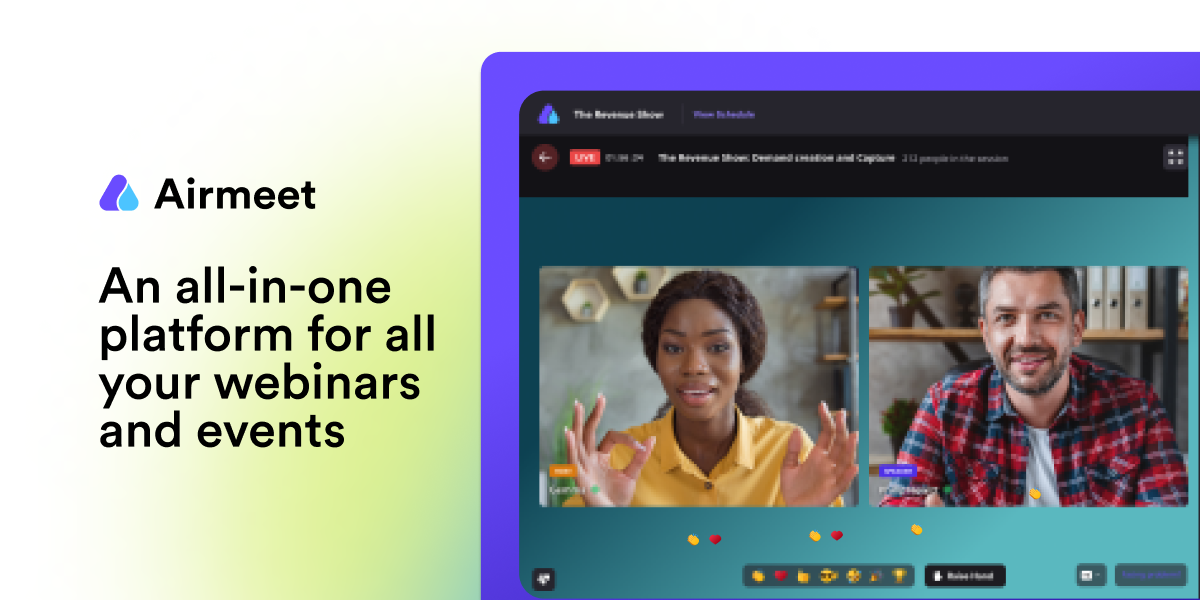
The company's founders had a specific theory. The problem with virtual events was not the screen. It was that everyone sat and watched. So Airmeet built the things a conference has that a broadcast does not - a hallway to run into people, a lounge to sit and talk, a stage you could actually be pulled onto. Regulars describe the same moment: you raise a virtual hand, your camera flips on, and suddenly you are talking to the speaker.
That engagement-first design is now aimed squarely at B2B marketing. Airmeet's pitch to companies is uncomfortable and honest - most webinars are lead-gen theater. Measure real engagement, tie it to your CRM, and prove the event moved someone. The platform's AirIntel scoring and integrations exist to make that case.
More than 5,500 brands host events on Airmeet each month, from Comcast and Unilever to the Linux Foundation and dozens of universities. The company grew recurring revenue 24-fold between its Series A and Series B, raised over $50 million, and was named a G2 Winter 2025 Leader in both Enterprise and Mid-Market. Not a moment. A movement, after all.
"Powering authentic human connections virtually."— Airmeet, on its own mission
An all-in-one platform for webinars, summits, and hybrid conferences - engineered around the parts of an event people remember.
Live, presentation, panel, Q&A, and interview formats with in-session CTAs, polls, and engagement scoring for up to 10,000 attendees.
Multi-session summits and conferences with exhibitor booths, branded stages, and tracks that run in parallel.
Timed matchmaking and fluid tables that recreate the hallway conversations watch-only tools can't.
Engagement-score analytics and CRM integrations that connect attendee behavior to pipeline and attribution.
Auto-generated clips and highlights from recordings - reported to save marketers 4-10 hours per webinar.
Points, leaderboards, and interactive polls that keep large, distributed audiences active rather than passive.
Over $50M raised across three rounds - the Series B arriving after a 24x jump in recurring revenue.
Accel, BetterCapital AngelList Syndicate, Global Founders Capital.
Led by Sequoia Capital India with Redpoint, Accel India, Venture Highway, GFC. Valued ~$50M.
Led by Prosus Ventures with Sistema Asia, RingCentral Ventures, KDDI, DG Daiwa, Nexxus Global.
Adoption skews toward education and professional services, spanning 21+ industries. A sample of named customers:
The market is crowded - Hopin (RingCentral Events), Zoom Events, ON24, Hubilo, vFairs, Bizzabo, GoTo, Microsoft Teams. Airmeet's wedge is engagement plus attribution.
Virtual lounges, speed networking, and gamification that watch-only tools like Zoom Webinars and legacy ON24 don't natively offer.
AirIntel engagement scores and CRM connections position events as a demand-gen channel, not a vanity metric.
Frequently cited as more accessible for small teams and startups - including a free tier - while still scaling to 10,000 attendees.
IIT Roorkee CS grad. Previously co-founded CommonFloor, one of India's largest online real estate platforms, later sold to Quikr.
Leads engineering for a platform built to stream millions of interactive minutes across thousands of concurrent attendees.
Part of the founding team that launched Airmeet's beta in early 2020 and steered it through the virtual-events surge.
Lalit Mangal, Vinay Kumar Jasti, and Manoj Singh incorporate the company to reinvent virtual events.
The beta ships in February, just before global lockdowns; a seed round follows in March.
Sequoia Capital India leads a round valuing Airmeet at about $50M as demand surges.
Prosus Ventures leads, after Airmeet grows recurring revenue 24x since Series A.
Engagement scoring and CRM integrations lean the product toward B2B marketing.
AI clip and content generation launches, targeting marketer productivity.
Recognized as a Leader in both Enterprise and Mid-Market segments.
Founder conversations and product walkthroughs from around the web.
Airmeet is a SaaS platform for hosting virtual and hybrid events - webinars, summits, and conferences - with a focus on audience engagement, networking, and pipeline analytics for B2B teams.
Airmeet was founded in 2019 by Lalit Mangal (CEO), Vinay Kumar Jasti (CTO), and Manoj Singh. Mangal previously co-founded CommonFloor, later sold to Quikr.
Over $50M across a $3M seed (2020), a $12M Series A led by Sequoia Capital India (2020), and a $35M Series B led by Prosus Ventures (2022).
More than 5,500 brands host events monthly, including Comcast, Unilever, Capgemini, PwC, Spotify, the Linux Foundation, and many universities - concentrated in education and professional services.
Airmeet emphasizes interactive engagement - virtual lounges, speed networking, gamification, and raise-your-hand-to-stage moments - plus AI content repurposing and CRM-tied engagement analytics aimed at B2B demand generation.