Malte Scholz had a product job, a head full of ideas, and software that seemed to require another occupation altogether: spreadsheet custodian. At a 200-person software company in Hamburg, he wanted to work out what the business should build. Instead, product planning ran through Excel, PowerPoint, and improvised arrangements in Jira. The work of making a decision had acquired a substantial entourage.
He had arrived with energy and theory. The missing ingredient was a process that could turn competing demands into a defensible product direction. He looked for a tool that suited the job. The available options did not give him what he wanted. So he began building one with Christian Hoffmeister. A workplace irritation was about to become a workplace of its own.
That origin explains much of Scholz's subsequent career. His subject has remained the distance between having a promising idea and knowing whether it deserves a team's time. In software, an idea can look inexpensive while the discussion is still taking place. The bill arrives through engineering work, coordination, maintenance, and the other ideas quietly postponed.
Scholz would become airfocus's co-founder, CEO, and CPO. Today he is its co-founder and Head of Product within Lucid. The titles have changed around a remarkably persistent question. Getting a product built is a considerable undertaking. Choosing the product is where his story begins.
Three weekends, then eighteen months
The first experiment was small enough to fit around ordinary employment. Scholz persuaded Hoffmeister to help build a minimum viable product over three weekends. They put it on BetaList and received a few hundred signups. Feedback gave them reason to keep going. The initial web application and website took roughly six weeks.
There was, however, the matter of paying for further work. Scholz and Hoffmeister left their jobs and started WeLevel, a technology agency building web and mobile applications. It financed airfocus while requiring attention of its own. The founders divided their time between client work and their product. An agency could pay the bills; it could also fill the calendar.
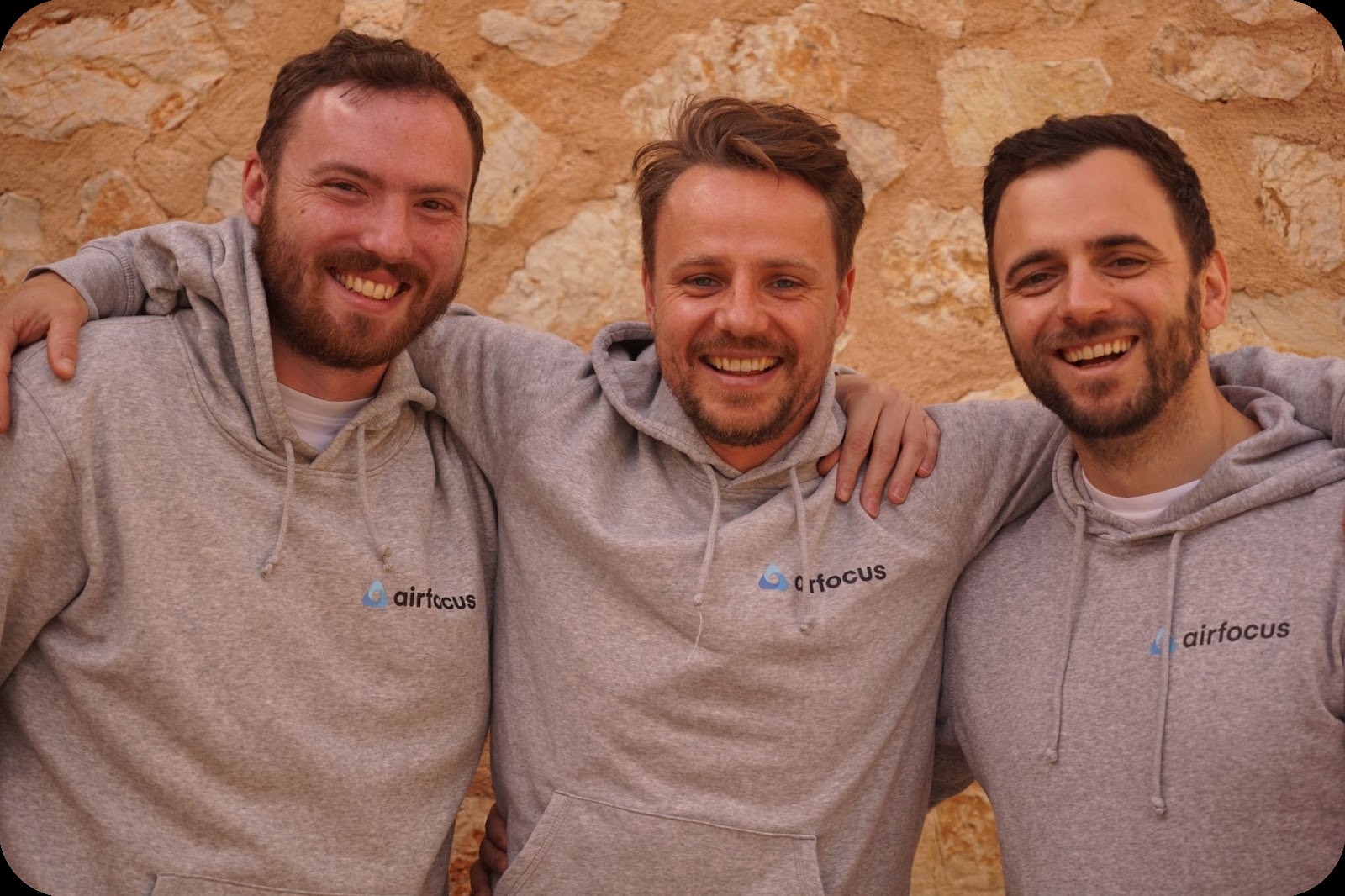
Valentin Firak joined as the third co-founder, bringing marketing expertise. He and Scholz had known each other since high school. In the early partnership, product and engineering experience acquired a counterpart: someone focused on getting the software in front of people who might need it. The company was founded in 2017, and paid plans followed in April 2018.
The side-project phase lasted about eighteen months before the founders committed fully to airfocus with funding. It is a useful correction to the tidy startup montage. The first version could be measured in weekends. Building a business that could support it took rather longer. A prototype is mercifully spared the obligation to send invoices.
A career in the space before delivery
Scholz's earlier work gave him more than an objection to spreadsheets. At ePages, he worked as a senior product manager, overseeing products and features using agile and Scrum methods. His work included moving a shop system toward an open platform, with a developer program, an app store, and a theme store. Product decisions had consequences beyond a single screen.
He earned a master's degree at Otto von Guericke University in Magdeburg. His listed areas of study included management and entrepreneurship, marketing and e-business, and international business. Technology interested him at university; his subsequent career put that interest beside questions about customers, markets, and how organizations choose a direction.
The original airfocus proposition addressed a particular gap. Teams already had tools for managing tasks. Prioritization required gathering information from different people, comparing possible work, and explaining the result. The company offered frameworks and visual roadmaps, with connections to tools teams already used. Scholz was trying to make that earlier stage of work easier to share.
There is a social difficulty buried inside the technical one. Different colleagues know different things. They also want to be heard. A planning process must collect useful knowledge without becoming a permanent committee. A spreadsheet can hold scores, but the scores still need reasons. Scholz's business grew around making those reasons available for discussion.
The customer got larger; the job changed
By January 2024, airfocus announced a $7.5 million funding round led by Newion, with participation from XAnge, Nauta, Riverside Acceleration Capital, and Picea Capital. Total funding stood close to $15 million. The company reported more than 800 customers worldwide, including Caterpillar, The Washington Post, and Orange. The tool conceived around one product manager's frustration was serving rather different workplaces.
Larger customers brought requirements that a simple signup flow could not settle. Scholz added sales support alongside the company's product-led approach. Enterprise work involved permissions, single sign-on, integrations, and more involved buying decisions. The transition happened gradually. The product had to serve its original purpose while accommodating organizations with more people and more dependencies.
The modular architecture reflected those differences. A small software team and a company with multiple product divisions could share an interest in clearer decisions while needing different ways to organize the work. The ambition became a connected system for feedback, priorities, roadmaps, and objectives. Flexibility was part of the answer to a customer base that would not fit one prescribed process.
The founder who left room for “it depends”
Talking about roadmaps, Scholz is willing to complicate the advice. He likes a now, next, later structure, with future problems left open to further investigation. Yet he also accepts that some organizations need timelines. A manufacturer has dependencies that a software startup can avoid. The calendar does not become optional because a product management book has expressed reservations about it.
His approach makes room for a provisional plan. When airfocus began using product objectives and key results, the team initially used objectives without key results for a quarter. Starting with a workable version allowed them to learn without spending all their time perfecting the planning machinery. That detail fits a founder who sells structure but still wants people to get back to work.
He also credits customers with teaching him. His reading reaches into positioning and marketing, including April Dunford's books. In a conversation about tools, he even allowed that a roadmap could live on a slide or a Trello board if it was accessible and current. This is refreshingly awkward advice from someone with roadmapping software to sell. The practical requirement survives the sales pitch.
“I don't know anything, right?”
Malte Scholz, on putting ideas up for discussion
A deal, and the people behind it
Lucid Software announced its acquisition of airfocus on April 3, 2025. The fit joined visual collaboration with structured product management: ideas developed in Lucid's tools could connect to priorities and plans in airfocus. For Scholz, the move extended a business already concerned with the handoffs between different kinds of work.
The acquisition also changed the setting for his product decisions. An independent company could ask what to build next. Within a larger ecosystem, it had to consider how the work fitted alongside other products. A useful feature considered alone could still create friction elsewhere. Integration became part of the decision, carrying both technical and operational costs.
His announcement made room for the people who had built the company. He thanked Hoffmeister and Firak, singled out first hire Julian Tiemann, and remembered a boat trip during a Mallorca team offsite. The detail is pleasantly specific. An acquisition announcement usually has room for a strategy paragraph; this one also had room for a memory shared by colleagues.
Investor Valerie Bures and XAnge were part of the surrounding network. XAnge backed airfocus in 2021 and supported its expansion in France. Scholz has credited early investors with helping him understand financial models and business metrics. The founder who wanted product decisions to draw on distributed knowledge had to learn the same lesson while building his own company.
The hours he tries to keep for thinking
Scholz has described trying to reserve two to three hours a day for conceptual thinking, writing, and planning. He admits the timing and balance remain a work in progress. It is an unusually revealing habit for the founder of a prioritization tool. Even he has to create space for choosing the work rather than merely responding to it.
Positioning is another responsibility he keeps close. He has described himself as a “Chief Product Marketing Officer,” emphasizing the need to understand the customer and the specific problem being solved. Customers arrive with immediate difficulties. A founder's grand future can be a poor substitute for a clear explanation of what the product helps them do today.
He has also acknowledged hesitation about removing features. Software can acquire obligations one release at a time. Retiring work requires a decision as deliberate as adding it. Across these habits, his practical concerns are consistent: fewer distractions, clearer explanations, and a willingness to revisit choices. None makes for a particularly theatrical founder portrait. They do explain how a product manager might continue to recognize himself in the job.
For conceptual thinking, writing, and planning. A stated daily aim, with the balance still evolving.
The bottleneck comes back around
In 2026, Scholz's writing returned to judgment as AI entered everyday product work. He described ambiguous goals, missing context, and poorly documented reasoning as problems that models could amplify. Teams needed to make their constraints and intentions legible. Producing another draft quickly did little to settle whether the underlying decision made sense.
The new airfocus product intelligence platform carries that concern into its software. Its announced capabilities include an agent for exploring connected product data, an Insights agent for analyzing feedback, and an MCP server that gives external AI tools access to structured product context. Strategic drift detection is designed to flag work that moves away from company objectives.
The direction is an extension of Scholz's original problem. Customer signals, strategy, priorities, and delivery need to connect. Faster engineering makes the question of what to build more pressing. A team can now move quickly while carrying an unresolved argument along with it. Speed is helpful, but it does not volunteer an opinion about where to go.
Scholz began by looking for relief from improvised product planning. He helped build a company, recruited colleagues and investors, and carried that work into a larger organization. Now the tools are changing again. Somewhere between a customer's request and the next release, a decision still has to be made. It is familiar territory for him. The spreadsheet has finally found someone to take the job.
“AI has made execution faster”
Malte Scholz, on the changing product bottleneck