The first version of Lucidchart was not a grand declaration about the future of work. It was, in co-founder Ben Dilts’s later description, a prototype that was “mostly working most of the time.” At the end of 2008, he put it online, contacted bloggers, and spent about $100 on ads. Thousands of people registered in two weeks. The signal was blunt: people wanted to draw together in a browser, and the available tools made that harder than it should have been.
That modest test contains most of the Lucid Software story. Ship before the edges are sanded. Watch what users pull from you. Make an old category feel native to a new computing environment. Then keep moving up the organizational chart until the doodle becomes infrastructure.
The diagram escaped the desktop
Dilts had spent years around web graphics and online applications. His bet was technical but easy to understand: diagramming should behave like the web, not like a file marooned on one person’s machine. Real-time collaboration around graphics was unusual then. Microsoft Visio owned the mental category, but its desktop heritage left an opening for a browser-native product that could be shared with a link.
In 2009, Dilts left his day job and returned to Brigham Young University to finish his degree while building the business. He met Karl Sun at a speed-pitching event where founders rotated through tables of potential investors. Sun had spent about eight years at Google, including work on its China office. He wrote an early check, then joined full time as CEO. They formally co-founded Lucid Software in 2010 and worked from Dilts’s student apartment.

“I had my hands on something good.”Ben Dilts, on the first rush of prototype users
The company’s first trick was not drawing rectangles. It was collapsing the distance between making a picture and inviting someone else to change it. A network diagram could pass between an engineer and an operations lead. A product flow could collect comments before the meeting ended. An org chart could stop pretending the boxes were the hard part; the hard part was getting everyone to agree on what belonged inside them.
Lucid sells agreement, then governance
Lucidchart remains the structured half of the business: flowcharts, process maps, UML diagrams, cloud architectures, org charts, wireframes, and data-linked documentation. Lucidspark, launched in October 2020, is the loose half: sticky notes, voting, workshops, retrospectives, and the cheerful disorder before a team chooses a direction. The two meet in the Lucid Suite, where a brainstorm can become a process diagram without being exiled to another vendor.
The customer list ranges from Google, GE, and NBCUniversal to DocuSign, Ping Identity, Western Union, Amazon, Sonos, Jaguar Land Rover, and HubSpot. Lucid says more than 100 million people have used its products in over 180 countries. The statistic that matters to enterprise buyers is 99%: that is the share of the Fortune 500 where Lucid says its software is used.
The business model / utility to infrastructure
The commercial motion is classic freemium SaaS. A person can begin with a limited free plan. Individual and Team subscriptions add premium features. Enterprise contracts bundle Lucidchart and Lucidspark with administration, security, and deployment controls. Specialized accelerators and professional services add larger-ticket work: Cloud Accelerator imports AWS, Azure, and Google Cloud environments; Process Accelerator standardizes official documentation; Enterprise Shield adds tighter control.
That distinction explains why a familiar, approachable canvas can support a sizable enterprise company. The drawing tool gets adopted from below. Governance, integrations, migration, and security get purchased from above. In 2020, Lucid passed $100 million in annual recurring revenue. A year later, it said one-third of revenue came from outside the United States.
The products that did not stay put
Lucid’s portfolio has never been as tidy as the finished diagrams suggest. The company launched Lucidpress, a browser-based layout and brand-design tool, in 2013. Dilts said the point was partly to prove that Lucid’s graphics technology could support more than one application. It could. But in 2021, investment firm Charles Thayne Capital acquired Lucidpress and made it independent. The business now operates as Marq. The expansion was not erased; it was separated.
Lucidscale followed as a way to visualize sprawling cloud estates. In 2025, Lucid began moving those capabilities into Cloud Accelerator. Again, the job survived while the packaging changed. Cloud teams did not merely need a picture of what existed. They needed repeatable documentation, audit artifacts, standardized blueprints, and a way to plan what should exist next.
Then came airfocus. Customers had been asking Lucid for roadmapping and product portfolio management. Lucid experimented with related features but reached an unusually candid product conclusion: a roadmap needs rigid structure and must serve as a system of record, while a visual canvas earns its keep through flexibility. Rather than make one interface impersonate the other, Lucid acquired airfocus in April 2025. The price was not disclosed.
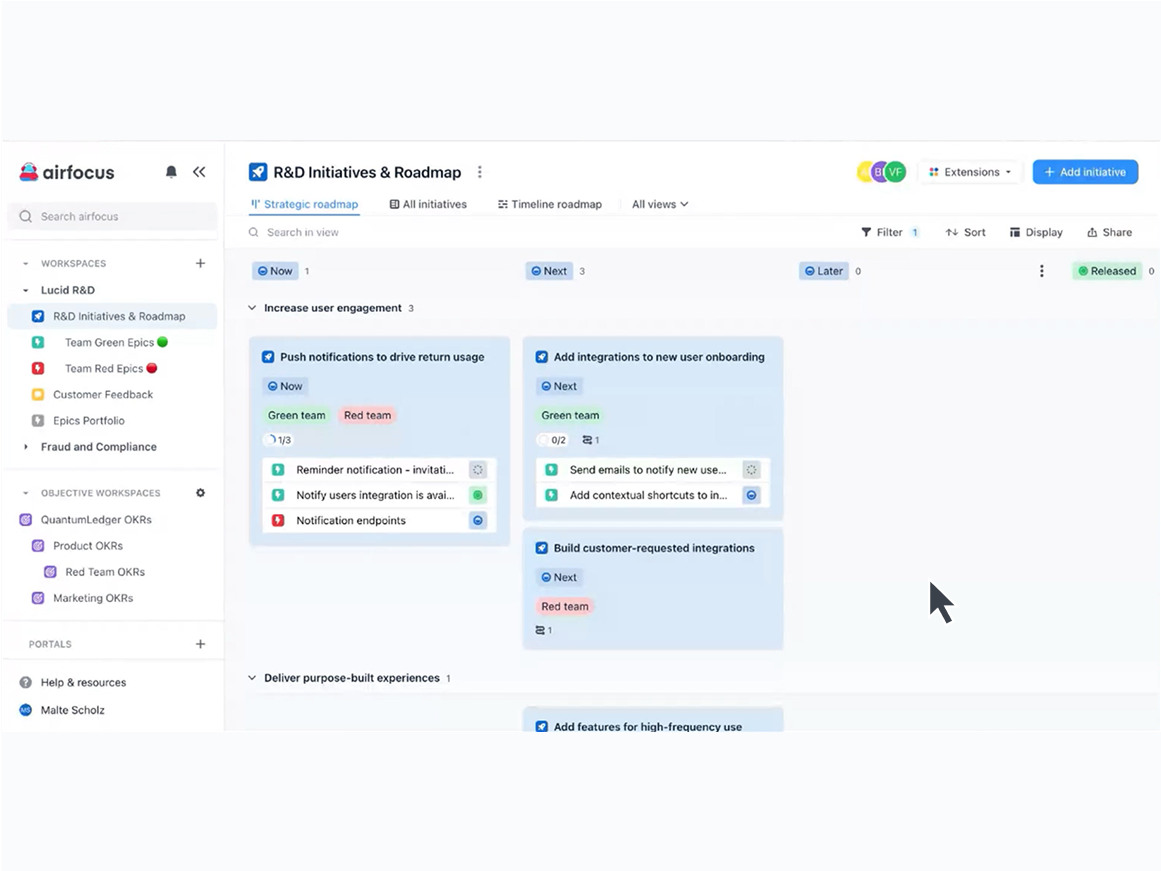
A crowded canvas, with sharper edges
Lucid sits across several markets that overlap without becoming identical. Visio is the established alternative for formal diagramming, especially inside Microsoft estates. Miro and Mural are facilitation-first whiteboards. FigJam is close to designers. SmartDraw, Creately, Whimsical, Cacoo, and diagrams.net cover different combinations of price, polish, and complexity. Airfocus also puts Lucid beside Productboard, Aha!, and Jira Product Discovery.
Formal diagram
Lucidchart, Visio, SmartDraw. Precision, standards, architecture, documentation.
Workshop canvas
Lucidspark, Miro, Mural, FigJam. Facilitation, ideas, voting, shared motion.
System of record
airfocus, Productboard, Aha!. Priorities, roadmaps, portfolios, decisions.
Connected suite
Lucid’s pitch: move between all three without losing the argument along the way.
Lucid’s advantage is breadth with connective tissue. Its integrations with Google, Microsoft, Atlassian, Salesforce, Slack, and major cloud platforms put visuals inside work people already do. A Google Workspace integration user, Lucid says, shares 25% more documents with colleagues. That is less glamorous than a new drawing feature and more useful as a distribution strategy.
Its weakness is the mirror image. A specialist can beat a suite on a narrow task. Visio can suit deeply standardized Microsoft shops. Miro can feel more natural to facilitation-heavy teams. A free diagrams.net file may be enough for a small, occasional job. Complex, layered diagrams can also become slow or unwieldy, and any visual document can turn into decorative archaeology when nobody owns the update.
Now the canvas wants to brief the machine
By 2025, Lucid had adopted a broader phrase for its market: work acceleration. The language risks sounding like enterprise perfume, but the product direction is concrete. It launched Cloud and Process Accelerators, expanded scenario and capacity planning, and pushed artificial intelligence across the suite. Users can generate a board from a prompt, summarize a canvas, sort ideas, and ask a Process Agent to draft or critique documentation.
The more consequential move is Lucid’s Model Context Protocol server. It lets compatible AI clients search, retrieve, summarize, create, edit, and share Lucid documents. In April 2026, the company launched a Claude connector using that bridge, including support for Claude Code. The premise is that the valuable part of an old diagram is not the JPEG-like surface. It is the organizational context underneath: which systems connect, why a process changed, what a team rejected, and who owns the next decision.
This is a plausible answer to a current enterprise problem. AI assistants can draft quickly but often lack the specific history that makes a draft correct. Lucid already holds some of that history in visual form. If it can keep the permissions intact and the documents current, the canvas becomes a memory layer. If it cannot, AI will merely automate the production of more confident-looking stale diagrams.
Prototype demand, then a company built around browser-native collaborative graphics.
$100 million ARR, Lucidspark, and a $3 billion valuation during the remote-work surge.
Airfocus arrives; Lucid reframes the suite around work acceleration and governed transformation.
MCP and AI connectors turn diagrams from destinations into context that other tools can use.
The useful bits to steal
Lucid’s story offers a practical sequence, not a motivational poster. First, Dilts tested pull with a product rough enough to embarrass a perfectionist and an ad budget small enough to fit on a dinner receipt. Second, the company made collaboration part of the object itself, not a feature bolted on later. Third, it treated integrations as distribution. Finally, it learned that enterprise value lives in control, continuity, and shared context, not merely in a friendly interface.
Test the pull
Put a functioning wedge in front of strangers. Measure unsolicited use before scaling the story.
Ride the workflow
Connect to the tools customers already open. Integration reduces the cost of changing behavior.
Respect the data model
Do not force a flexible canvas to become a rigid record. Acquire or specialize when the job changes.
The conditions matter. This approach works when the product becomes more valuable with collaborators, when a free user can invite colleagues, and when enterprise administrators eventually need governance. It is weaker when work is solitary, switching costs are negligible, or the existing suite already does the job well enough. Visuals also need owners, live data, and a place in recurring decisions. Without those, clarity has a half-life.
Lucid has spent 16 years turning pictures into shared work. The next chapter asks whether those pictures can also become usable context for machines. It is a bigger claim than diagramming, but it comes from the same observation behind that $100 ad test: people do not struggle to make boxes. They struggle to see the same thing.