Karl Sun’s first contribution to Lucid’s working week included pizza. He had left Google, was living in Utah, and had become interested in a piece of software built by Ben Dilts, a university student. Sun signed on as an adviser. Once a week, he brought food. It was an agreeable way to investigate a business opportunity, with the additional advantage that everyone could eat the evidence.
The arrangement became more serious. Sun became an early investor, then co-founder and CEO. Dilts’s diagramming tool became the foundation of Lucid Software. And the adviser who had initially expected to observe from nearby found himself helping build an organization whose daily operations he would eventually entrust to someone else.
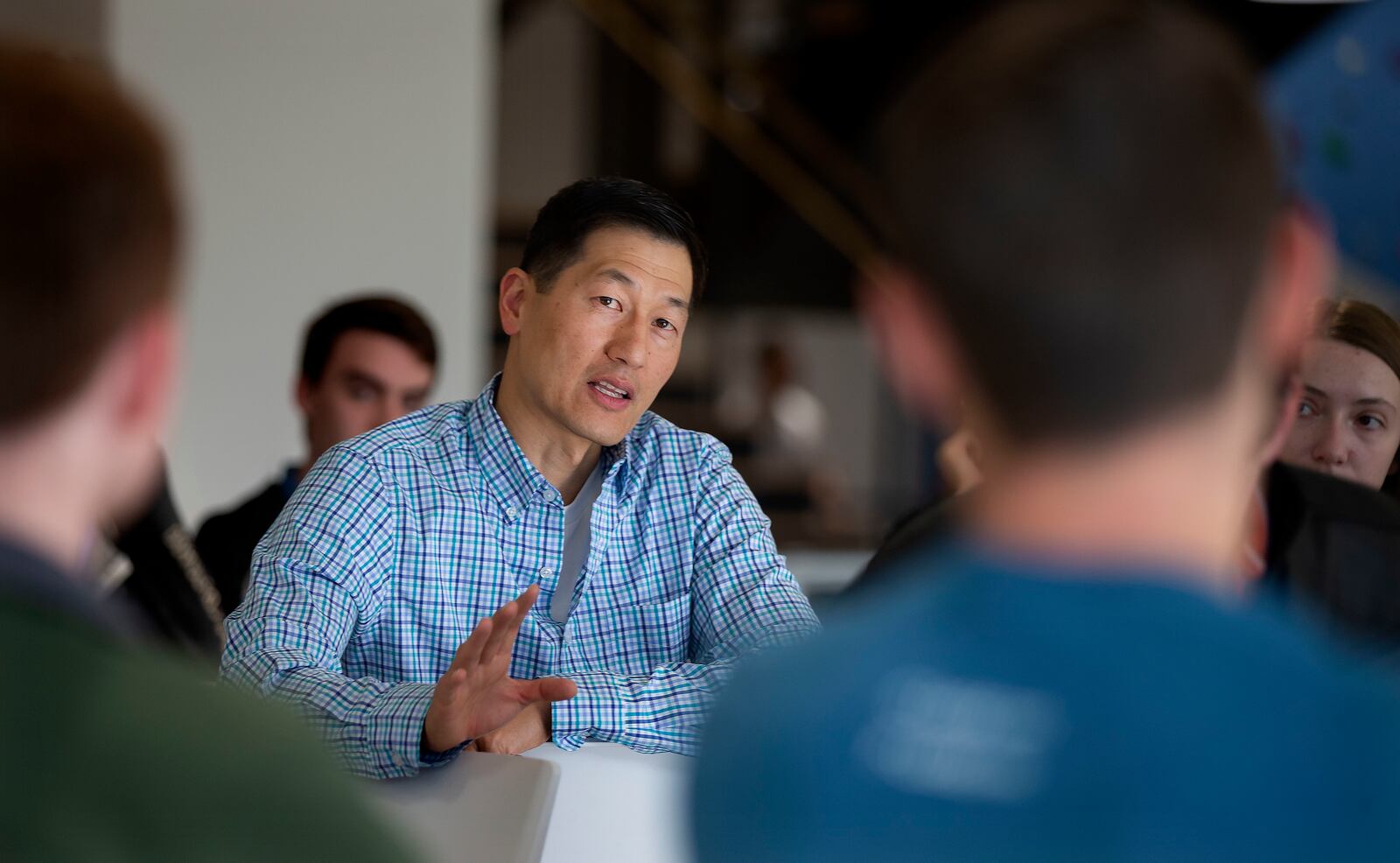
In March 2026, Sun sat down with Dilts and their colleague Dave Grow to revisit those beginnings. The weekly pizza delivery was still part of the story. So was a question that runs through Sun’s career: once you recognize something promising, how do you find the people who can carry it further than you could alone?
An adviser, with extra cheese
Sun and Dilts connected through a speed-pitching event, the entrepreneurial equivalent of a room full of first dates conducted over spreadsheets. Dilts had a working version of Lucidchart. Sun could see a practical use for it: colleagues could draw, examine and change a diagram together through a browser. A process that had involved versions and attachments could happen on a shared canvas.
At first, the surroundings offered little competition for the product. The early team worked in Dilts’s student apartment near Brigham Young University, then in a rented basement. A recognizable corporate address would have to wait. In 2017, Sun recalled that he had gone without a salary for a year. His involvement required more than being impressed at a demonstration.
The attraction makes sense in light of what he had just experienced. Google had shown him software delivered through the browser, updated continuously, available to colleagues working together. Dilts had made that prospect tangible in another category. Sun had enough experience to understand the opportunity and enough curiosity to exchange a familiar organization for a very small one.
He also had a less polished detail to contribute to the founder biography. Asked for a fun fact in 2019, he offered this: “I failed my first three tests in college.” It is a pleasing interruption to a résumé otherwise rather well furnished with degrees. Even an impressive academic record can begin with an uncomfortable afternoon looking at a marked paper.
Long before patents or software, Sun had reclaimed usable bricks from demolition piles, bagged groceries and worked at a summer camp for teenagers. He drew different lessons from the jobs: finishing necessary work, serving a customer properly, watching people with different talents make something together. The first also left him appreciative of air conditioning. These are ordinary experiences to set beside MIT and Harvard, which is part of their appeal. They give his interest in teams a history outside conference rooms, and give the polished career story a little welcome dust.
A different kind of Google credential
Sun’s preparation crossed several disciplines. He earned bachelor’s and master’s degrees in electrical engineering and computer science at MIT, another MIT master’s in technology and policy, and a law degree at Harvard. He practiced law before joining Google. Technical questions, legal questions and organizational questions were already sharing space in his working life.
At Google, which he joined in 2002, he established the patent department. By 2005, he was leading business development for its China division. Later came work on renewable energy investments at Google.org. These were different ways of helping an organization build beyond its existing boundaries: protecting inventions, opening relationships in a new market, examining technologies that might become businesses.
Utah entered the story before Lucid. Sun moved there in 2007 while still working for Google. When he and Dilts began building their company, the decision to stay was deliberate. Some prospective investors wanted a move to the Bay Area; some made relocation a condition of investing. The founders kept the business in Utah.
Family and Dilts’s university ties mattered. So did Sun’s belief that the region offered talent and room to concentrate. There is something revealing in that choice. He had worked inside a company associated with Silicon Valley’s possibilities, yet he did not conclude that every new company needed the same geography. Experience gave him a comparison to make, rather than a location to copy.
The interview that never left his calendar
The habit Sun did carry over was an attention to recruiting. He had been impressed by the people he met while interviewing at Google, before he fully understood the company. At Lucid, he wanted candidates to encounter colleagues who would give them a similarly compelling reason to join.
He kept meeting new hires himself as the business grew. In his account of recruiting, the point was to maintain a shared standard across managers. A sales leader and an operations leader could both be enthusiastic about candidates for quite different reasons. His involvement let those judgments meet in one place. It also made recruiting visible as work deserving the chief executive’s time.
“Hiring is the most important part of what I do.”
Karl Sun, writing in 2017
That policy had a cost. Every interview occupied time that could have gone to another decision. Sun’s argument was that trusted colleagues would make those other decisions possible. Delegation depends on the judgment of the people receiving the work. His approach put considerable effort into choosing them before expanding their freedom.
He was willing to spend on relationships after hiring, too. A small team’s outings grew into company retreats. In 2017, he described preparations to take nearly 300 people to Bear Lake. The logistics had become considerable. Customer support still needed coverage. Work still arrived. The company had to weigh the expense against the value of colleagues knowing people beyond their immediate teams.
Smaller traditions needed adjustment as well. Taking everyone out for burgers when a new employee arrived eventually exceeded the restaurant’s seating capacity. Growth had produced a wonderfully literal management problem: the team no longer fitted around the table. Team activity budgets offered another way to keep the conversations going.
A product that could introduce itself
Choosing people was one part of Sun’s job. Finding customers required a different sort of introduction. Lucidchart’s free offering let someone begin using the product before a company-wide purchasing decision. When enough colleagues found it useful, there was an opening for a conversation about bringing those users together in an enterprise account.
Pearson became Lucidchart’s first enterprise customer in 2012. Serving an organization at that scale required changes to administration and user systems. A product that worked for a smaller group needed the machinery to support a larger one. Success brought engineering work with it, a useful corrective to the idea that a popular free tool simply grows into a corporate business by itself.
- 01TryOne person finds a use
- 02ShareColleagues work together
- 03OrganizeAn enterprise account connects them
Sun also brought a goal-setting habit from Google: objectives and key results, or OKRs. They gave teams a way to connect ambitions with measurable outcomes. He described them as a defense against the chief executive’s bottomless collection of tasks. Being busy provides excellent cover for avoiding the question of whether the right work is getting done.
In spring 2020, he set a particularly concrete challenge: build and launch a virtual whiteboarding application in less than five months. The team had considered the idea before. Now Sun wanted it delivered. Lucidspark would give teams room for brainstorming and early ideas alongside Lucidchart’s more structured diagramming.
The distinction matters to the ambition behind the company. A diagram can explain a process already understood. A whiteboard can help people discover what they think in the first place. Lucid was trying to participate in more of that working conversation, including the messy portion before anyone had agreed which boxes belonged where.
Lucid’s company valuation in a secondary investment of more than $500 million.
The colleague at the other end of the table
The next consequential change involved Sun’s own job. On April 13, 2022, Lucid announced that Dave Grow would become CEO, with Sun continuing as board chair. The transition followed discussions over several years. Grow had joined in 2010 and accumulated responsibilities across product, strategy, revenue and operations. Sun could assess him through years of working together.
Grow remembered the original assignment as “figure out and grow the business.” That job description had proved remarkably elastic. He also recalled conversations in the basement about reaching a billion users. The number described their ambition. The smaller decisions, including who would answer questions, build departments and take responsibility, were how they attempted to move toward it.
Sun’s announcement carried mixed feelings. He looked forward to having more time and expected to miss the daily company of the team. His continuing board role gave the transition a practical shape: a change in responsibility within an institution he had helped create. The founder could remain involved while someone else made the daily decisions.
His later biography includes advising startups and research groups, alongside board service with SSP International and The Nature Conservancy’s Utah chapter. There are new settings in which experience can be useful. The 2026 reunion with Dilts and Grow also suggests how much of the Lucid story belongs to a continuing conversation among colleagues.
The pizza anecdote survives because it catches Sun before the titles hardened. He saw a working product, kept returning and gradually accepted more responsibility. Years later, he could look across the company and recognize someone ready to accept his. For a founder so attentive to choosing people, that was a substantial decision to be able to make.