The revealing object in Mark Abbott’s story is not a pitch deck, a term sheet, or even a piece of software. It is a damp document pulled from a flooded basement. Abbott had come home after heavy rain to find water among boxes from his earlier career. In the wreckage was a vision paper he remembered writing around 1996. Its horizon was 2020. It mapped culture, structure, growth, and the divisions a company might someday build.
Long-range business plans tend to age like formalwear: impressive in their moment, slightly comic later. This one mattered because it showed Abbott had been worrying at the same questions for decades. How does a group of people agree on where it is going? What makes a company coherent as it grows? Why do sensible adults, presented with the same facts, so often pull in different directions?
By the time that paper was written, Abbott had already spent years close to corporate distress. He began at Continental Bank in 1982, working through the consequences of loans and companies that had gone wrong. He moved to Heller Financial, where he helped build and later run a commercial finance operation. Private equity followed. Across more than 100 investments and dozens of boards, he saw the costumes change while the plot remained stubbornly familiar: an unclear destination, a weak plan, little agreement about performance, and too much knowledge stranded inside individual heads.
The book that somebody else wrote
In 2005 Abbott conceived an answer: write a book and build software for the basic disciplines of company building. He did not rush to a keyboard. Other work intervened, including a proposed chief executive role at a new finance company. Then he found Traction, Gino Wickman’s book about the Entrepreneurial Operating System, or EOS. The awkward discovery was that another person had already written a version of the book in his head.
Abbott’s response was characteristic. He entered the system rather than orbiting it. In 2012 he became EOS Implementer number 33, coaching leadership teams and attending the community’s quarterly gatherings. He pitched Wickman on software. The initial answer was that software was not EOS Worldwide’s natural business. Abbott stayed. For roughly four years before launching the product, he learned the users, vocabulary, habits, and fault lines of the market.
The patient route to a software company
Patience did not protect the idea. Abbott talked about it freely within the community, and the concept traveled to a software company that produced a rival first. In most founder folklore, this is the point when the hero learns secrecy. Abbott learned something more useful: arrival order and durable advantage are not the same thing. Ninety launched in 2016 as an EOS-compatible platform and later secured an official trademark license. The coaches he had worked beside became product critics, advocates, and a distribution channel.
The early numbers have the pleasing economy of a garage story, even though the garage here was a professional network. About $500 a month in Facebook advertising helped Ninety find self-implementing EOS companies. Coaches carried it further. Revenue funded the operation until the company had passed 1,000 customers and 50 employees.
The acceleration problem
In 2021 Insight Partners invested $20 million. Abbott had deliberately waited until he believed Ninety could command a valuation around $100 million, a private equity veteran’s way of buying growth while limiting dilution. Two years later, Blue Cloud Ventures led a $35 million Series B with Catalyst Investors and Insight participating. Ninety said the round valued it above $200 million. At the time, annual recurring revenue was approaching $25 million, following growth of more than 80 percent year over year.
Capital arrived in two large steps
Money is a potent accelerant and a poor referee. Ninety hired quickly. Experienced executives arrived carrying playbooks polished elsewhere, which meant they also arrived carrying different assumptions about pace, decision-making, and culture. Abbott later called the resulting leadership dynamic “a mess.” The company had created software to establish a shared operating language, yet its own leaders were speaking in competing dialects.
This is where Abbott’s story ceases to be a demonstration and becomes a test. His long career had supplied pattern recognition. It did not grant immunity. People who were admirable colleagues could still be wrong for a job that had changed beneath them. Leaders could mistake kindness to their teams for stewardship of the enterprise. Employees could sit quietly with too little useful work because no norm required them to raise the alarm.
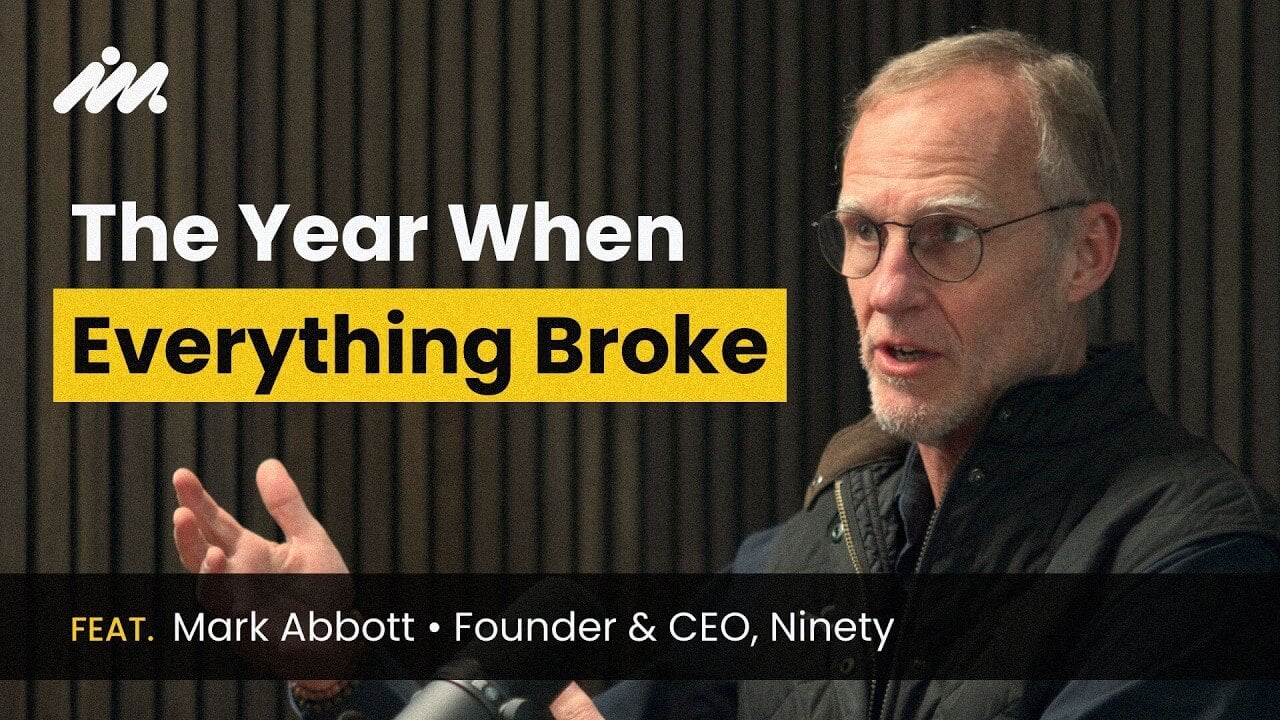
His answer became a compact phrase: “succeed or escalate.” Finish what the organization needs, or move the obstruction to somebody who can resolve it. It sounds almost insultingly plain. Many good management rules do, right until a deadline meets a hierarchy and everyone decides silence is safer.
The reckoning included reductions in force. Abbott has said the first was handled in a way he would not have chosen, though he allowed it to proceed. He regretted that choice. A later round demanded more direct founder involvement. He also named other mistakes, including a payments decision and a new commercial model. The specificity matters. “Lessons were learned” is corporate incense; naming the decisions opens a window.
Crossing out “great”
By 2026, an interview described Ninety at roughly $44 million in annual recurring revenue and more than 18,000 customer companies. It had also made the Inc. 5000. The occasion invited the usual founder retrospective: a clean staircase of conviction, sacrifice, and reward. Abbott began writing one, then stopped at a sentence saying he was proud not only of the growth but of how the company had grown. In the margin, he wrote: “I’m not.”
He went further. There had been months when he hated his company, an uncomfortable admission from someone whose stated mission is to help founders build companies they do not end up hating. He crossed the word “great” out of another passage and replaced it with three less ornamental qualities: curious, earnest, and humble. Greatness, he argued, is too often survivorship dressed as advice.
There is still plenty of the systematizer in him. Abbott publishes Founder’s Framework, hosts long conversations about culture, capital, leadership, and artificial intelligence, and speaks in taxonomies. He compares a company to a house whose vision, plans, tools, and disciplines must fit together. He describes good organizations as places where one plus one plus one can equal five. Ninety has been developing Maz, an AI assistant intended to help teams find useful signals inside their operating data.
But the more interesting development is not another framework. It is the willingness to show where frameworks end. A scorecard can report that growth missed the plan. It cannot absorb the moral weight of laying off good people hired for growth that did not arrive. An organizational chart can define accountability. It cannot make a founder intervene at precisely the right moment. Software can keep a meeting honest only if the people in it prefer truth to comfort.
A longer measure of a company
Abbott now writes about legacy founders and companies built to outlast their creators. It is a natural horizon for someone who once drafted a 24-year vision and kept the wet pages. His aspiration is larger than efficient meetings: companies that are productive, humane, and resilient, places where work carries meaning and where stakeholders share enough reality to build together.
The biography offers no tidy proof that the method works. It offers something better: a practitioner still revising it. Banking taught Abbott to study failure after the fact. Investing let him watch patterns repeat. Coaching placed him in rooms where plans met personalities. Software turned those observations into a product. Growth then sent the lesson back with corrections in red ink.
Four decades after his first job, Abbott remains occupied by the old question: why is this so hard? Ninety is his answer, but his candor supplies the footnote. Companies are built from systems, incentives, capital, and code. They are also built from people who delay hard conversations, remain loyal past usefulness, import old playbooks, and occasionally recover a waterlogged plan that reminds them how long they have been trying. Alignment is not a destination. It is the work that returns every Monday morning.