The bank job was waiting. Renaud Charvet had studied finance at ESCP in Paris and was preparing to enter the sensible world of financial services. Jean-Samuel Najnudel, a classmate with a taste for telecom and unfinished ideas, asked him to choose something less sensible. Najnudel wanted to build a business. Charvet listened. In 2005, the two became equal partners, pooled their savings and began selling inexpensive international calls.
There was no grand unveiling, no category waiting to be conquered, and very little that looked like modern software. The pair worked through the useful mechanics of business communication: fax-to-email, audio conferences, virtual switchboards, inbound call management and a service that could send a caller directly to voicemail. Their company learned by touching the pipes.
Then the pipes moved. Skype, Viber and WhatsApp made parts of the early proposition feel old with startling speed. An entrepreneur can respond to that kind of change by polishing yesterday or by admitting tomorrow has arrived. Charvet and his partners turned toward calls made through the web. The eventual product would be Ringover, but first came years of engineering and the rather character-forming experience of being early, wrong in places, and still in business.
The education after business school
Charvet's formal education was in finance. His practical one came from watching communications technology destroy and recreate its own market. The partnership with Najnudel lasted because the roles were complementary. Najnudel gravitated toward telecom and technical questions. Charvet handled marketing and relationships with carriers. Ludovic Rateau, a networks and infrastructure specialist, later joined them and pushed for a new generation of business telephony suited to remote work, mobility, coworking and freelancing.
The founding question was plain: why should the user carry the difficulty created by the technology? Charvet put it neatly: “We always thought that efforts in tech should be with the developer, and not with the customer.” It is the kind of line that sounds obvious until one encounters a phone system designed as revenge.
In 2013, the team began working with WebRTC, the technology that makes real-time audio and video possible in a browser. The Ringover project took shape around 2015. Commercial sales followed in 2018 after more than three years of development. The delay was not accidental. The founders had elected to build the telecom platform in-house instead of presenting a polished interface over rented machinery.
“Focus - it might feel slower in the short term, but it compounds much faster in the long term.”Renaud Charvet, 2026Built, not assembled
The expensive part became the advantage
Owning infrastructure is an unromantic decision. It consumes time, money and attention before a customer can admire anything. For years, it can make a company look slower than rivals who buy the underlying service and hurry to market. Charvet accepted that bargain. Control of the network meant control of call quality, data handling, product integration and the pace of technical change.
This choice became more valuable as the product widened. Ringover grew from browser calling into voice, text messaging, video, team messaging, analytics, coaching and integrations with customer relationship management and applicant tracking systems. A call was no longer merely a sound traveling between two people. It was an event inside a workflow, attached to a customer record and capable of leaving useful evidence behind.
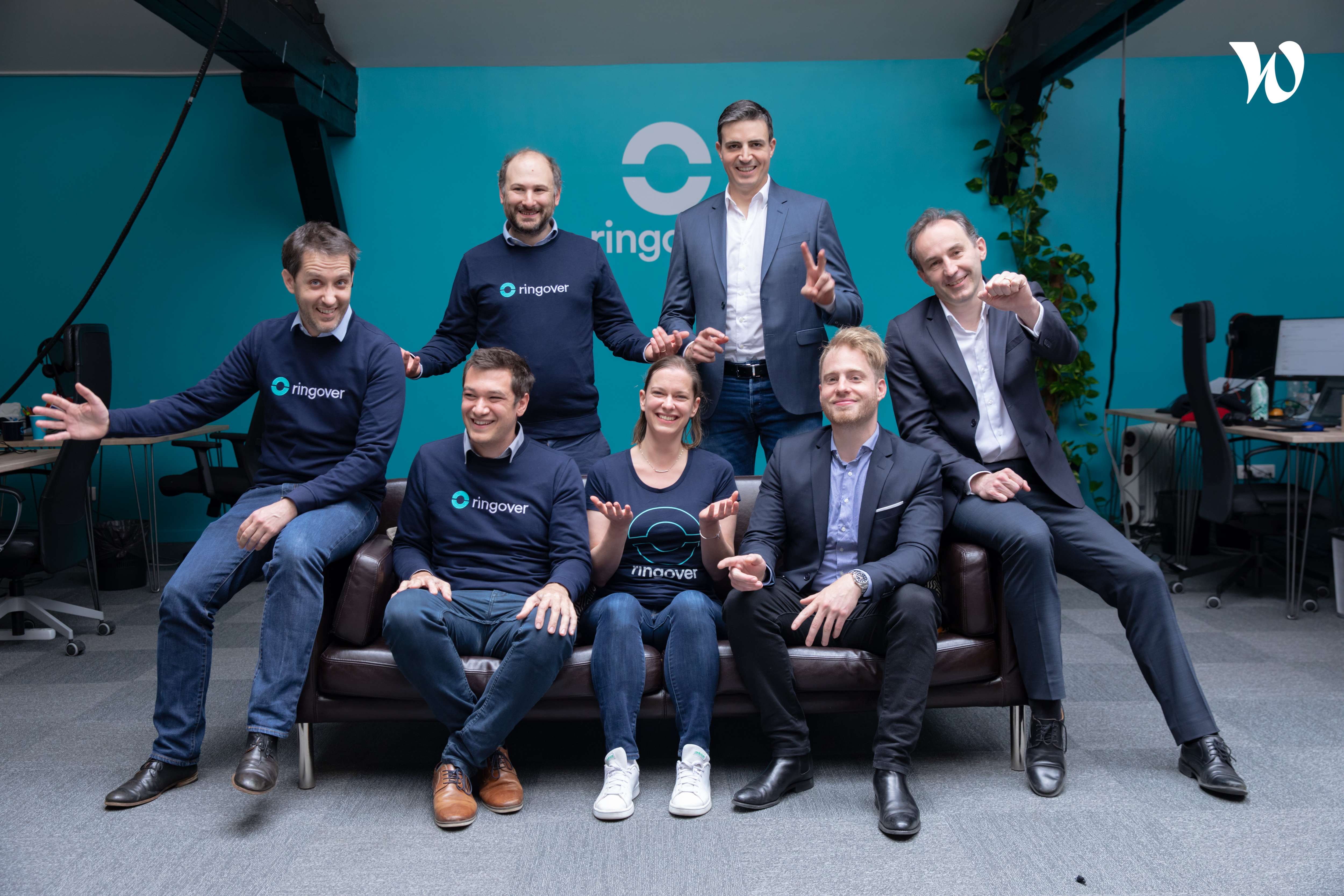
The founders also resisted another fashionable shortcut. Ringover remained profitable and self-financed for roughly 15 years. In 2021, it accepted €10 million from Expedition Growth Capital. A €20 million Series B followed in 2023, led by Orange Ventures and Bpifrance's Large Venture fund. Charvet's rule was not hostility to capital. It was timing. Money made sense when the company had an in-house platform to improve and countries to enter.
Capital changed the scale of the management problem. Ringover began 2020 with about 40 employees and reached 125 by January 2021. It later grew past 300 people across Paris, Atlanta, Barcelona and London. Charvet's answer to fast hiring was less theatrical than the numbers: look for skill and attitude, keep existing managers connected to the mission, and communicate when colleagues no longer share an office. Software can make geography disappear on a dashboard. Organizations remain stubbornly physical collections of habits, misunderstandings and people wondering whether their work matters.
Reported recurring revenue, as the platform traveled
Atlanta and the discipline of being unknown
International expansion has a cruel little joke in it: your history crosses the ocean, but your reputation may not. Charvet moved his family to the United States to lead Ringover's American effort. He chose Atlanta because of its position as the commercial hub of the Southeast, its concentration of major companies and its access to a growing technology community. In 2021, the local team was a dozen people. The European record bought them a story to tell, not a market to own.
The American strategy sharpened around staffing and recruiting. It was a practical niche. Recruiters live on calls and messages, yet the valuable context often leaks between a phone system, a CRM and an applicant tracking system. Ringover could connect those records, reduce manual logging and make conversation data usable. Partnerships with Bullhorn, Avionté, TempWorks, Loxo, Crelate and Vincere gave the focus an ecosystem.
A 2024 change in leadership clarified the division of labor. Rateau, the technical co-founder who had created the Ringover platform, became chief executive of the wider group in September. Charvet continued as co-founder and CEO of Ringover's U.S. business. The handoff put product development and international strategy under Rateau while leaving Charvet close to the American market he had crossed an ocean to learn. Founder stories often treat the chief executive title as a crown. Here it behaved more like a tool: useful in the hands best placed for the next piece of work.
Charvet's public work followed the same direction. He hosted French Tech Atlanta gatherings, built relationships across the staffing community and promoted The Staffing Ring podcast, where operators discuss the untidy meeting point of people, process and software. His recurring theme is that automation should clear clerical work away from a relationship rather than impersonate the relationship itself.
A human boundary for artificial intelligence
By 2025 and 2026, Ringover's product language had shifted decisively toward conversational AI. AIRO Coach offered prompts and guidance during calls. AIRO Voice handled standard inquiries and passed unusual ones to people with context intact. Pitch Room let employees rehearse calls with an artificial counterpart before speaking to a real one. In February 2026, the company said it had crossed $50 million in annual recurring revenue.
Charvet described the operating principle without dressing it as magic: “Let AI take care of routine tasks at scale, let people focus on complex, high-value conversations.” The sentence places a boundary around the machine. Before the call, software can assemble context. During it, software can surface a useful prompt. Afterward, it can transcribe, summarize and find patterns. The judgment inside the difficult exchange still belongs to a person.
This is a continuation of the old idea rather than a fashionable detour. In the fax-to-email years, the aim was to remove physical friction. With browser calling, it was to remove hardware. With integrations, it was duplicate entry. With AI, it is the blank page before a call and the administrative debris after one. The technology changes. The burden keeps moving away from the user.
“Let AI take care of routine tasks at scale, let people focus on complex, high-value conversations.”Renaud Charvet, February 2026The long stroke
A rower's preference for pace
There is one biographical detail that would feel too convenient if Ringover had not published it itself: Charvet was a French Grandes Écoles national rowing champion. He later compared company building to a marathon, choosing a runner's metaphor for a rower's career. Both sports are intolerant of wasted motion. Both punish the athlete who mistakes an early lead for the finish.
His record suggests a temperament more interested in compounding than spectacle. He stayed with the same broad problem for two decades. He built with the classmate who diverted him from banking. He waited to raise outside capital, then used it for product and geography. When the group structure changed in 2024 and Rateau became group CEO, Charvet continued as co-founder and chief executive of the U.S. operation. The title narrowed. The American assignment did not.
Ringover's story has tidy numbers now: more than $50 million in recurring revenue, hundreds of employees and operations on both sides of the Atlantic. The numbers can make the route appear inevitable. It was not. The route ran through consumer apps that erased an early advantage, years of invisible infrastructure, a delayed product launch and an overseas market that had no obligation to care.
The more revealing achievement is continuity without rigidity. Charvet kept the problem and changed the product. He kept the partners and changed the roles. He kept the belief that communication should be easier while expanding what a conversation could leave behind. The bank job remains the clean alternate life. The chosen one is messier, longer and considerably more interesting.