Ken Yeung had built the sort of software that makes complexity look respectable. At Saxo Bank, he worked on systems carrying price updates and trades, and helped develop SaxoTraderGO, a cloud platform that opened a window onto 37 stock exchanges. The machinery was fast, consequential and mostly invisible to the person tapping a screen. It was excellent preparation for a career in software. It also taught him a dangerous lesson: difficult technology feels like progress even when the buyer is taking months to say yes.
By 2016, Yeung had left the bank, passed through Entrepreneur First in London and co-founded Quantize Analytics. Back in Hong Kong, an angel investor introduced him to Bianca Ho. Yeung was looking for someone with business instincts to complement his technical background. They entered a hackathon together, won an award and funding, and turned the experiment into Clare.AI, a company building conversational assistants for large institutions.
The product spoke the language of the moment: machine learning, natural-language processing, industry-specific assistants, support for Asian languages. Its clients included JPMorgan and Fidelity. On paper, Clare.AI had pedigree. In practice, its bank customers had procurement calendars long enough to acquire their own weather.
We had a choice: Change or go bust.Ken Yeung, recalling Clare.AI's turning point01 / The expensive virtue of subtraction
The wrong answer was working
Yeung has described the company as running out of money while banks took their time. The awkwardness was not a broken demo or an absent market. It was a mismatch between an elaborate product and the speed at which a young company needed customers to decide. Clare.AI could be technically convincing and commercially stranded at the same time.
A WhatsApp partnership exposed another market. Smaller companies were already trying to sell, support and notify customers inside chat. Their problem was less glamorous than advanced banking AI and easier to recognize: too many conversations, too few hands, and no sensible way for a team to share the work.
Large banks
Long sales cycles
Complex implementation
Small and medium businesses
Self-serve logic
A repeatable product
In 2019, the founders began developing a WhatsApp product line. Wati officially launched in 2020. Its first crew was almost comically lean beside the problem: a few developers, one project manager, outsourced design and marketing support found through Fiverr. The constraint forced a useful discipline. Each feature had to explain itself. A business could place several employees in one inbox, route messages, save responses, tag contacts, send notifications and automate routine exchanges without first becoming an AI laboratory.
Yeung's summary of the discovery is blunt: businesses wanted an easy way to talk to customers. WhatsApp was already open on their phones. The innovation lay in turning familiar behavior into a dependable company workflow.
The complement in the room
The Wati story can be told as a clean product pivot, but clean stories usually conceal the people who argued their way toward the answer. Ho has said she initially doubted the economics of serving small customers, who would each pay much less than a bank. Yeung saw what he called a broad open market. Enquiries from smaller businesses after the WhatsApp partnership helped settle the debate.
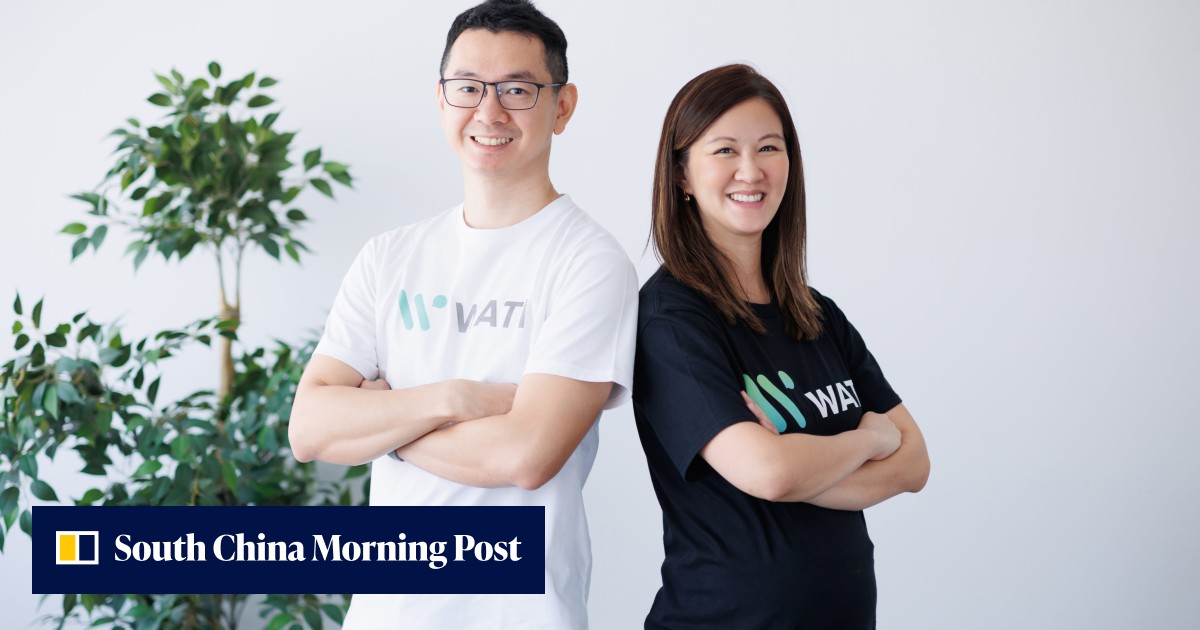
Yeung has written that the difference is the point. Ho's business judgment affects product strategy; his technical background pulls in another direction; their aligned goals keep the argument useful. He also credits her with the less visible benefit of a co-founder: someone who can challenge an idea, maintain accountability and absorb the peculiar loneliness of making decisions before evidence arrives.
Their first hackathon now looks like a miniature of the company they built. A bounded problem. A deadline. Two sets of instincts. An outcome concrete enough for outsiders to fund. Founding myths often involve sudden revelation. This one began with an introduction and a trial run.
Making things simple is... not simple.Ken Yeung on the product lesson behind Wati03 / Growth without the tidy line
The graph bends because the company did
Wati's early customer counts show what repeatability can do. Within roughly a year of launch, an investor profile reported more than 1,000 customers across 54 countries. By October 2022, Yeung told the South China Morning Post that Wati had 6,000 customers in 78 countries. In a four-year reflection, he put the cumulative figures above 10,000 customers and 160 countries. Peak XV now describes more than 16,000 businesses using the platform.
Four public snapshots of reach
Customer totals are selected figures published at different points, not audited annual series. They show scale, not a precise growth rate.Capital followed. An $8.3 million Series A led by Sequoia India arrived in 2021. In 2022, Tiger Global led a $23 million Series B, joined by existing investor Sequoia India and Southeast Asia, later renamed Peak XV, plus DST Global Partners and Shopify. Two years later, Forbes Asia included Wati in its 100 to Watch list under Enterprise Technology & Robotics.
Yeung does not describe the route as a victory parade. His public writing lingers on doubt, failure, confused team dynamics and the founder's disappearing control over time. He says every failure taught him something about product, market or himself. The useful note is not confession for its own sake. He keeps turning the discomfort into operating advice.
A speed dial for hard days
One of Yeung's more revealing stories is about a beer, a metric and a founder community. Four years after joining Surge, Peak XV's accelerator, he recalled believing Wati's growth was slow because he was using a conventional benchmark. Another founder suggested the market demanded a different definition of traction. Wati changed the metric, and Yeung says the trajectory made more sense.
The anecdote fits his engineer's suspicion of dashboards without context. A number can be accurate and still produce a poor decision. He now argues that founder communities remain useful after product-market fit, when a company has more data but fewer people with whom its leader can speak plainly. Surge stayed, in his phrase, on speed dial.
Mentorship appears elsewhere in his outlook. Yeung has written that he once believed technical skill and effort were sufficient. Experience changed that view. Mentors supplied perspective, accountability and access to people who had already survived a version of the same mess. As CEO, he says he tries to return the favor by mentoring people inside Wati.
This emphasis softens the familiar portrait of the solitary technical founder. Yeung's career is full of systems, but the turning points arrive through relationships: the investor who introduced Ho, the co-founder who questioned his market, the peer who challenged a metric, the mentors who made a problem feel less unique.
05 / The next conversationFrom inboxes to agents
Wati has widened since its WhatsApp Team Inbox beginnings. Yeung announced support across WhatsApp, Messenger and Instagram in 2025. The company's current language is AI-native: support agents, sales agents and voice agents that can work inside channels customers already use. In public comments, he has argued that small businesses do not need AI merely because it is capable. They need it embedded in workflows they are unlikely to abandon.
That view preserves the lesson of Clare.AI. The next layer of intelligence must not make the product feel like a research project. It has to arrive where the work is already happening, with clear permissions, useful context and a human available for the risky cases. Yeung's recent public software contribution follows the same instinct: in 2026 he proposed a Wati WhatsApp integration for the open-source LobeHub project, connecting an agent platform to a familiar business channel.
His path has moved from stock exchanges to bank assistants to the chat window on a shopkeeper's phone. At every stop, information arrives faster than one person can comfortably manage. The engineering challenge is to route it. The product challenge is to make the routing disappear.
Wati grew when Yeung stopped asking how much intelligence the company could place in front of a customer and started asking how little friction could remain between a message and a useful response. That is a modest-sounding ambition. It has carried the business from a small rescue project to thousands of companies. In software, simplicity is rarely the absence of hard work. It is where the hard work goes to hide.