Mikhail Tokovinin’s business education began with second-hand computers and an inconvenient truth. At 14, he bought used machines with pocket money, repaired them, and sold them. The trade contained the whole commercial loop in miniature: find overlooked value, improve it, explain it, ask for money. Years later, with a university degree and a young web studio, the final step would prove the hardest.
He had not trained for software. Tokovinin graduated from Moscow Automobile and Road Construction State Technical University in 2003 as an automotive engineer. While studying, he worked as a systems administrator. A conventional job selling equipment for auto-service businesses offered a solid salary, training in Germany, and a two-year commitment. He declined it. His calculation was simple enough to fit on a receipt: refusing the salary preserved two years. Time, not cash, would be his startup capital.
In 2004, he started QSOFT with Denis Mitrofanov and Alexander Sukhov. The partners were friends; Tokovinin had met Mitrofanov as a teenager during a failed attempt to build a raft at a country house. The raft never floated. The partnership did. QSOFT began with roughly $1,000 and three people whose skills appeared complementary. They could manage, code, and design. For six months, they earned nothing.
The phone book was the first CRM
The diagnosis was not technical. Nobody truly knew how to sell. Tokovinin responded by closing himself in an office with a telephone directory and calling companies to ask whether they needed a website. It was repetitive, exposing work, full of refusals and thin signals. It was also direct contact with the market. Every objection was data. Every second conversation revealed how buyers described a need.
“Sales, good sales, is not pushing something on someone; it is helping them make a choice.”Mikhail Tokovinin
That distinction became a durable part of his operating philosophy. A founder’s attachment to a product can make selling feel vulgar. The product is precious; the buyer is skeptical; rejection feels like a judgment on the work. Tokovinin came to treat sales as its own process, something that deserves design, rehearsal, measurement, and emotional discipline. His later line was blunter: he considered himself a real entrepreneur only after he learned to sell.
QSOFT grew into an established developer of complex websites and integrations. Yet custom work contains a quiet ceiling. Every new client brings new requirements, new labor, and another delivery problem. By 2009, Tokovinin was looking toward software as a service. The team built several cloud products and funded the experiments itself. One survived the narrowing: a simple customer-relationship system for small sales groups.
A smaller product for a bigger opening
The early amoCRM proposition was deliberately modest. Many business systems tried to serve every department and were sold to the chief executive. Tokovinin’s team focused on working sales groups and their daily motion. The system had fewer features than heavyweight competitors, which was part of its usefulness. A lead entered. A conversation happened. A task appeared. Somebody followed up. The software’s job was to keep the promise from vanishing.
In 2011, the company opened an office in San Francisco. Tokovinin later described the initial return less as revenue than education. The US market exposed the team to another sales culture and to customers whose habits differed from those at home. The experiment included retreat and return. The company learned that international expansion is rarely one decisive leap; it is a sequence of corrections made far from the comfort of the original market.
AmoCRM formally launched in 2012. Four years later, enterprise software company 1C acquired a 51 percent stake. Tokovinin said the existing management would remain, while 1C could strengthen the domestic business and support international development. The transaction gave a self-funded product a larger strategic partner without turning its founders into a decorative origin story.
Software steps onto a stadium stage
CRM is a worthy product with the natural charisma of a filing cabinet. Tokovinin understood the marketing problem. Instead of pretending the category was inherently thrilling, amoCRM created amoCONF, an event shaped more like a live show than a seminar. At Moscow’s Olympic Stadium in 2018, 25,000 attendees watched a program that included Steve Wozniak, journalist Yuri Dud, musician Sergey Shnurov, and entrepreneurs talking about the machinery behind their companies.
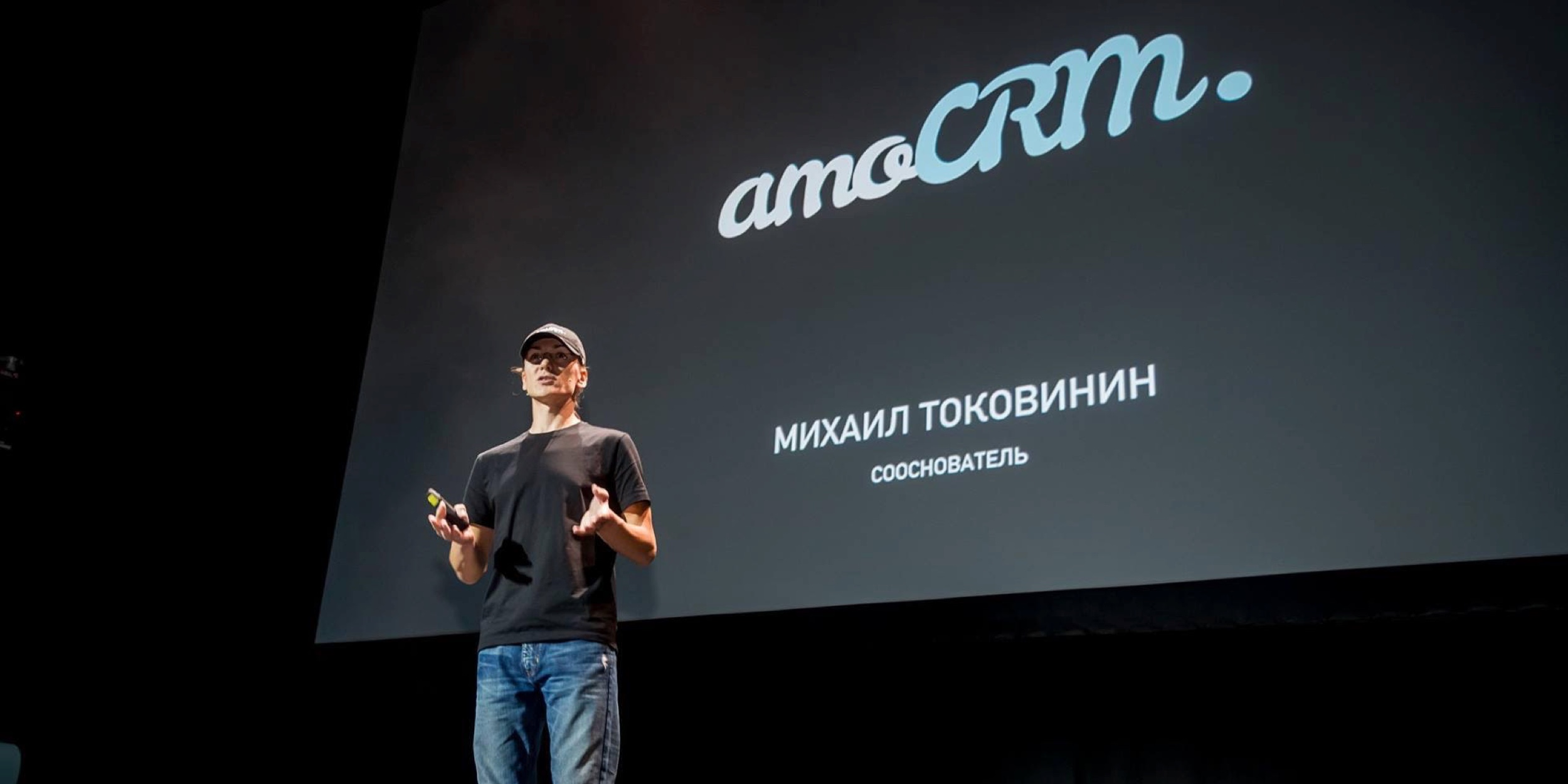
The conference reportedly lost about $1 million. Tokovinin did not disguise the economics. The event’s purpose lived outside ticket margin: make the product known, give the company a cultural identity, and let a large audience feel the synchrony of a concert around the supposedly dry subject of business. He compared a business conference to a rock show and argued that people place more value on pleasure than knowledge alone. The trick was to refuse the false choice. A useful idea could also have lights, music, jokes, and nerves backstage.
This taste for provocation appears in his management comments too. He has said he does not believe in hiring as a reliable science, then offered a revealing test. He asked candidates to name five leaders in their market and describe them. Many could name only two or three. The question looked for curiosity that existed before the interview. Genuine interest leaves residue: names remembered, opinions formed, competitors watched without being assigned.
When the pipeline became a conversation
As messaging apps became storefronts, amoCRM stretched beyond the classic sales pipeline. Customers wanted WhatsApp, Instagram, inboxes, bots, templates, and automated follow-ups in one place. Marketing and support teams entered a product once framed for salespeople. Some users barely visited the pipeline at all. The category had not disappeared, but the daily behavior around it had changed.
In October 2022, the international brand became Kommo. The new name drew on communication, while the product kept its CRM foundation. The rebrand was an admission that labels have a shelf life. “CRM” described the database. Kommo wanted to describe the movement around it: a message arrives, an answer is due, context follows the customer, and the next action belongs to someone.
Tokovinin and Kommo development director Matvey Kardash turned much of this operating experience into the book Sales to People: amoCRM in the First Person. Its central concern is not theatrical persuasion. It is the construction of a repeatable system: qualify leads, understand objections, design a funnel, hire people who can work it, and keep the founder’s wounded pride from sabotaging the conversation. A founder may believe the product is obviously wonderful. The buyer remains entitled to require evidence.
His more recent public conversations have widened to the economics of small-business software, international expansion, and artificial intelligence. The questions are current; the underlying concern is familiar. Tools become cheaper. Categories blur. Interfaces change. A company still has to reach someone, understand the problem, and make the next step easier than doing nothing.
The system beneath the show
Tokovinin’s public persona favors the sharp sentence, the branded cap, and a willingness to puncture a comfortable assumption. Yet the career beneath it is less a sequence of stunts than a sequence of systems. The repaired computer had to work. The cold call needed a list. The web studio needed a sales process. The CRM needed a simple workflow. The conference needed a production machine capable of putting 25,000 people in their seats.
The transferable idea is plain enough to be missed: businesses grow when attention becomes a process. Notice what customers say. Record it. Assign the next action. Return when promised. Learn which part failed. Then make the system a little easier for the next person to use.
The useful heresy
There is a productive tension in Tokovinin’s thinking. He can be skeptical of management rituals while building highly structured operations. He can say technology itself does not fascinate him while spending his career in software. The apparent contradiction clears when the object of his attention comes into view. Tools matter when they change behavior. A programming language is somebody else’s professional judgment; a missed customer call is a business problem with a name and a timestamp.
That pragmatism also explains his fondness for strong claims. A sharp claim invites a response. It gives listeners something to test against their own experience. When he argued that the web-development market was becoming brutally competitive, the point was not to hold a funeral for websites. It was to force service companies to examine commoditization, margins, recurring revenue, and the temptation to confuse today’s workload with tomorrow’s demand.
His best provocations operate like sales questions. They disturb the easy answer. Why are you building this? Who pays? What happens after the first deal? Can your team remember the promise without you? The questions are less glamorous than a product launch and more durable than one. They turn optimism into an operating plan.
That is what a CRM does when it is doing more than storing names. It gives memory to a group of people who are otherwise busy, distracted, and prone to optimistic forgetting. Tokovinin’s route from a paper phone book to a messaging platform covers two decades of technology. The human problem barely moved. Somebody is waiting for an answer.