The most revealing thing a software customer can do is ignore the screen you consider essential. Kommo learned this when it was still called amoCRM, a sensible name for a sensible product: a cloud database, a visual sales pipeline, tasks, contacts and reminders. Then the customers got unruly. Marketing and support teams moved in. New users handled business from messages and sometimes barely ventured into the pipeline. The company had built a map of the sale, while its customers were busy having the sale somewhere else.
That somewhere was the chat window. A property buyer sent a WhatsApp message. A shopper replied to an Instagram story. A prospect appeared through Messenger, Telegram or, later, TikTok. Each exchange contained intent, objection, history and the next action - precisely the information a CRM is supposed to preserve. Yet the salesperson still had to copy the useful bits into a record, assign a task and remember to return. The clerical work arrived after the human work, which meant it often did not arrive at all.
Kommo's wager is to reverse the order. Let the conversation create the client profile. Put every channel in one inbox. Attach the owner, deal stage, reminders and previous exchanges automatically. Then let rules, no-code bots and AI handle the repeatable portions without removing the accountable human. The old CRM asked the rep to log the conversation. Kommo asks the conversation to log itself.
Act I / The useful failure
The pipeline was not wrong. It was no longer the front door.
Mikhail Tokovinin launched amoCRM in 2009 out of QSOFT, the web business he had built with partners. He has said the product took no outside investment at launch. By 2013, he reported more than 1,500 paying subscribers and offices in Russia and the United States. The early pitch was pointed: a lightweight SaaS tool for small groups that sell, rather than a multiyear enterprise implementation with consultants wandering the halls.
The business matured the unfashionable way - subscription revenue first. In October 2016, enterprise software company 1C acquired 51 percent of amoCRM and management stayed. It was not a venture round dressed as inevitability. A working, bootstrapped product had sold control while preserving the team that operated it.
“We started to ask ourselves if amoCRM was really a CRM anymore.”Kommo, announcing the 2022 rebrand
The first thing to fail was not the company. It was the taxonomy. By 2022, amoCRM said customers increasingly expected to connect across multiple channels; marketing and support teams used the service through the entire customer journey; and some newcomers did not understand or care about the initials C-R-M. That changed the company's mind about what belonged at the center. It added a unified inbox, more messenger integrations, templates and Salesbot, then renamed the international product Kommo.
The name is cheerfully overthought. It points toward “communicate” and “como,” or “how” in Spanish and Portuguese, while keeping a trace of amo, love. The chopped K in the logo is meant to say that everyone communicates differently and can still be understood. Branding aside, the strategy was specific: stop asking a chat-led business to translate itself into CRM language before it can work.
Act II / What the machine does
A message enters. A sales process grows around it.
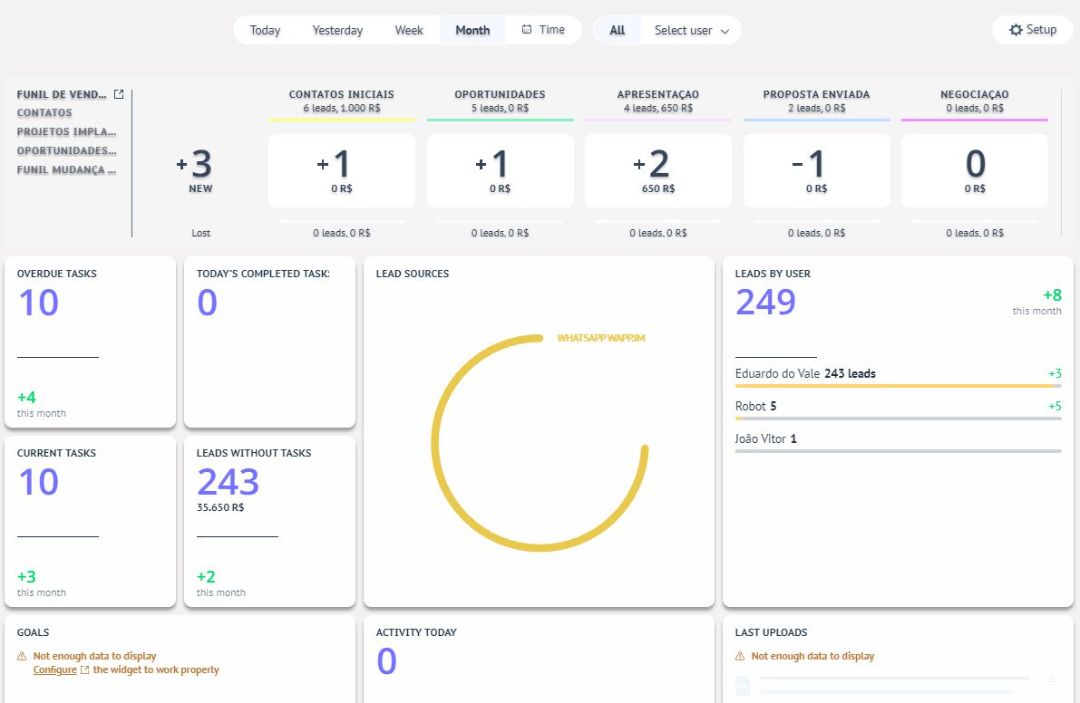
Kommo now describes itself as an AI-powered, messenger-based CRM. The foundation is still recognizable. There are kanban-like pipelines, contact and company records, task calendars, lead forms, email sync, call integrations, analytics, mobile apps and an API. But the differentiated layer is the conversation stack: WhatsApp, Instagram, TikTok, Facebook Messenger, Telegram, email and other connections flow into a shared inbox and the same client history.
One conversation, four automatic artifacts
Salesbot is the no-code foreman. A team can build branching sequences that greet a prospect, ask questions, collect details, route the lead, issue a reminder or trigger another system. Broadcasting and templates support campaigns. Meta's Cloud API integration adds interactive WhatsApp buttons, lists, carousels and flows. The Conversions API can send CRM events back to Meta so a click-to-message ad is connected more credibly to the revenue it produced.
Kommo AI sits on top of that plumbing. Its conversational tools draft and rewrite messages, summarize threads and suggest replies or tasks. AI agents use company-provided knowledge to answer questions, qualify prospects, recommend products, send documents and book appointments. Copilot helps users operate the system, while the Pro plan's Analyst Mode accepts plain-language questions about sales data and produces tables or charts. The premise is not that a robot should become charming. It is that a well-bounded machine can cover the gaps between “Can you send the catalog?” and “A human should handle this negotiation.”
The customers are defined less by industry than by traffic pattern. Agencies, clinics, educators, real-estate teams, consultants, retailers, financial advisers and franchises all fit when a large share of demand arrives as a message. Kommo says more than 100,000 clients use the platform and its LinkedIn profile lists customers in 109 countries. Latin America is an especially intuitive market: a business conversation conducted on WhatsApp needs little explanation there.
“Before amo, because I had many conversations with customers, I used to get lost in terms of who I spoke to.”Victor, Silicon Cities Consulting and Advisory
The published customer stories are useful when treated as examples, not laboratory trials. Retro Guestbook describes leads flying in from Facebook, Instagram, text and email, with spreadsheets becoming a nightmare. A two-person partnership team at Women in Cloud used automated, personalized SMS follow-ups and reported twice as many certified partners and a 34 percent higher response rate in three months. The transferable move is not “install Kommo and receive growth.” It is to centralize a fragmented intake, define ownership and make the next action unavoidable.
Act III / The bill and the boundary
Cheap software can still demand expensive discipline.
As of August 2026, Kommo's public tiers cost $15, $25 and $45 per user per month for Base, Advanced and Pro, plus a custom Enterprise plan. The minimum subscription is six months. Base includes the core workspace, pipeline, unified inbox, dashboard and basic AI assistance. Advanced adds automation, broadcasting, no-code bots and up to three AI agents. Pro expands channel limits, agents, booking, audience activation, analytics and AI functions. Included monthly AI credits vary by plan and extra packages cost more.
The monthly sticker price, per paid user
On September 1, the company plans to raise Base and Advanced prices for new customers to $25 and $35. Existing customers can keep current pricing while they remain on their plan and renew within the stated grace period. Kommo says this is its first such move after roughly a decade of stable prices, now that AI, booking and automation have become part of the package.
What fails first in practice is usually the seam between channels and identity. A customer messages from two numbers. WhatsApp and a personal account create duplicate cards. A Meta permission changes. A template is rejected. A salesperson keeps a side conversation on a private phone. Public reviews praise the all-in-one history and also complain about setup complexity, support and message synchronization. When the messaging layer is the product's moat, it is also the blast radius.
Kommo is different from HubSpot, Salesforce, Zoho or Pipedrive in emphasis, not ontology: they all manage contacts and deals, and several offer messaging. Kommo makes the inbox the primary work surface and the pipeline its organizational spine. Against messaging specialists such as respond.io, WATI, SleekFlow or Trengo, it leans harder into sales stages, tasks and deal accountability. Against a spreadsheet plus WhatsApp Business, it charges for shared memory, automation and fewer dropped balls.
Copy this when
Leads arrive through several chat channels, response time matters, multiple people share ownership, and a repeatable path exists from first message to revenue.
Do not copy it when
Volume is tiny, one person owns every conversation, the work is mainly ticket support, or governance and deep enterprise customization matter more than chat speed.
The steal
Study the skipped screen.
The most portable part of Kommo is not its chatbot. It is the decision to observe where the work naturally happened and make that action generate the paperwork. A founder can copy this without building a CRM: watch the workaround, locate the second entry of the same information and remove it. If a customer replies to a message, can that reply update the record? If a meeting is booked, can the pipeline move? If a payment arrives, can the owner and next step change without another form?
It works under three conditions. The natural action must contain enough signal to structure. The team must agree on stages and ownership. And automation must have an obvious escape hatch to a person. Without those, “AI-powered workflow” becomes a decorative phrase attached to a faster mistake.
Kommo still sells a pipeline. It simply stopped demanding that every user begin there. The chat is immediate, untidy and personal; the CRM is durable, structured and managerial. The company's product is the bridge between the two. Its best lesson is almost embarrassingly plain: when customers keep walking around your front door, move the door.