The trouble at Ron Marhofer Auto Group was ordinary enough to be expensive. Customers were shopping online. The dealership wanted to carry those conversations into the showroom. Its old CRM did not integrate with the group’s other system, and getting help meant an employee going to a manager, who then called the software provider. A customer could be ready to move while the dealership was still trying to move information.
That is a useful place to begin with VinSolutions. Forget, for a moment, the glamorous promise of artificial intelligence. Consider the less glamorous spectacle of a salesperson waiting for someone else’s screen. VinSolutions sells automotive dealerships a way to keep customer history, sales activity and the next action together. Its position inside Cox Automotive adds something more interesting: clues about what customers are doing beyond the dealership’s own front door.
- The job: manage leads, customer conversations, follow-up and deal proposals.
- The advantage: connect dealership records with shopping signals from Autotrader, Kelley Blue Book and Dealer.com.
- The human ingredient: a dedicated performance manager helps the dealership use what it bought.
- The catch: a buying signal still needs a relevant message, a working process and a salesperson who follows through.
01 An address book with a sense of timing
A dealership CRM is a peculiar kind of memory. It must remember a person, a vehicle, a conversation and a promise. The promise might be a call tomorrow. The vehicle might already be sold. The person might have bought a car years ago and started shopping again this morning. A record is useful only if someone can make sense of it at the right moment.
Connect CRM is VinSolutions’ central product. It organizes customer information and lead activity, assigns follow-up tasks, supports mobile work and gives managers reports on their sales process. Automated database maintenance updates contact information and reconciles duplicates. Sales and service records can be matched and merged into a single customer view. These are housekeeping jobs with commercial consequences: contacting the same person twice is a poor way to demonstrate that you remember them.
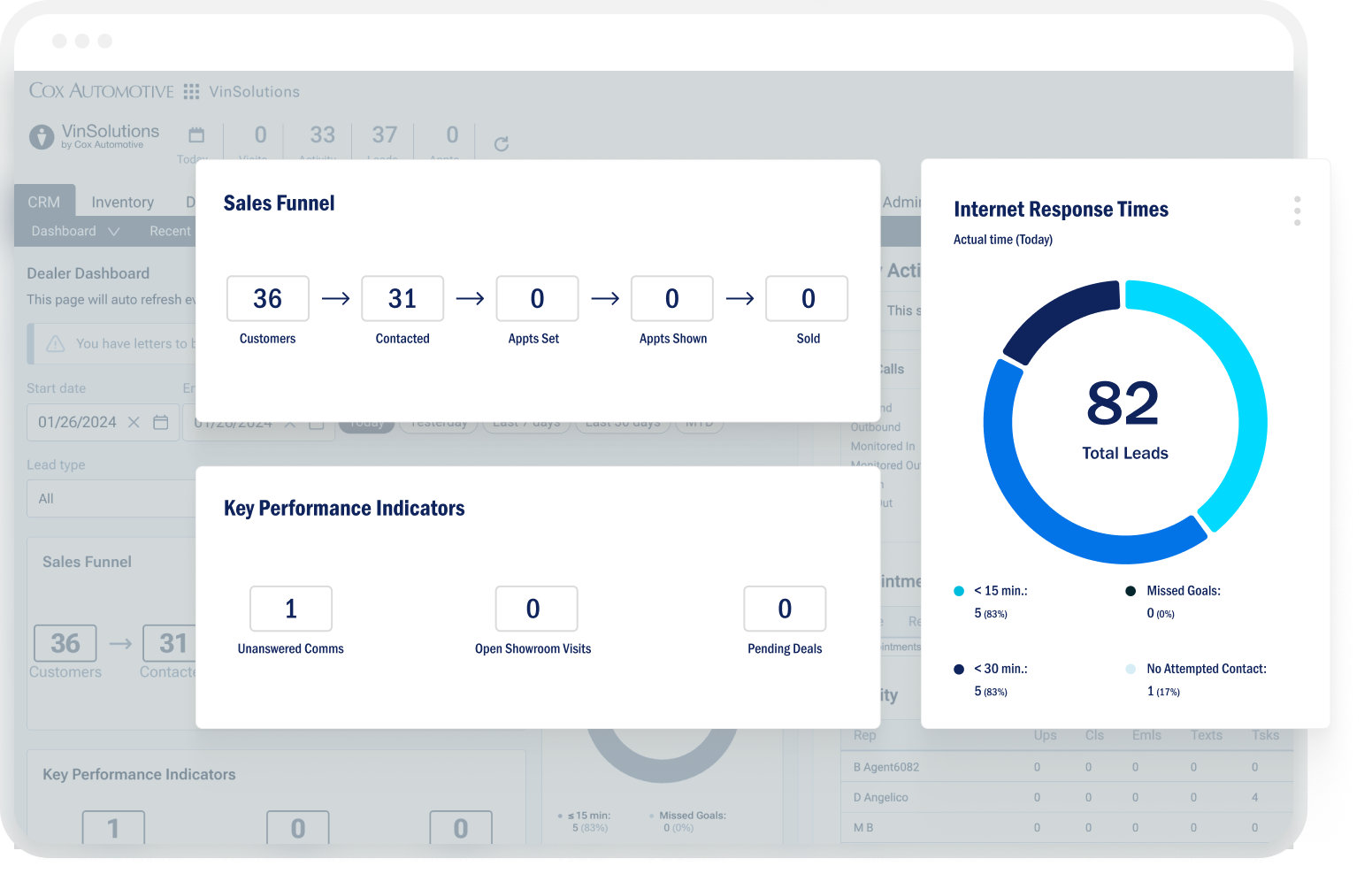
The users include salespeople, internet sales teams, business development centers and managers. Public customer examples range from Tynan’s Nissan to Davidson Automotive Group and Parkway Kia Mazda. This is business software for the people behind the car purchase. The shopper experiences it indirectly, through a quicker reply, a more informed conversation or a proposal that does not require starting over.
02 The buyer who has not raised a hand
Traditional lead handling begins when a shopper announces an interest. VinSolutions’ Predictive Insights reaches earlier into the process. Cox Automotive shopping activity can help a dealership recognize that a known customer is back in the market and identify interests such as vehicle type, mileage or price range. The attractive idea is timing: an old customer record can become a current opportunity.
VinSolutions reports that shoppers identified by its buying signals were nine times more likely to purchase than the comparison group. Its self-guided demo dates that analysis to September 2025, using August 2024 through July 2025 data. Read the claim carefully. It describes the relative likelihood of purchase among shopper groups. It does not mean installing the software makes a dealership sell nine times as many cars.
Vendor-reported buying propensity.
A prioritization signal, not a sales multiplier.
That distinction is the difference between a useful queue and a fairy tale. A salesperson still needs to ask whether the vehicle is available, whether the customer wants contact and whether the message fits the situation. The software can improve the order of attention; it cannot make every prospect equally willing to buy.
03 From a clue to a conversation
In December 2024, Cox introduced generative AI capabilities into VinSolutions’ Predictive Insights. The system uses shopper context to draft personalized emails and texts. Dealers can modify, edit and approve those messages. For a busy sales team, the practical attraction is spending less time composing the first sentence and more time deciding whether the conversation is worth having.
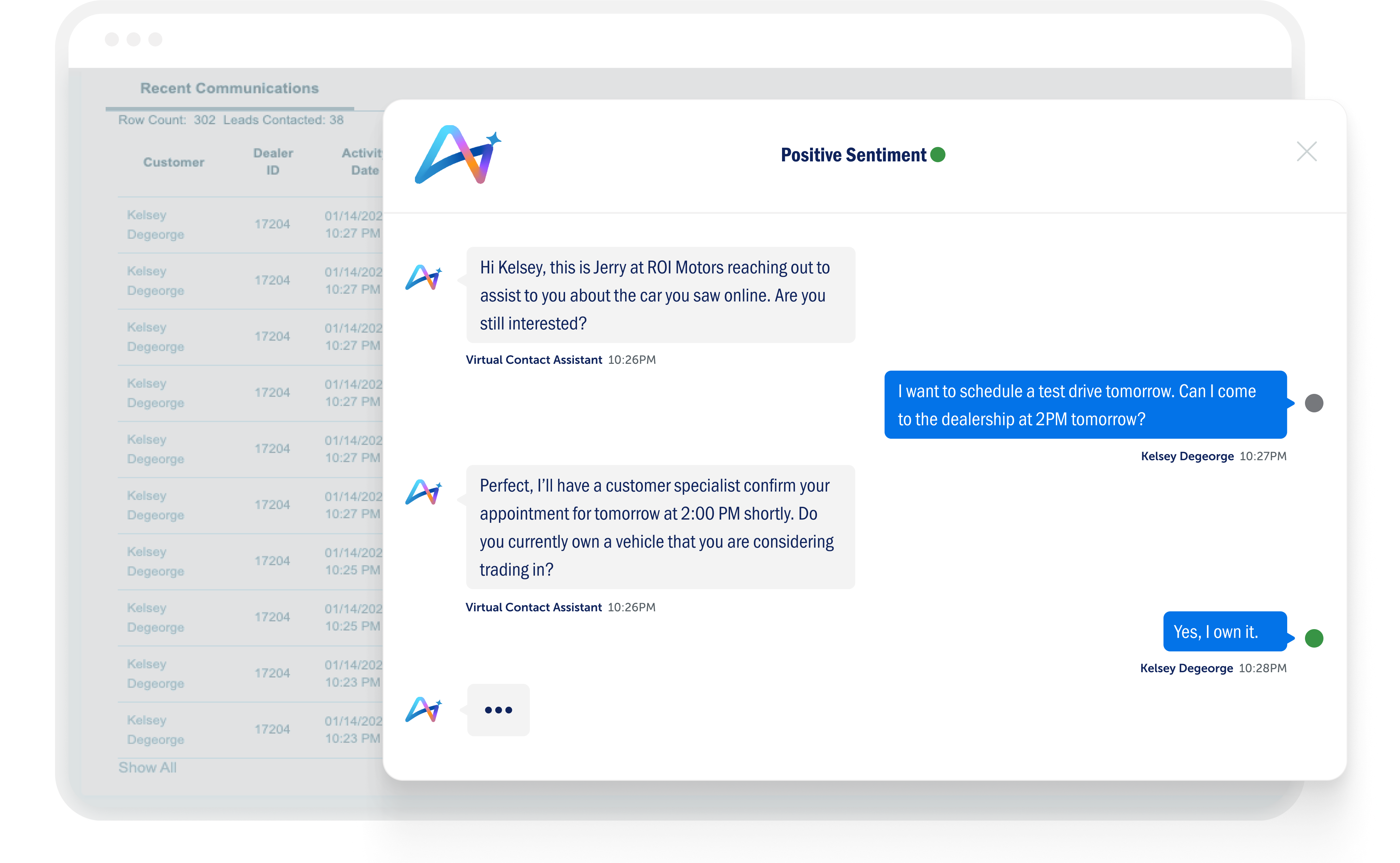
The newer Virtual Contact Assistant goes further. It can engage leads around the clock, qualify interest, schedule appointments, summarize shopper needs and update the CRM record. Dealers control how and when it engages. The handoff matters: if an assistant gathers useful information and the human asks all the same questions again, the dealership has merely automated the prelude to irritation.
Marketing has its own version of this work. VinSolutions’ current marketing page promotes Fullpath Audience Activation, following Cox’s 2026 move to acquire Fullpath. The offering combines customer data with personalized email and SMS journeys, automated campaign testing, custom audiences and reporting. A useful way to think about the distinction: the CRM organizes the relationship; the marketing layer decides which conversation to start at scale.
- 01 / NOTICEShopping activity adds context to an existing record.
- 02 / ENGAGEA salesperson or assistant starts a relevant conversation.
- 03 / PROPOSECustomer and vehicle details carry into the deal.
04 The unromantic art of working a deal
Once a customer is interested, someone must turn the conversation into numbers. VinSolutions Desking builds and compares payment scenarios using rates, rebates and incentives. The product can generate up to 18 scenarios and send proposals by text, email or print. This is where a software company earns its place in the showroom: the negotiation should not be interrupted by repeated data entry.
The wider Cox family gives VinSolutions a distinctive setting. Dealertrack connects customer and deal information; vAuto connects inventory and appraisal work; Xtime brings the service lane into view. Dealer.com can surface website activity and proposals within the CRM. A service visit, for instance, may become a vehicle acquisition opportunity when the dealership can connect the appointment with its inventory needs.
DealerSocket, CDK/Elead and DriveCentric belong on an automotive CRM shortlist too. The sensible comparison is a live customer journey through the dealership’s actual systems. VinSolutions’ strongest argument is the combination of Cox shopping data, connected workflows and ongoing guidance. A store gets more from that argument when the relevant connections are present and its staff use them consistently.
05 The software comes with a person
VinSolutions pairs customers with a dedicated performance manager. The role covers adoption, usage reviews, process improvement and advice drawn from automotive retail experience. It is an acknowledgement that software can contain an excellent report which nobody opens. A recurring conversation about the report may be as valuable as the report itself.
“We use reporting to help quantify the gaps and fix the leaks in the sales flow.”Chris Marhofer, president and COO, Ron Marhofer Auto Group
In VinSolutions’ case study, Ron Marhofer used customized reporting to identify coaching opportunities and act on trends before month end. The group reported over 900 additional internet sales in 2017 compared with 2016, attributing the increase in part to the CRM and stronger processes. It is a customer account of improvement, not a controlled experiment. The copyable part is specific: inspect the gaps weekly, give someone responsibility for them and connect the systems employees need.

06 A camera, a subscription and a larger family
The early business helped dealers get vehicle photos online. Co-founder and former CTO Matt Watson dates the precursor work to 2003; company materials give 2006 as the founding year. Inventory advertising led toward internet lead management as customers moved their shopping online. Watson describes a business financed with revenue, credit cards and a small angel investment rather than institutional venture capital.
AutoTrader bought the business in June 2011. Its SEC filing records $134.6 million in initial cash and a final accounting purchase price of $144.1 million after earn-out accounting and a working-capital adjustment. The strategic fit is easy to see: a marketplace helps someone find a car; dealership software helps the seller manage what happens next.
Today the commercial model remains subscription software, sold through a demo and configured quote, with additional modules and services. For a buyer, the useful cost calculation includes the selected products, implementation work, integration requirements and staff time spent learning a new process. A cheap subscription can become expensive if the dealership cannot make it part of the working day.
In August 2026, VinSolutions announced refreshed mobile and desktop experiences and a two-week release cadence, alongside its AI tools. CRM-native VinSolutions Video was scheduled for general availability in November. The direction is consistent with the company’s earlier evolution: reduce the small delays between noticing a customer, contacting them and working a deal. The decisive test happens in a showroom, when somebody opens a record and knows what to do next.