In 2006, Chip King had a marketing problem and a stack of phone calls. The Toyota dealership he ran near Baltimore was spending more than $20,000 every month on direct mail. The agency could connect the campaign to incoming leads, but King could not connect those leads to additional car sales. So he did what any irritated customer with a large invoice might do: he called to cancel.
The agency suggested one last audit. It had recordings, call-tracking logs and brief notes in an Excel spreadsheet. King listened through a month of conversations. The ads were making phones ring. What happened after the ring was murkier. Some callers were mishandled, transferred poorly or never guided toward an appointment. The marketing had not merely failed. The measurement stopped too early.
The first cost in the CallRevu story was not software. It was a recurring advertising bill that produced leads without a clean line to sales. Listening changed King's diagnosis from “bad campaign” to “invisible conversation problem.”
That distinction became CallRevu. Formally founded in 2008, the company began by tracking and monitoring dealership calls. Its early premise was practical: a phone number can attribute a lead, but the conversation reveals whether the dealership earned the visit. CallRevu built the tools to capture that second half.
The leak after the leadA ringing phone is demand. A good conversation is conversion.
Automotive retail is unusually vulnerable to the handoff between marketing and people. A shopper may spend hours comparing inventory online, then call with a specific question: Is the blue model still available? Can service fit me in Thursday? What documents should I bring? That caller carries more intent than a casual browser, yet the interaction can die in a transfer, on hold or in an employee's failure to ask for the appointment.
CallRevu sits in that seam. Its system records and attributes calls, transcribes conversations, classifies outcomes and surfaces coaching opportunities. SalesVision and ServiceVision organize the signals for the two broad halves of a dealership. Managers can roll performance up across a group, then drill down to a store, department or employee. The company says its analytics capture more than 90 data points per call, including over 50 sales-specific and 40 fixed-operations signals.
Connect the call or lead to its source, store and department.
Transcribe, classify and score what happened in the conversation.
Alert a manager, recover the opportunity or trigger follow-up.
Turn the observed mistake into targeted coaching and role-play.
The loop matters more than any individual dashboard. Traditional call tracking answers, “Which advertisement caused this call?” CallRevu keeps going: Was the call answered? Did the person have access to inventory? Was an appointment requested? Did the caller sound frustrated? Was the outcome logged in the CRM? What should the employee try next time?
“Every morning we know exactly how we performed the day before. There is no hiding from the numbers.”Rob Aleman, BDC manager at Spotless Auto CenterFour jobs, one system
The product grew outward from the phone.
CallRevu now describes its portfolio with four verbs: Connect, Convert, Optimize and Develop. They are conveniently neat, but they also show the strategy. Own the communication foundation, move the lead, understand the outcome and train the human responsible for the next one.
Automotive telephony
A cloud-hosted phone system built around dealership routing, call capture and CRM integration, rather than a generic office directory.
Lead response
Automated cadences, intelligent routing and cross-channel follow-up designed to shrink the gap between inquiry and response.
Conversation analytics
Attribution, sentiment, call outcomes, agent behavior and real-time alerts for sales, service and multi-store operators.
Coaching and practice
CallCoach comments on real interactions; TestTrack lets employees rehearse realistic customer scenarios without risking a live lead.
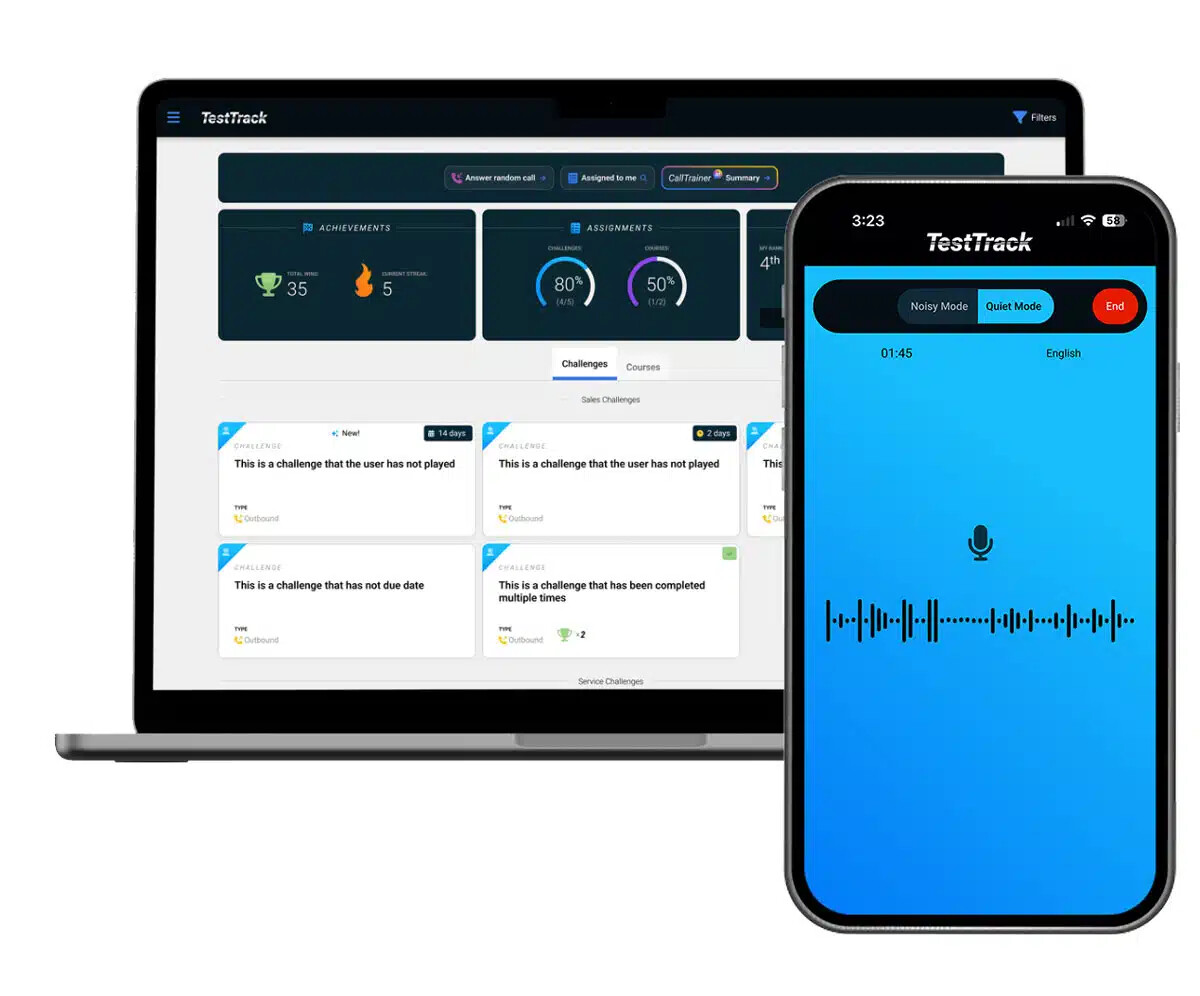
TestTrack is the clearest example of CallRevu turning observation into intervention. Launched in 2024 with iWish AI, it places employees in two-way simulations for appointment setting, objection handling and service recommendations. The system can assign role-specific learning paths, score challenges and track progress. CallCoach closes the other side of the loop by producing a concise review and recommendations shortly after a real call.
In a company-produced case study, Bob Ruth Ford said it deployed TestTrack in April 2025 using one administrator and regular scenario practice. Over 90 days, the dealership reported a 20 percent reduction in appointment no-shows, a 14 percent increase in appointments set and a five-point lift in its appointment-opportunity set rate. Those are customer-reported results, not a controlled trial, but they show the intended mechanism: practice the conversation, then measure what the next real customer does.
Bars are scaled to the largest reported change. Figures were published by CallRevu from the dealership's first 90 days and should be read as a case study, not a universal forecast.
Generic AI hears words. CallRevu wants to hear a dealership.
CallRevu's defensible idea is less glamorous than a model launch: specialization. Dealerships have rooftops, BDCs, fixed ops, service schedulers, rotating inventory and separate teams that can make one customer feel as if they called four companies. For years, the business paired human review with a proprietary automotive vocabulary. Machines took on more of the volume while people supplied quality control, context and coaching.
That focus separates CallRevu from several kinds of alternative. CallRail and Invoca sell broader call tracking and marketing intelligence. CallMiner analyzes contact-center conversations across industries. Car Wars and Marchex compete closer to the automotive call-management problem. A dealership can also combine a generic cloud phone system, CRM reports and managers manually sampling calls. CallRevu's pitch is that one automotive-native layer can see the whole chain with fewer seams.
Those figures are company-reported, but they explain why the niche can become a data advantage. CallRevu's 2024 benchmark covered 149 million dealership calls. Its 2025 year-end report studied 74.9 million inbound calls. The midyear data contained an uncomfortable finding: 94 percent of variable-operations calls were answered, while CallRevu said dealers still missed 74 percent of potential opportunities. Picking up was not the same as progressing.
That is also where the product can disappoint. Analytics cannot make a manager coach, keep inventory data current or persuade an employee to follow a talk track. An automated follow-up can arrive instantly and still feel irrelevant. The system works best where dealerships connect their CRM and schedulers, define what a successful call means, and give someone authority to act on the alerts. Without those habits, communication intelligence becomes a polished mirror.
Capital and consolidationFirst measure the call. Then own more of what happens around it.
Serent Capital invested in CallRevu in 2017, when the investor said the company served more than 3,300 dealer locations and partnered with 20 global automotive manufacturers. No amount was disclosed. Under Serent, CallRevu expanded its AI capabilities and product line. In 2024 it acquired TotalCX, adding a hosted telephony platform formerly known as InteractiveTel. The purchase made the phone system part of the product rather than a distant source of data.
The call audit becomes a company
CallRevu is founded around automotive call tracking and monitoring.
Serent Capital invests
Growth capital arrives as the company passes 3,300 dealer locations.
TotalCX, TestTrack and CallCoach
Telephony, simulated practice and rapid feedback widen the operating loop.
Astira Capital takes ownership
The private-equity acquisition closes for an undisclosed price.
Calldrip extends the clock
Automated lead response moves CallRevu beyond the phone and into the first five minutes after any inquiry.
Astira Capital Partners acquired CallRevu from Serent in October 2025, again without publishing a price. Six months later, CallRevu bought Calldrip, a lead-engagement company founded in 2009. Calldrip brought automated outreach, workflows and customers in Europe, the Middle East and Africa, plus a foothold in agriculture and adjacent vehicle markets. Roughly 100 days after the acquisition, CallRevu said the technology was integrated into its Convert product.
The sequence reveals what changed. CallRevu began as the observer of a dealership call. TotalCX gave it the pipes. TestTrack and CallCoach gave it the practice room. Calldrip gave it the ability to respond. In January 2026, DylanAI pushed the same logic into reception: recognizing callers, checking staff availability and routing with dealership context from inside the phone system. CallRevu says the feature is embedded rather than sold as a disconnected plug-in.
The company began by asking, “What happened on the call?” Its current ambition is to shape what happens before, during and immediately after it.The useful copy
Steal the feedback loop, even if you never sell a car.
The most portable lesson here does not require 149 million recordings. It requires refusing to stop measurement at the convenient boundary. Marketing teams count leads. Sales teams count deals. Customer-service teams count tickets. The expensive mistakes often live in the handoffs.
A five-step conversation audit
- Choose one high-intent channel and sample the actual interactions.
- Define a successful next action, not a vague quality score.
- Tag the first failure: routing, knowledge, tone, timing or follow-up.
- Alert the person who can recover the opportunity while it is still warm.
- Turn repeated failures into practice scenarios, then measure the next cohort.
CallRevu's original mistake was understandable. A mailer looked like a marketing expense, so King first judged the marketing. Listening showed him a system problem. The ad, phone tree, employee, appointment process and CRM record were one customer journey wearing different department labels.
That is where CallRevu fits in the market now: vertical SaaS at the intersection of communications infrastructure, revenue intelligence and workforce training. It sells to dealerships, dealer groups and automotive manufacturers through demos and subscriptions; public list prices are not posted. The specialization limits its addressable market compared with a horizontal contact-center vendor, but it gives the product an opinion about what should happen next. In a dealership, “someone answered” is a technical result. “The customer booked” is the business result.
The company has spent nearly two decades shortening the distance between those two sentences. Its story began with a dealer threatening to stop spending. It continues because businesses keep buying demand, then losing it in conversations nobody bothered to inspect.