Before the infinite canvas, there was a tram stop in Perm. Andrey Khusid was seven or eight, selling newspapers that someone had brought to his school for the children to resell. The commercial empire was modest. The effect on his sleep was not. At night, he later recalled, the sales pitch kept going around in his head.
This is an unusually apt first scene for the founder of Miro. Khusid has spent much of his life worrying a message until it becomes clear enough to travel. First it was a newspaper pitch. Then it was graduation videos made with school friends. Then it was a creative brief that had to cross the distance between his agency and a remote client. Eventually, it was a blank whiteboard that needed to pass through a browser.
On September 10, 2026, the message was harder. He told Miro's staff that the company had signed an agreement to be acquired by Bending Spoons. The enterprise value was $1.355 billion, with an approximate equity value of $1.79 billion after adding Miro's net cash. The transaction was expected to close in the fourth quarter, subject to approvals. Khusid called the decision personal. Fifteen years of building, he wrote, sat behind it.
The brief that refused to stay brief
Khusid grew up close to the unvarnished mechanics of small business. His father ran a printing shop with three or four people near the family home. The boy saw paper being ordered and collected, old printers being bought, and weekends being surrendered to repairs. Entrepreneurship arrived without a mythology department. It meant knowing the machine and fixing it when it sulked.
At the end of school, Khusid, Oleg Shardin, and friends spotted a market in filming graduation ceremonies. Once they entered university, the project evolved into Vitamin, a creative agency that handled design, video, and digital work. Khusid studied management and marketing at HSE University in Perm, graduating in 2011 from a master's program in state and municipal administration. Along the way he helped organize student entrepreneurship weekends and launch the university's business incubator. Curiosity, he said in an early interview, came from the unknown: what happens at the next step?
The next step grew out of an irritating ritual. At the end of a meeting, a remote client or teammate would insist that everything was clear. Work would begin. Dozens of questions would promptly appear. Email, video calls, task trackers, and documents could carry information, but they did not reliably carry understanding. Different professions used different dialects. A designer's shape, a manager's sentence, and a developer's system had difficulty occupying the same room.
So in 2011, Khusid and Shardin built an online whiteboard called RealtimeBoard. The name was gloriously literal, like a tin labeled TIN. The domain cost $10. The ambition, at first, was similarly restrained: put the whiteboard in a browser so people in different places could look at one thing together.
“You don't build a product customers will love by accident. You have to plan for it and set goals around it, starting at the end and working backwards.”Andrey Khusid on product craft and distribution
Every invitation was also an engine
The product had a useful social property. A board improves when another person joins it. Miro's team measured how many new people each user brought in, set targets, and experimented with ways to raise the number. The invitation was collaboration and distribution in the same click. The company did not wait for virality to descend from the cloud wearing a halo. It put virality on a dashboard.
By 2013, RealtimeBoard had about 100,000 users. Product-led adoption carried it into user-experience design and agile software work, where a shared visual surface could hold journeys, sticky notes, wireframes, and plans. In 2018 the company raised a $25 million Series A. A year later, RealtimeBoard became Miro, a name associated with the Spanish artist Joan Miró. Khusid liked the echo between the artist's bright shapes and the riot of marks on a busy collaborative board. The new name also released the company from a description that had become too small.
RealtimeBoard launches from Perm with a simple browser-whiteboard premise.
The product becomes Miro and widens its ambition from whiteboarding to visual collaboration.
Distributed work accelerates adoption; Miro passes 10 million users.
The company introduces an AI Innovation Workspace for teams and agents.
Miro signs an acquisition agreement with Bending Spoons after fifteen years of building.
Then offices closed. In 2020, the company passed 10 million users, nearly tripling its user base in a matter of months. Some boards were used simultaneously across more than 40 countries. The workforce more than doubled to nearly 700 that year; across an 18-month stretch in 2020 and 2021, headcount rose from roughly 200 to 1,800. A tool born from avoiding travel suddenly became the table around which schools, companies, and public institutions tried to continue their day.
Khusid had a metaphor for the company he wanted. A cube requires a push each time it moves. A sphere gathers momentum as it rolls. Product love, referrals, investment, and awareness could reinforce one another until motion began to feel natural. Yet he reserved a practical exception for people. An employee's difficulty does not disappear because the corporate ball is rolling. He admitted that the human part of business was the hard part, and that he could become absorbed in why one person felt stuck or why another considered leaving.
A very public change of scale
Miro raised $400 million in 2022 at a $17.5 billion valuation, the sort of number that turns a useful product into a financial allegory. Four years later, the Bending Spoons agreement supplied a less theatrical enterprise value. The gap is impossible to miss and easy to oversimplify. One figure priced a preferred financing during a feverish software market. The other priced an entire business in a cash acquisition agreement after the market, the category, and expectations had changed.
Two different snapshots
The 2022 figure was a private financing valuation. The 2026 figure is enterprise value in a pending acquisition agreement. They describe different transactions and are shown to convey scale, not accounting equivalence.
Numbers still clarify what rhetoric can blur. At the time of the agreement, Miro had around $600 million in annual recurring revenue, nearly four million paying users, and more than 750 customers spending over $100,000 a year. Almost 90 percent of recurring revenue came from business and enterprise customers. This was not a vanished pandemic novelty. It was a substantial software company confronting the colder mathematics of a changed market.
Khusid's note to employees tried to hold several constituencies on the same board: users, staff, and investors. Eligible employees would receive varying credit for unvested equity based on tenure, paid as a cash bonus at closing. Bending Spoons would study the organization before making decisions about roles and structure. The founder said the buyer's long-term ownership and product discipline had persuaded him. A founder's letter is partly explanation, partly morale, and partly an attempt to reduce a roomful of private uncertainties to a legible diagram.
When the collaborators are no longer all human
The company's latest reinvention returns to Khusid's original theme. AI can make a person astonishingly quick in private. A product manager can draft a strategy, a designer can summon a prototype, and an engineer can generate code. The trouble begins when everyone brings those accelerated outputs back to the team. Speed multiplies the volume of work that must be understood, compared, challenged, and coordinated.
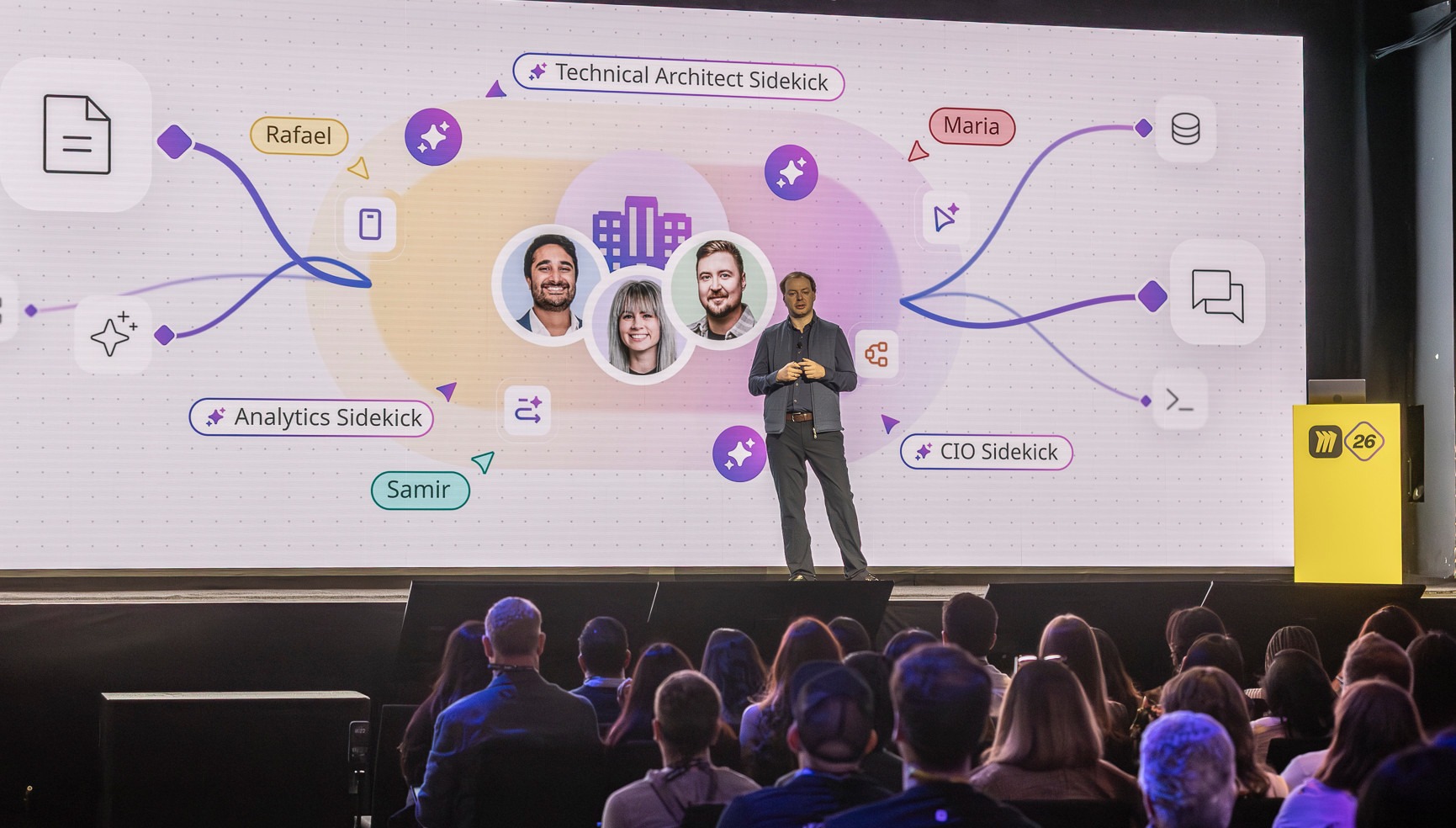
Khusid now talks about “makers,” people who can carry work from idea to execution with fewer traditional role boundaries. He also sees a coordination plane that has acquired extra dimensions: human to human, human to agent, and agent to agent. Miro's proposed answer is to put that activity on a visible canvas. Its Sidekicks and Flows are meant to let teams see an agent's contribution, interrupt it, redirect it, and keep the surrounding context attached.
“A decision like this is always personal for a founder: fifteen years of building alongside you sit behind it.”Khusid announcing the Bending Spoons agreement
There is a pleasing continuity here. The cast has changed from remote clients and agency designers to global teams and specialized agents. The difficulty remains mutual comprehension. Tools can produce more material than ever. Someone still has to decide what belongs next to what, which arrow is true, and whether “everything is clear” means anything at all.
Khusid has said Amsterdam's architecture helps him think about product design, and that he wants users to enjoy exploring Miro as he enjoys discovering pieces of the city. It is an appealing picture of his working mind: systems and streets, both understood by moving through them. He appears to prefer structures that invite wandering but keep their bearings.
Miro's next ownership chapter remained unwritten at the time of publication. The agreement had been signed, but the closing conditions still mattered. What was already settled was the long first chapter: the printing-shop child, the tram-stop pitch, the graduation videos, the literal domain, and the browser window that became a meeting place for millions.
A blank canvas can look like an absence. Khusid built a career by treating it as an invitation. Now the board contains a buyer, a changed market, millions of users, and a row of machines asking to join the workshop. The cursor is still blinking.