In March 2020, the future arrived at Bizzabo as a mass deletion. In roughly two weeks, customers canceled more than 1,000 events scheduled for that spring. This was not a soft quarter or a bad campaign. The physical product around which the company had spent nine years building software - the professional gathering - had become illegal or unwise almost everywhere at once.
The founders had seen a version of this movie before. Eran Ben-Shushan, Alon Alroy and Boaz Katz started Bizzabo in 2011 after meeting in an Israeli entrepreneurship program. Their first product was a social app that helped conference-goers discover events and meet one another. It was tidy, useful and increasingly ordinary. By 2015, event apps were proliferating. The team listened to organizers and moved upstream, from one attractive feature to the ugly, recurring workflow behind it: websites, promotion, ticketing, registration, agendas, speakers, contacts and measurement.
That is what Bizzabo does now, at enterprise scale. Its Event Experience OS is the control room for a company's whole event portfolio - big conferences, small field dinners, webinars, virtual sessions and hybrid productions. It connects the public experience attendees see with the operational machinery marketers need and the customer data revenue teams demand. The interesting part is not that it puts forms and agendas online. The interesting part is its effort to preserve the messy humanity of a live event while making it legible to a database.
“Our biggest partners in innovation have been our customers.”Eran Ben-Shushan, co-founder and CEO
The first product failed politely
Bizzabo's original attendee app did not explode on the runway. Something more instructive happened: the market around it became crowded, and the customer kept asking for adjacent jobs. Event organizers did not merely need another place for attendees to exchange profiles. They needed to get people registered, send them the right email, manage speakers, publish an agenda, sell sponsorships and explain afterward what the event accomplished.
The founders changed their minds because customer demand widened the frame. In 2017, Ben-Shushan described the company as digitizing the organizer's process from start to finish. The shift brought larger customers and a repeatable subscription business. A $6.5 million round in April 2017 was followed by $15 million that December and $27 million in 2019. Bizzabo moved toward mid-market and enterprise buyers: teams for whom events are not a party line item but a standing channel for pipeline, education and customer retention.
A networking app is born in a family garage.
The app becomes an all-in-one organizer platform.
Rooms close; virtual production becomes the product.
Four acquisitions add AI, video, infrastructure and wearables.
Bizzy AI moves the help desk into the attendee's pocket.
The copyable move is specific: follow the broken handoff. Watch where customers export a CSV, hire temporary staff, or reconcile two systems by hand. Bizzabo moved from attendee networking to organizer workflow because that handoff was painful and recurring. It moved into virtual delivery when the venue vanished. When rooms reopened, it bought the technology that could make physical behavior measurable.
When the room vanished, video became the venue
The 2020 pivot was fast because it did not require abandoning the company's customer or purpose. Bizzabo still helped professional events happen; it changed the medium. The platform added live and on-demand video, virtual session controls, chat, questions and audience engagement. The company said its revenue doubled in 2020 while the number of events run through Bizzabo grew 65 percent. In December, Insight Partners led a $138 million Series E, bringing reported total funding to roughly $194 million.
Then came the spending spree. In 2021, Bizzabo acquired four companies in about six months. Whalebone brought web infrastructure. The once-famous scheduling assistant x.ai brought matchmaking technology. TeeVid added video production. Montreal-based Klik brought the physical-world prize: smart wearables and an onsite operation. These were not random trophies. Together, they filled gaps between the browser, the broadcast and the ballroom.
But the capital had a cost beyond its dollar amount. Bizzabo expanded past 400 employees and opened more locations just as the market began another turn. Virtual-only enthusiasm cooled, in-person events returned, and technology funding tightened. In July 2022, the company announced that it would cut close to 30 percent of staff to prioritize financial efficiency. A later report described another roughly 100 jobs cut. The pandemic pivot worked; the pace and size of the expansion proved harder to sustain.
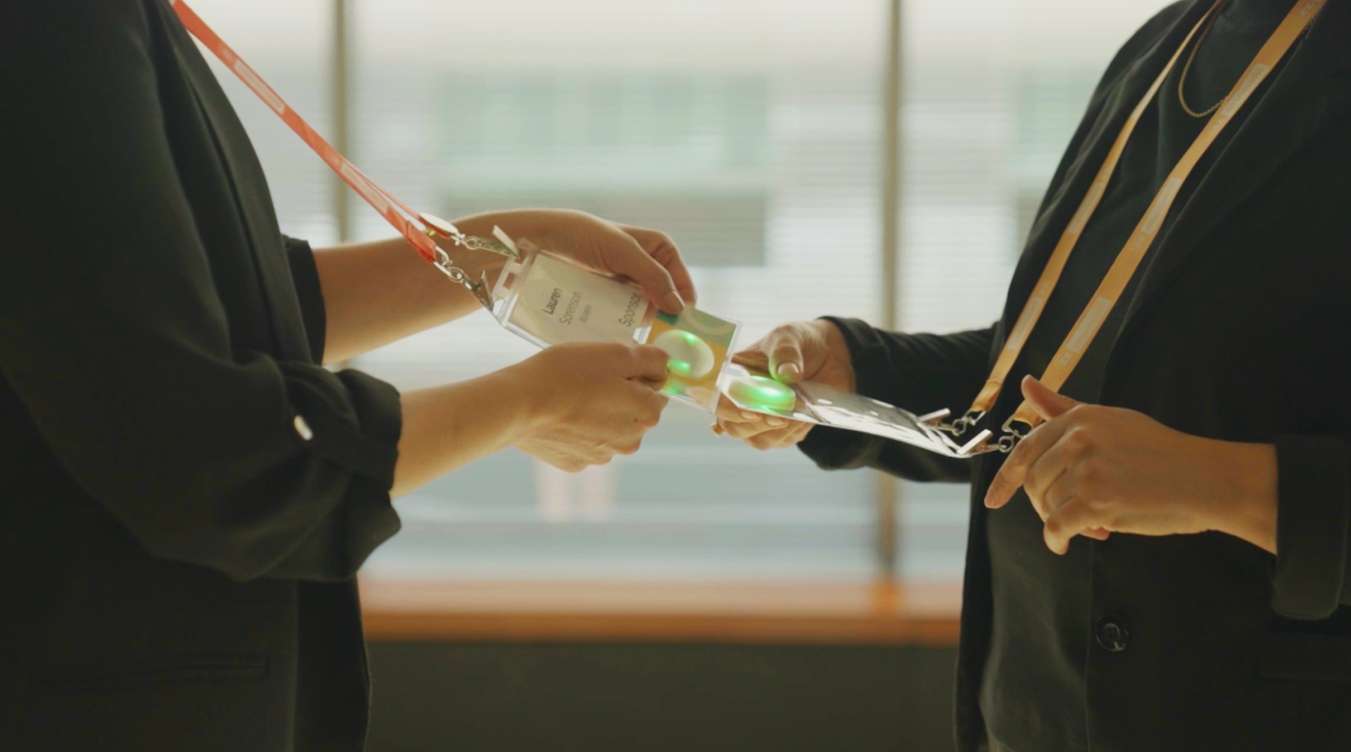
The badge with a second job
Klik explains Bizzabo's modern pitch better than a feature list. Two attendees tap their glowing badges to exchange details. The gesture is playful enough to invite use, but every exchange can feed engagement reporting. The badge can also support session scanning, exhibitor lead capture, gamification and passive traffic signals. Organizers get the sort of behavioral trail that online events produce naturally, without asking guests to spend a conference staring at an app.
At HubSpot's INBOUND 2022, Bizzabo says 89 percent of onsite attendees participated in contact exchange, producing more than 85,000 connections. At Customer Management Practice's 2024 conference series, 500 attendees generated 8,963 exchanges; exhibitors averaged 87 leads, a reported 315 percent lift over the previous QR-code system. These are vendor case studies, not controlled experiments. They are still useful because they show the job the hardware is hired to do: reduce friction for the person while increasing evidence for the organizer.
The rest of the suite surrounds that moment. Registration and ticketing capture intent. Websites, emails and agenda tools shape the run-up. A mobile app handles schedules, networking and now Bizzy, an AI attendee copilot that answers event-specific questions and recommends sessions. Check-in and badge printing get people through the door. Reports combine registration, attendance and engagement. Integrations with Salesforce, HubSpot, Marketo, Eloqua and Microsoft Dynamics push the resulting signals into marketing and sales systems.
The price tells you who it is for
Bizzabo publishes an unusually legible starting number for enterprise event software: $499 per user per month, billed annually, with a three-user minimum. That is $17,999 a year. The core includes unlimited events and registrations, registration and ticketing, campaigns, a website builder, a mobile app, analytics, onboarding and support. Advanced onsite, virtual production, networking, deeper integrations, portals, SSO, API access, branded apps and Klik hardware can cost more. Professional services are custom-scoped.
This is not software for a book club that wants to sell 80 tickets. The economics improve when a central team runs dozens or hundreds of events and would otherwise pay for separate registration, email, virtual production, mobile, check-in, badge, lead-capture and analytics products. Myriad Genetics says it uses Bizzabo for more than 100 annual events and cut event-site building time by 20 to 40 percent. DJI estimated more than 100 staff hours saved on one virtual conference. The platform sells consolidation as much as capability.
Good fit
A recurring enterprise event portfolio, multiple formats, strict security needs, CRM integration, onsite complexity and a team accountable for measurable pipeline or engagement.
Poor fit
One or two simple events, a tight nonprofit budget, no dedicated event team, little need for behavioral data, or a workflow already served by a registration form and video link.
Cvent remains the obvious heavyweight alternative. RainFocus, Swoogo, Stova, Splash, Whova, EventMobi, vFairs and Accelevents attack different slices of the same market; Eventbrite serves a lighter, more transactional need. A determined team can also assemble Zoom, a registration tool, a marketing platform and an onsite vendor. Bizzabo's difference is the promise that one platform - plus a closely involved service team - can keep the attendee record intact across formats. Its risk is the familiar suite risk: customers may prefer a sharper specialist, a cheaper bundle, or more flexible per-event pricing.
The useful Bizzabo lesson is not “pivot quickly.” It is: keep the customer, keep the painful job, and be willing to replace almost everything else.
What survived both pivots
The company's mission has remained more stable than its product: use professional events to create rewarding, consequential experiences. Its internal phrase is Be Rosh-Gadol, Hebrew for taking a big-picture view and acting beyond a narrow job description. All three founders served between six and ten years in the Israeli air force, an experience they have said influenced how they build teams. The phrase can sound like standard startup wall vinyl. Here, it at least rhymes with the history.
Recent product moves pull the company back toward disciplined utility. A rebuilt registration flow launched in 2025 with conditional questions, group and session registration, more than 20 currencies and embedded forms. Bizzabo said early adopters saw conversion increases as high as 300 percent. In the first half of that year, its customers hosted 27 percent more in-person events, while small gatherings under 150 attendees grew 34 percent. Support ticket volume fell 37 percent, which the company attributed partly to its Event OS Copilot.
In 2026, Bizzy AI became available inside the event app. The pitch is modest in the right way: answer the repeated “Where is the keynote?” questions, surface relevant sessions, and show organizers what people keep asking. The condition for success is a clean event knowledge base and reliable retrieval. A wrong ballroom number is not an amusing hallucination when several hundred people are walking the wrong direction.
Bizzabo works best when the event is not an island. If registration signals enrich a CRM, badge taps reveal sponsor value, and attendance data changes the next invitation, the annual platform can become infrastructure. It works less well when measurement is decorative, staff will not maintain integrations, attendees reject wearables, or the event cadence cannot justify an enterprise contract. No operating system rescues a dull agenda. No badge manufactures a useful conversation.
Still, there is something appealingly literal about the company that began by helping strangers meet. Fifteen years later, after virtual stages, acquisitions, layoffs and a great deal of software, its most memorable object is a small badge that lights up when two people touch it together. Bizzabo has spent its life adding data to the room. Its best products remember that the room comes first.