At 8:57 on conference morning, nobody cares about digital transformation. They care that 4,000 people have arrived at once, the badge queue is curling toward the escalators, a room has changed, a sponsor wants its leads, and someone in sales is asking whether the prospect in row six ever opened the follow-up email. Events are physical deadlines with software hidden inside them. RainFocus built its business in that uncomfortable seam.
Founded in 2013 by event-technology veteran Doug Baird, the Lehi, Utah company sells an enterprise platform for registration, content, exhibitors, on-site operations, mobile and virtual experiences, analytics, and integrations. That list sounds like a catalog. The more useful explanation is architectural: RainFocus tries to keep every event moment attached to one attendee profile, then make that behavior available to the rest of a company's marketing and sales machinery.
The customer list explains the ambition. Public materials name Adobe, Cisco, Oracle, Red Hat, Salesforce, NVIDIA, Microsoft, Workday, Databricks, Broadcom, SHRM, Esri, Trimble and The Pokémon Company International. These are not organizations looking for a cheerful ticket page. They run global programs with strange permissions, layered sponsorships, hundreds of sessions, privacy rules, regional teams, and the occasional small army at check-in.
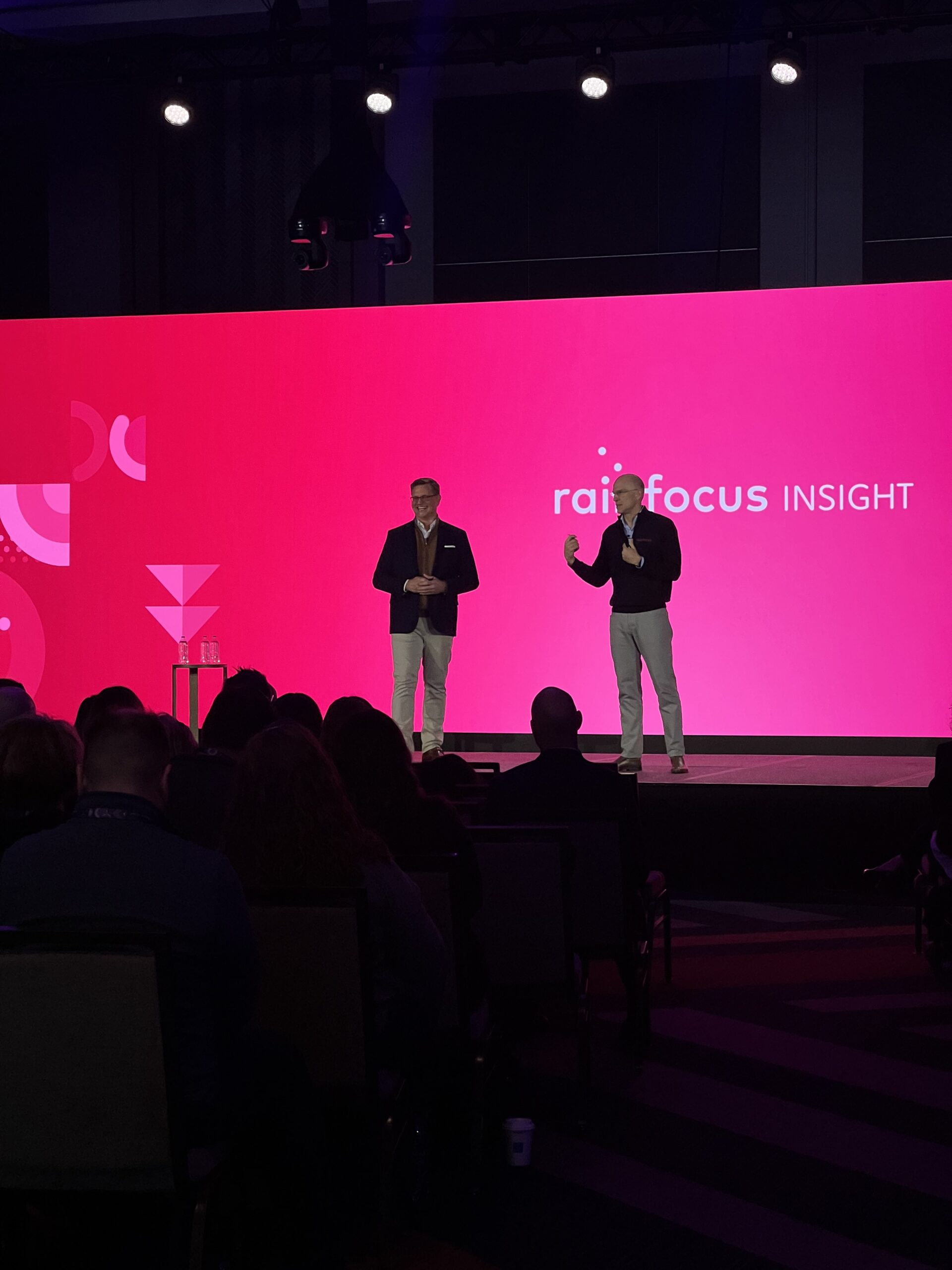
01 / The original bruiseThe first thing that failed was the handoff
RainFocus's founders had spent years around legacy event systems. Their complaint was specific: important programs were assembled from separate products and custom integrations, sometimes taking months to configure and requiring developers for routine changes. Registration knew who signed up. The session tool knew what they watched. A scanner knew which booth they visited. The CRM knew an opportunity existed. Nobody had a dependable, live view of the person moving between them.
The company changed the premise. Instead of customizing a stack around one conference and living with brittle connections, it built a configurable SaaS platform around shared data. Early proof came from demanding programs including Oracle CloudWorld, VMworld and Cisco Live. If one architecture could survive those crowds and exceptions, it could support a portfolio - a flagship conference, regional roadshows, executive dinners, webinars, partner meetings - without rebuilding the foundation every time.
“Events still sit on an island from a technology standpoint.”JR Sherman, RainFocus CEO, in a 2021 Forbes interview
That observation also changed who had to care. A conference was no longer just an operations expense with attendance as its final score. It could become a stream of first-party intent: the security session someone chose, the product booth they revisited, the expert they met, the content they saved, the survey answer they gave. Once those signals flow to a customer data platform or CRM, an expensive live event has a measurable afterlife.
02 / The productOne dashboard, several constituencies, no small amount of choreography
For the planner, RainFocus handles forms, packages, pricing, speakers, sessions, content, communications and schedules. For attendees, it supplies registration, personalized agendas, recommendations, mobile navigation, alerts, chats and surveys. Exhibitors get a portal for contracts, assets, staff, booths and lead tools. On-site teams get badge and access workflows, scanning and live operational data. Marketing and sales teams get the part that matters after the carpet is rolled up: behavior, segments, attribution and follow-up.
Its modular workflow engine is the useful center. Large customers can encode different rules and experiences without forking the underlying platform. Templates let central teams maintain governance while field marketers launch smaller programs. That is a crucial enterprise trick - make the approved path reusable, but leave enough room for the event not to feel like it came from a vending machine.
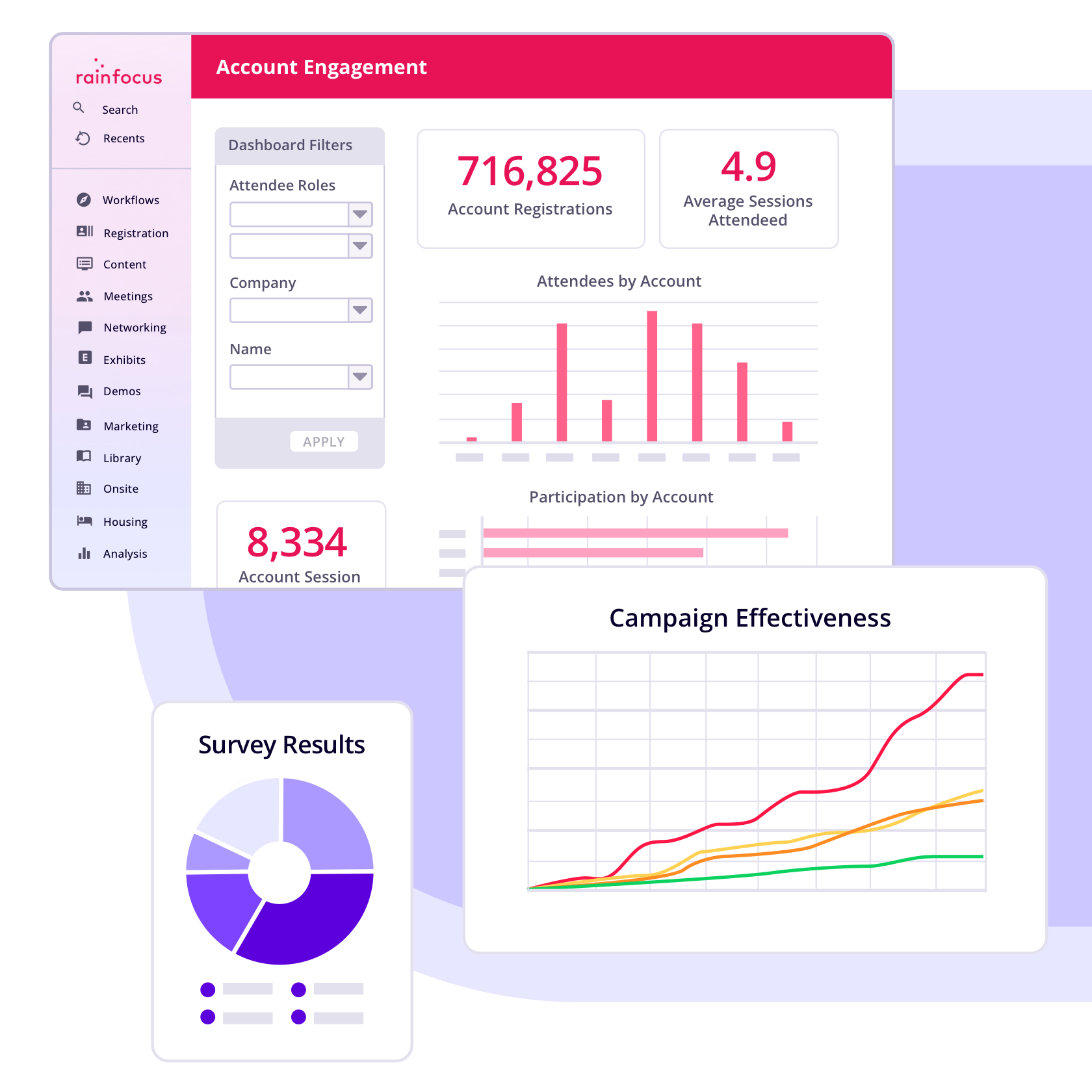
The integrations are where RainFocus makes its category claim. Its Adobe Source Connector streams event behavior into Adobe Experience Platform, where teams can update profiles, create segments and personalize other channels. RainFocus for Salesforce puts invitations, registration status and engagement inside the CRM, so a seller does not have to visit an event platform to learn that a prospect attended a technical session or arrived on site.
03 / The receiptPersonalization earns its keep when the numbers move
Adobe Government Forum 2024 offers a tidy example. The event drew nearly 700 people on site and more than 400 virtually. Adobe connected its real-time customer profiles with RainFocus event data, respecting stored communication and privacy preferences while recommending relevant sessions and activities. By the close, attendees had logged more than 1,012 session attendances and exhibitors had collected 1,328 new leads. The same setup became a live demonstration for customers at the event.
The lesson is not “add recommendations.” It is sequence. Unify identity and consent first. Capture behavior second. Personalize from the combined context third. Then return the new signals to marketing and sales. Teams that reverse that order get a clever front end sitting on questionable data.
The glamour is on stage. The durable value sits in the handoff between the badge scan, the customer profile and the next useful conversation.
04 / The businessEnterprise SaaS for organizations with expensive complexity
RainFocus is privately held and does not publish list prices. The model is enterprise SaaS with custom contracts, modules, implementation, integrations, support and a partner ecosystem. That makes more sense than a per-ticket sticker for the problems it tackles, but it also makes evaluation harder. Buyers must compare the cost of the platform with the full cost of point tools, integration work, manual reconciliation, on-site risk and lost data - not with a lightweight registration product alone.
The company raised a $40 million strategic growth investment from JMI Equity in 2019, then a $60 million Series C led by KKR in 2021 with JMI participating. It acquired WebEvents Global in September 2024, gaining an established event-technology and analytics team, customer relationships and deeper integration consulting. The purchase reinforced a theme: the software matters, but enterprise event data still requires patient implementation expertise.
In the market, RainFocus sits with all-in-one platforms such as Cvent, Bizzabo, SpotMe, Swoogo and Stova, while also overlapping webinar and virtual-event vendors. Public analyst coverage has repeatedly placed it among leaders, with particular praise for complex event support, data capture, a global attendee profile and deep integrations. Its difference is clearest when events need to behave like a governed marketing channel. For a one-night fundraiser or a neighborhood workshop, that strength can become unnecessary weight.
05 / The next betAI agents enter the room carrying clipboards
In January 2026, RainFocus introduced Nexus, an agentic system built on a context layer and an orchestration layer. The context layer is supposed to understand program requirements, data and attendee sentiment. Specialized agents then act on that understanding. A Configuration Agent automates setup workflows; RainFocus says it can cut launch time in half. A Concierge Agent answers attendee questions. Growth, On-Site and Integration agents were previewed for pipeline work, live operational guidance and data connectivity.
This is the logical extension of the original strategy. An agent without context is a chat window with confidence. RainFocus already holds schedules, roles, permissions, profiles, content, session capacity and behavioral history. That can give an assistant enough situational awareness to answer “Where is my next session?” or help an operator investigate a sudden check-in bottleneck. The harder test is action: what may the agent change, how is consent enforced, when does it escalate, and can a busy human audit the decision?
RainFocus says personally identifiable information protections and governance are built in, and that its cloud-agnostic approach can accommodate clients that need their own hardware. Those claims will matter more than the mascot. Event software fails in public, at a fixed hour, in front of a crowd. A hallucinated room change is not a quirky beta moment. It is 600 people walking in the wrong direction.
What a builder can steal from RainFocus
- Start with the ugly handoff. The valuable product often lives between two systems that each think their job is finished.
- Win a demanding use case early. Complexity becomes a useful design constraint when simpler customers can still use the same core.
- Make one record survive the workflow. A persistent profile compounds value across programs; isolated event databases do not.
- Integrate where users already work. Sales behavior changes faster when the signal appears inside the CRM.
- Add AI after context and permissions exist. Automation is more credible when it sits on governed, operational data.
06 / The fitWhen the playbook works - and when it does not
RainFocus works best when events are a meaningful revenue or relationship channel, several teams need the data, programs repeat across regions, personalization matters, and Adobe, Salesforce or another marketing system is central. The more complex the permissions, content, sponsorship and customer journey, the easier it is to justify a common architecture.
It works less well when a team needs to sell 200 tickets, send three emails and check people in. It is also a poor fix for an organization unwilling to agree on data ownership, consent, definitions and follow-up. A unified platform cannot unify a company that insists every department keep its own version of the attendee.
Strong conditions
Large portfolios, expensive events, multiple audiences, recurring templates, real-time decisions, strict governance, and marketing-stack integration.
Weak conditions
One-off gatherings, tiny teams, commodity ticketing, no CRM discipline, unclear consent, or no appetite for implementation and change management.
The company’s best idea remains pleasingly unflashy: an event is not over when the chairs are stacked. It is over when the organization has learned what happened and done something useful with it. RainFocus turned that idea into enterprise plumbing. Nexus now asks whether the plumbing can think. The answer will arrive not on a keynote slide, but at 8:57 on conference morning.