A conference has an excellent memory for who registered and a rather poor one for what happened next. Someone asks a question. Someone watches a session again. Someone quietly reveals an interest that could make the next conversation useful. Then the lights come up, the badges come off, and the evidence disperses. SpotMe has built its present identity around keeping that evidence together.
- Branded event apps, live streams and onsite tools serve enterprise audiences.
- CRM connections make attendee behavior available for follow-up.
- Onomi concentrates the offer around life sciences requirements.
- Software comes with an optional human crew: builders, producers and coordinators.
There is something pleasingly practical about the ambition. The Swiss company does not merely want a successful afternoon. It wants the afternoon to leave behind information that a medical team, marketer or sales representative can use. Its product sits at the junction of event management, audience participation and customer relationship software. The invitation gets people into the room. The harder problem is preserving what the room taught you.
A stranger, a gadget, a change of medium
Before this was a software story, it was a hardware story. Founder Bänz Ledin conceived a portable device to help people meet in 1997. SpotMe’s early event business rented devices using proprietary radio technology. Imagine networking with a dedicated gadget rather than another app on a phone. The company’s own timeline dates its founding to 2000 and the networking device to 2001; its predecessor, Shockfish, goes back to 1998.
The first difficulty was commercial. An account published by the regional innovation agency Innovaud describes hard beginnings in a young market, with support from the Foundation for Technological Innovation helping the company through uncertainty. Britain and then France supplied early demand. This was a business looking for customers who could see a use for something unfamiliar.
Then the iPhone and App Store changed the available medium. SpotMe moved toward software, carrying a customer base into a category suddenly full of competitors. Innovaud records that regional support helped the development team grow from two people to ten. By 2011, SpotMe had launched its event app SaaS platform. The device could change; the problem of helping people participate remained.
The attendee sees an agenda. The company sees a signal.
Today an organizer can build a branded app, arrange simultaneous session tracks, assign different experiences to speakers or attendees, and distribute documents and recordings. Participants can ask questions, vote in polls, exchange messages and find other people. Registration, check-in and analytics handle the necessary administration around those interactions. The mobile app is the visible face of a much larger workflow.
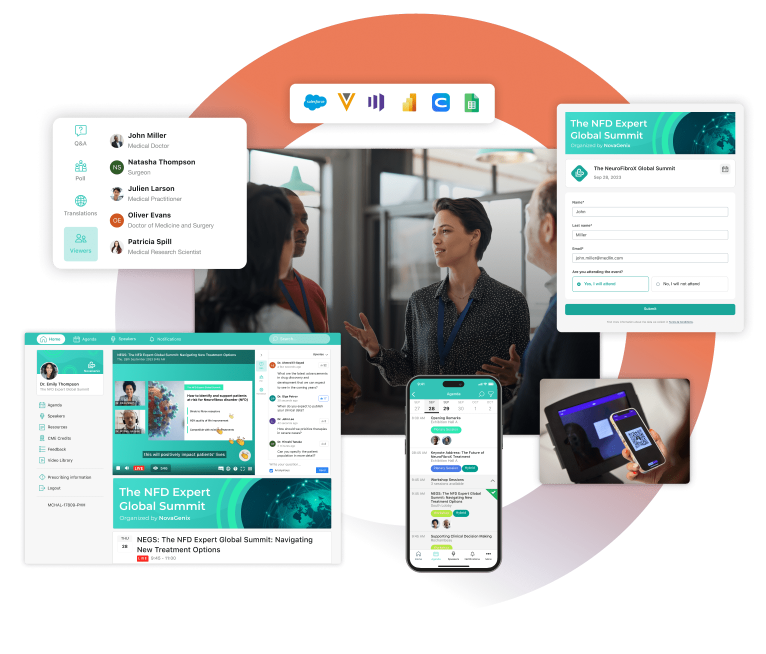
Virtual delivery has its own practical machinery. SpotMe Studio supports live sessions with speakers, shared content, polling and questions. Organizers can also send a broadcast through RTMPS or embed a third-party stream. That matters for teams with existing production equipment: the event platform can receive a professional broadcast without demanding that every production decision happen inside one tool.
On-demand content gives the event another timetable. A recording can remain useful after a live session; a resource library can provide a reason to return. The company also offers integrations with systems including Salesforce, Veeva, Marketo and HubSpot. The intended destination of engagement data is the customer’s existing technology stack. For the buyer, the question becomes very specific: can this interaction reach the right record, in a form someone will actually use?
- ParticipateSession attendance, questions, content use
- ConnectMatch event data with CRM records
- Follow throughGive customer-facing teams context
The feature it was willing to leave behind
In December 2024, CEO Pierre Metrailler described an email he had sent his team. Its title was “Bringing back the R into the CRM.” He argued that customer relationship systems had become too concerned with transactions and too little concerned with relationships. Events, in his account, remained a place where worthwhile customer contact could happen.
“Bringing back the R into the CRM.”Pierre Metrailler’s title for a team email
The revealing detail is the choice that followed. Metrailler said SpotMe concentrated on CRM integration and industry specialization, particularly life sciences. That meant maintaining only basic capabilities in some areas, including registration, while working to close those gaps. This is a recognizable product strategy because it has an opportunity cost. Engineers working on one difficult handoff cannot simultaneously perfect every other part of the event.
The market offers several credible alternatives. Cvent, RainFocus and Bizzabo joined SpotMe in the Leader group of Forrester’s Q4 2024 assessment of all-in-one event management platforms. SpotMe’s useful distinction is its emphasis on specialized engagement workflows and CRM context. A buyer whose hardest problem is somewhere else should test that problem directly. A badge scanner is easy to demonstrate. A reliable flow into an existing customer record deserves a more demanding rehearsal.

Three workshops, and the weeks between them
A published SpotMe case describes a Big Four professional services firm bringing together 100 internal and external leaders remotely. The program had three live workshops across three months. Between them came on-demand material and community activities. A welcome video, a feed post and a quick-start chatbot helped people find their footing. Quizzes, resources and discussion boards gave them something to do once they arrived.
Reported by SpotMe for this leadership program.
The case headline calls this 80% engagement. The underlying result is more precise: 80% app adoption, alongside a 77% average watch ratio and more than 50 questions. Those measures describe different behaviors. Keeping them separate is useful; a login, sustained viewing and a question each tell an organizer something different.
Another published case, involving BNP Paribas clients, describes 200 remote participants and three virtual events over two weeks. An onboarding checklist, chatbot guidance and direct support accompanied short interactive sessions. The reported average online time was 77 minutes for a 90-minute workshop. The copyable move in both cases is modest: help people enter, give them a reason to contribute, and make the interval between meetings part of the program.
Pharma buys the permissions as well as the performance
Life sciences brings requirements that a generic conference checklist can miss. In October 2024, SpotMe launched Onomi, its specialized life sciences product and services suite. Its stated scope includes congresses, webinars and advisory boards, with workflows for healthcare professional outreach, registration, validation, medical review and transparency reporting. Veeva and Salesforce connectors carry engagement information toward commercial, medical and marketing teams.
An anonymized Onomi case makes the operational problem plain. A top-ten pharmaceutical company had too many tools, inconsistent experiences, fragmented data, compliance exposure and expensive reliance on agencies. The response included a branded platform, templates, a SharePoint procurement workflow and several delivery options. Some events could be self-served; others could use agency or Onomi support.
One anonymized pharma customer. The same case reports 1,000+ annual events and 44% self-service.
That is a reported customer outcome, not a discount another buyer can assume. The lesson is organizational: consolidation works when teams also change how events are commissioned and built. For a small organizer with a simple guest list and no CRM workflow, this degree of specialization may buy little. For a distributed medical program, permissions and consistent records are part of the event itself.
The postal connection, and the price of a rehearsal
Swiss Post acquired a majority stake in April 2023, with SpotMe management co-investing. The combination looks less eccentric when viewed through Swiss Post’s interest in secure customer communication. SpotMe remained a standalone company under its own brand. The announced roadmap emphasized engagement, CRM integration, security and privacy. A digital audience still needs information delivered to the appropriate people.
The buying model pairs sales-assisted SaaS plans with services. Its public pricing page lists event allowances of two, five and 25, plus a custom enterprise plan. Platform fees require a quote. Separately advertised starting prices include $3,080 for live production and $4,930 for onsite coordination. These are listed add-ons, not a complete event budget; scope belongs in the proposal.
Human preparation is part of the offer. Speaker orientation, rehearsals, moderation and monitoring address problems that software alone cannot settle. SpotMe’s careers page describes a remote team, transparent quarterly objectives and weekly all-hands meetings. An event company also has to organize its own people well enough to support everyone else’s deadline.
The May 2026 release notes return the story to unglamorous details: offline lead capture that syncs after reconnection, and expanded two-way Marketo synchronization. Congress Wi-Fi can disappear. A contact still needs to survive. SpotMe’s most persuasive promise lives in that small passage from an interaction to a usable record. The applause may finish on time. The follow-up needs its own design.
Take a closer look
Explore the product, its specialist suite and the conversations around them.