Zuddl unveils AI Agents for event marketers at IMEX America 2025 & Money20/20 USA$13.35M Series A led by Alpha Wave Incubation & Qualcomm Ventures4.8 stars across 76+ G2 reviews100+ customers · 600+ events & countingTrusted by Google, Microsoft, ServiceNow & the United NationsFrom a Y Combinator seed to enterprise event stages worldwide
Company Profile · Event Software
Zuddl runs the room - and follows the lead home.
A modular platform for conferences, field events, and webinars, built for B2B marketers who are tired of duct-taping five tools together.
Founded 2020HQ San FranciscoStage Series ABacked by Y CombinatorTeam ~95
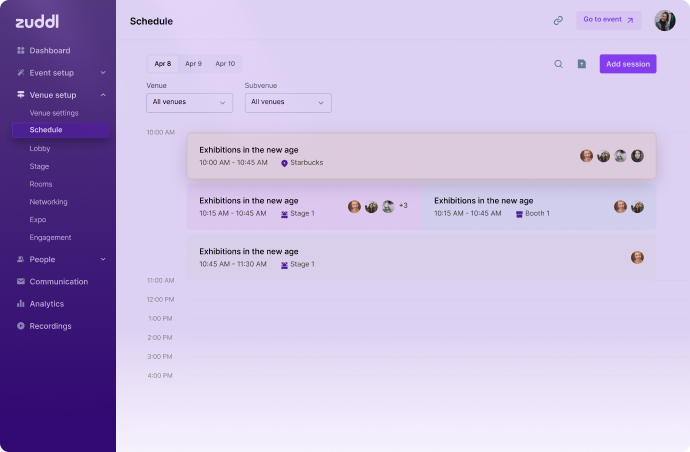
The Zuddl control room: a schedule builder that looks deceptively calm, considering it is holding an entire conference together. Logo, top left, doing its quiet job.
It is a Tuesday in Las Vegas, and the badge printer is humming.
Somewhere on a conference floor, a marketer scans a QR code, a name badge prints, and - this is the part that used to be impossible - that attendee's every poll answer and session minute lands in Salesforce before lunch.
That quiet handoff between a physical room and a CRM record is the whole point of Zuddl. The company sells event management software to B2B marketers: the people responsible for conferences, field events, and webinars who, until recently, ran each of those on a different tool and prayed the data lined up afterward.
Today Zuddl is a Series A company out of San Francisco, roughly 95 people, powering 600+ events for more than 100 customers - a roster that includes Google, Microsoft, ServiceNow, Kellogg's, and the United Nations. It is not the loudest name in events. It is the one event teams keep renewing.
"We are on a mission to simplify events."- Zuddl, on its own about page (refreshingly, just five words)
The problem they saw
Events generate pipeline. Nobody could prove it.
Here is the uncomfortable truth event marketers have lived with for years: an event is the most expensive thing on the marketing budget, and the hardest to measure. Registration lives in one tool. The webinar runs in another. The on-site check-in is a third. The recording sits on a hard drive. By the time anyone asks "what was the ROI?", the data has scattered to the wind.
The result was predictable. Events got treated as a cost center - a brand expense, a nice-to-have - rather than the revenue channel they quietly were. The tools reinforced the problem. Most webinar platforms politely end at "goodbye." Most registration tools never speak to the CRM. The stack was a museum of disconnected logins.
"The event ended. The data didn't follow. That was the bug Zuddl set out to fix."- The central tension, stated plainly
Zuddl's wager was that the fix was not a better webinar tool or a slicker registration page. It was one platform that owned the entire lifecycle - and refused to let go of the data at the end.
The founders' bet
One built the rooms. One built the software.
Zuddl launched in May 2020 - which is to say, at the precise moment in-person events vanished from the planet. Bad timing, or perfect timing, depending on how you tell it.
The two founders made an unusually complementary pair. Bharath Varma had spent years running Phoenix Live, a physical event agency that produced 300+ events for clients like Microsoft, Google, and Deloitte. He knew exactly where events broke, because he had stood in the rooms when they did. Vedha Sayyaparaju brought the other half: an MIT computer scientist who, the story goes, started coding at age six, with engineering stints at Facebook and Pinterest behind her.
Bharath Varma
Co-founder & CEO
Ran Phoenix Live, an event agency behind 300+ productions for Microsoft, Google, and Deloitte. Brought the operator's scar tissue - he knew the failure modes firsthand.
Vedha Sayyaparaju
Co-founder & CTO
MIT-trained engineer who reportedly started coding at six. Previously at Blend, Facebook, and Pinterest. Built the technical engine under the platform.
"An agency operator and an MIT engineer walk into a pandemic. The bet: events aren't a cost - they're a measurable channel waiting for software."- The founding logic, lightly compressed
The receipts
A short company timeline
MAY 2020Zuddl launches as the world's events go dark. Founded by Bharath Varma and Vedha Sayyaparaju.
OCT 2020$2M seed from Y Combinator, GrowX Ventures, and others. Joins the YC 2020 batch.
2021Roughly 20x growth in the first six months; team scales 3x to 60+ people.
JAN 2022$13.35M Series A led by Alpha Wave Incubation and Qualcomm Ventures, with GrowX and Waveform participating.
2024-25Sharpens its B2B focus on conferences, field events, and webinars; earns a 4.8-star average across 76+ G2 reviews.
OCT 2025Unveils AI Agents for event marketing at IMEX America and Money20/20 USA.
The product
Modular, not monolithic - you buy the pieces you run.
Zuddl's design choice is in the word "modular." Instead of forcing a team to swallow one giant suite, it splits into the formats marketers actually plan around. The connective tissue is the data layer underneath, which is the part competitors tend to skip.
01
Conferences
Multi-day, multi-session summits with tracks, sponsor hubs, exhibitor management, and networking spaces.
02
Field Events
On-site registration, QR check-in, badge printing, and lead capture for in-person field marketing.
03
Webinars
Demand-gen webinars with branded stages, live Q&A, interactive overlays, and broadcast-quality streaming.
04
Registration & Ticketing
No-code page builder, multi-tier and multi-language registration, complex discounting and approval flows.
05
Content Lab
AI-assisted repurposing that turns one recording into clips, blog posts, and social assets.
06
AI Agents
On-demand copilots that automate event workflows, personalize experiences, and surface real-time insights.
"Branded stages, badge printers, and Salesforce records - in one login. The boring miracle is that they finally talk to each other."- On why 'modular' beats 'monolithic'
The CRM integrations are the quiet heroes. Engagement data - poll responses, CTA clicks, how long someone actually stayed - flows into Salesforce, HubSpot, and Marketo, where it becomes lead scoring instead of trivia. That is the bridge from "we hosted an event" to "we sourced this much pipeline."
The proof
The numbers behind the renewals.
A platform people merely tolerate does not earn 4.8 stars. Here is the shape of Zuddl's traction - funding, footprint, and the review score event teams keep handing it.
Zuddl by the numbers
Relative scale across funding, footprint, and satisfaction (each bar normalized to its own metric)
Series A ($M)
$13.35M
Total raised ($M)
$15.5M
Events powered
600+
Customers
100+
G2 rating
4.8 / 5
Figures from public sources (Crunchbase, Zuddl, G2). Revenue and valuation estimates circulate (~$18M ARR, ~$54M) but are unverified - treat them as directional.
A partial customer list. Reviewers single out two things repeatedly: the customization, and a support team that answers at nearly any hour. The common gripe - a learning curve, because there is a lot under the hood.
The mission
Make events easy, straightforward, and revenue-driven.
Zuddl frames its purpose around "humanizing" virtual and hybrid experiences - keeping the human warmth of a room while bringing the rigor of software to everything around it. The vision is blunt about money: events should not just feel good, they should be accountable to pipeline.
That is a quietly contrarian stance in an industry that has long measured success in badge scans and vibes. Zuddl's answer is to treat every interaction as data worth keeping - then hand it back to the marketer in a form their CFO will actually respect.
"Events should be measured like the revenue channel they are - not the cost center the spreadsheet pretends they are."- The mission, distilled
Why it matters tomorrow
The badge printer is still humming. Now it remembers.
In-person events came roaring back, and the field-marketing budget came with them. But the bar moved. Nobody wants a beautiful event they cannot account for anymore. The 2025 launch of AI Agents points at where Zuddl is headed: not just capturing event data, but acting on it - automating the busywork and surfacing the insight while the event is still live.
The competition is real - Cvent, Bizzabo, ON24, Goldcast, and others want the same seat at the table. Zuddl's edge is its origin story: a founder who ran the rooms, an engineer who built the system, and a stubborn refusal to let the data evaporate at "goodbye."
So return to that Tuesday in Las Vegas. The marketer scans a badge. A name prints. But now the room is not a black box - every minute, every poll, every question rides home into the CRM, where it stops being a memory and starts being a number. That is the change Zuddl made: the event still ends. The data, for once, keeps going.
"Most platforms say goodbye. Zuddl says: tell me everything on the way out."- And that, in one line, is the company