The 66-Year-Old Radio Company Betting Your Cell Phone Will Fail You
Cell towers go down in storms. Midland Radio has spent 66 years selling the backup - and turned a fading CB brand into the default radio for Jeep trails, farm fields, and emergency closets.
Somewhere in a Missouri closet right now, a small black box is listening. It does nothing most days. Then a storm knocks out the power, the cell towers choke, and the phone in your pocket becomes an expensive flashlight - and the box comes alive with a NOAA weather alert for your exact county. That box is almost certainly a Midland. And selling the moment your other devices quit is, more or less, the whole business.
Midland Radio Corporation has been making two-way radios in Kansas City since 1959. It is not a startup, not venture-backed, and not chasing any of the categories that dominate a 2026 news feed. It is roughly 85 people making an estimated $30 million a year selling walkie-talkies, mobile radios, CB sets, and weather radios - and it has quietly outlasted the CB craze, the cell phone, and the smartphone by understanding one thing better than almost anyone: those technologies all fail, and someone has to sell what works when they do.
01 / What it doesThe company that sells the failure mode
Strip away the product catalog and Midland's pitch is a single sentence: the tower goes down, we don't. Its radios talk to each other directly, over the air, with no network, no subscription, and no monthly bill. On a Jeep trail with no bars, on a farm that sprawls past cell range, in a basement during a tornado warning, that is not a nice-to-have. It is the only thing that works.
The catalog splits into a few clear buckets: handheld walkie-talkies, in-vehicle mobile radios, business radios for worksites and events, CB radios, and the emergency and NOAA weather radios that sit in millions of American homes. Different customers, one promise.
02 / Where it came fromFrom CB boom to GMRS pivot
In the 1970s, Citizens Band radio was a cultural moment - truckers, farmers, and hobbyists all crackling across the same 40 channels - and Midland was one of the brands that rode it. Being early to a craze is easy. Surviving its collapse is the hard part, and that is where the more interesting story sits.
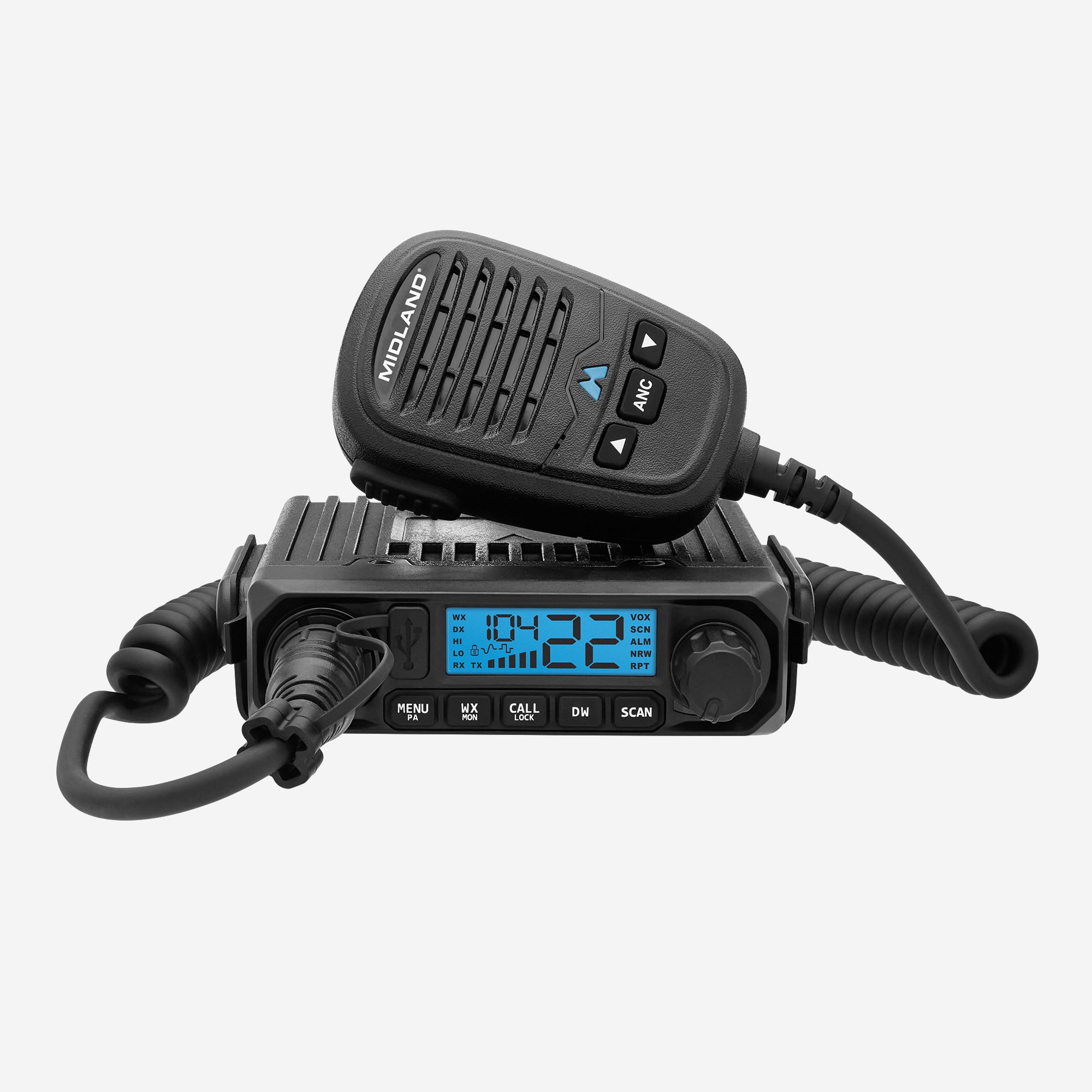
In 2001 the company acquired the U.S. land-mobile-radio operations of Securicor Wireless and formally became Midland Radio Corporation, adding a business-and-public-safety spine to its consumer line. Then in 2016 it launched MicroMobile, a line of GMRS radios - the license-light band that off-roaders actually wanted. CB was fading. GMRS was rising. Same company, same factory, new wave. Midland simply followed its customers to the next band and got there first.
03 / Who buys itSix audiences, one radio
Midland's customer list reads like a cross-section of people who spend time where the signal drops. Overlanders and off-roaders. Hunters and anglers. Farmers and ranchers running crews across acreage. Campers and families. Event and worksite teams. And emergency-preparedness households stocking the closet for the next storm.
One segment stands out for how deliberately it was chosen. Midland's WR120 weather radio pairs with a strobe light and a bed-shaker so deaf and hard-of-hearing families are alerted to a severe-weather warning by light and vibration - not sound. It is a product decision most companies would never think to make, and it is the kind of thing that turns a niche into a moat.
04 / The distribution trickHow Jeep made Midland the default
The smartest thing Midland did in the last decade was not build a better radio. It was get written into someone else's rules. Since 2020, Midland has been the official communication partner of Jeep Jamboree USA, and Jeep Jamboree and Adventure Academy events now require a GMRS radio to participate. Show up without one and you cannot roll.
That single policy converted an entire off-road culture from CB to GMRS - and made Midland the obvious brand to buy on the way in. A 2023 co-branded X-Talker Extreme sealed the association. Features get copied. A spot inside the rulebook does not.
05 / The productsFrom a matchbook to a hand-crank
The range is wider than the brand's low profile suggests, and the recent launches show a 66-year-old company that still ships.
06 / The businessA 1959 brand on a modern DTC stack
Here is the detail that amuses: the whole thing runs on Shopify. Behind a heritage manufacturer sits a thoroughly modern direct-to-consumer engine - Klaviyo for email, NetSuite for operations, Bazaarvoice for reviews - selling straight to buyers at midlandusa.com. That runs alongside an Amazon storefront, specialty dealers, and a B2B land-mobile line. Consumer at the front door, business fleets out the back. One brand, two business models, and no venture money holding the pen.
07 / Where it fitsSmall brand, big shelf
Midland competes on shelves dominated by much larger names - Motorola, Cobra, and Uniden in the mainstream, plus a wave of budget imports like BaoFeng in the handheld aisle. It does not out-spend them. It out-focuses them, embedding into the overlanding, hunting, and preparedness communities through partnerships with Mossy Oak, onX, RAM Mounts, and the Jeep ecosystem rather than mass advertising.
The through-line across 66 years is unglamorous and durable: find the people whose phones stop working, sell them the thing that doesn't, and be genuinely useful in the exact moment everything else quits. It is a smaller market than the one the phone makers fight over. It is also one nobody can take away.