In 2011, most people would have told you that a swimming pool and an iPod were a bad combination and left it at that. A marketing student in Oregon named Scott Walker did not. Working with his family, he developed a way to make a genuine Apple iPod Shuffle survive full submersion - without ever cracking the case open - and started selling it to the one audience that had been quietly starved of decent audio for years: swimmers. That small, stubborn idea became Underwater Audio, a family-run electronics company in Corvallis, Oregon that has spent well over a decade building products for people whose gym is a lane line.
It is a company defined by a single physical fact that most of the consumer-electronics world would rather ignore. Runners have podcasts. Cyclists have playlists. Lifters have their pre-set anthems. Swimmers, for the most part, had the sound of their own breathing. Underwater Audio exists to close that gap, and the reason it has been able to hold the space for so long comes down to a problem that is genuinely hard to solve.
01 / The ProblemWater breaks almost everything about headphones
Two things fail the moment you take ordinary earbuds underwater. The first is the seal: a headphone that is fully sealed against water tends to sound terrible, while a headphone that sounds good usually needs open vents that let water straight in. The second is the signal. Bluetooth, the technology every modern earbud depends on, does not travel well through water at all.
"You can close headphones up and make them waterproof, or you can leave spaces open and have good sound quality, but to do both of those is really hard."Underwater Audio
The Bluetooth issue is the more brutal of the two. Radio signal strength, as the company puts it, "falls off with the square of the distance," and water accelerates that decay dramatically. A phone left on the pool deck cannot reliably reach earbuds a few feet under the surface. This is why so many "waterproof" earbuds still cut out the instant a swimmer submerges - the hardware may survive, but the stream does not.
Why streaming struggles at the bottom of the pool
Underwater Audio's answer has been consistent for years: do not depend on a signal that disappears. Put the music on the device. It sounds almost old-fashioned in a streaming world, and that is exactly the point.
02 / The OriginBuilding a business on someone else's product
The company's first product was, in a sense, not its own. It took a real Apple iPod Shuffle and applied a proprietary internal waterproofing process - using hydrophobic materials, and notably never opening the device - so it worked fully submerged. The result functioned in everything from light humidity to complete submersion, tested to survive indefinitely in up to roughly ten feet of water. It was not affiliated with Apple, but it made Apple's smallest player do something Apple never intended.
The strategy worked. By 2013 the company had reached the number-two market-share position in waterproof music players and was named a top student-run business by the Utah Student 25. For a venture started by a college junior, that was real traction in a category the giants were not chasing.
03 / The PivotWhat happens when Apple kills your core product
In 2017, Apple discontinued the iPod Shuffle. For a company whose entire origin was waterproofing that exact device, this was close to an extinction-level event. A business built on modifying another company's hardware lives and dies by that company's roadmap - and the roadmap had just ended.
Rather than fold, Underwater Audio built its own player. The SYRYN arrived as an 8GB waterproof MP3 player holding roughly 2,000 songs, or about 138 hours of audio, loaded by dragging and dropping files from a PC or Mac. No streaming service required, no signal to lose. It was a deliberate throwback that solved the underwater problem by sidestepping it entirely.
04 / The ProductsFrom a stubborn MP3 player to a waterproof tablet
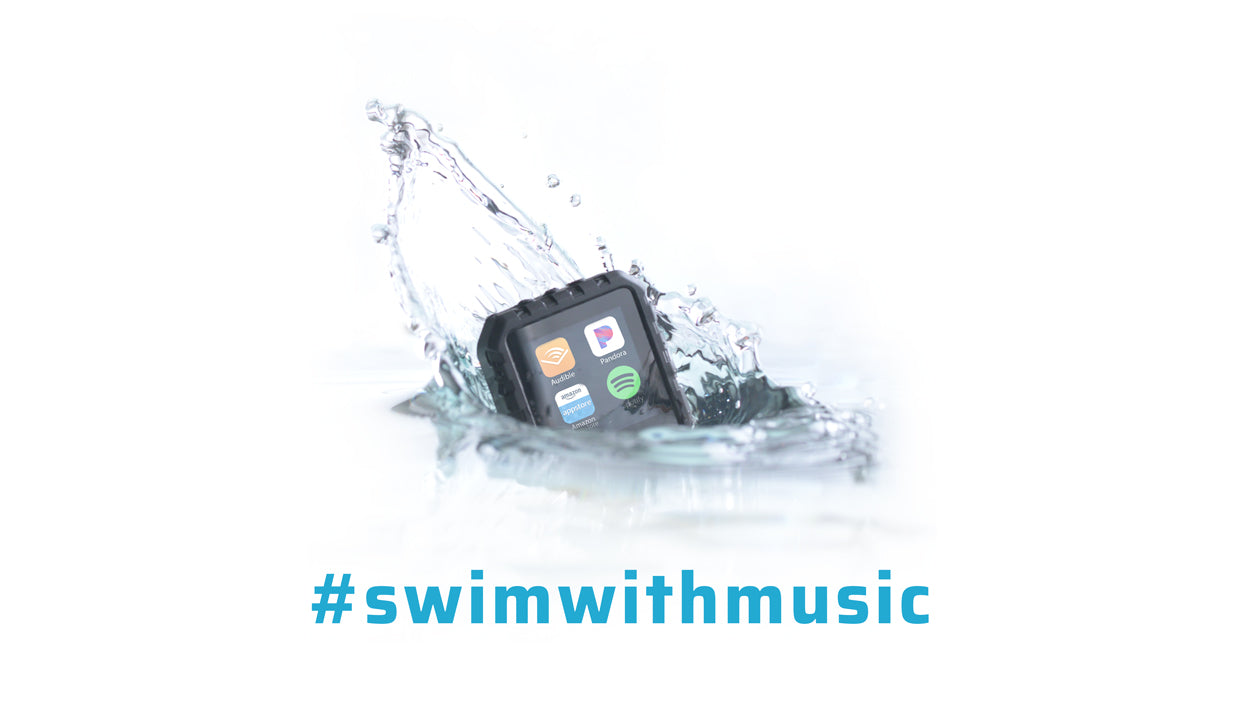
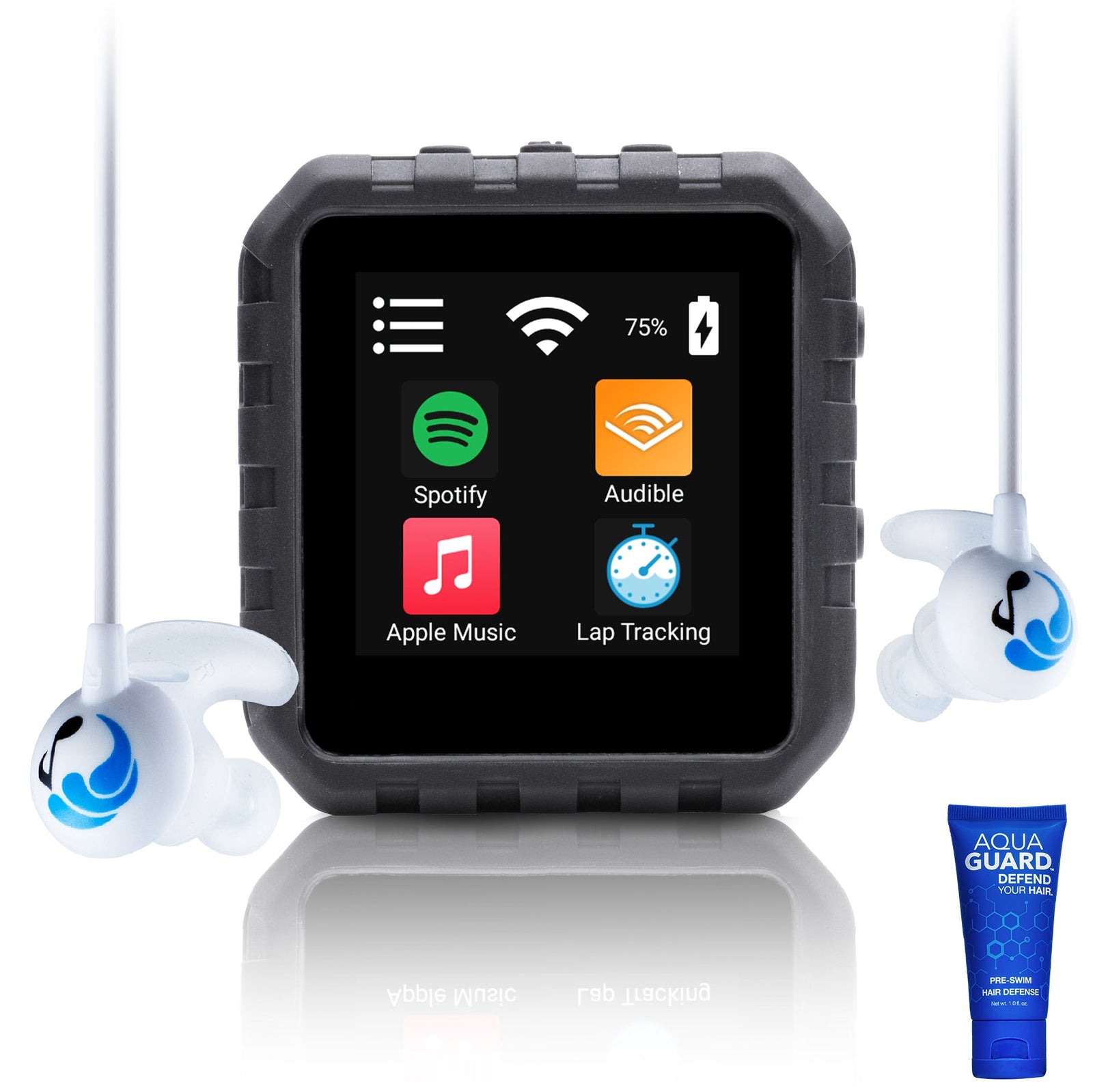
The Delphin is where the story gets more ambitious. It is a waterproof micro-tablet, offered in 8GB and 16GB versions, that runs the full versions of apps a phone runs - Spotify, Audible, Pandora, and titles from the Amazon Appstore. Crucially, it downloads that content to the device first, so playback keeps going even when a live signal would not. Where a swimmer does want a wireless earbud, the Delphin can clip to the goggle strap just inches from the ear, close enough that a short Bluetooth hop stays strong.
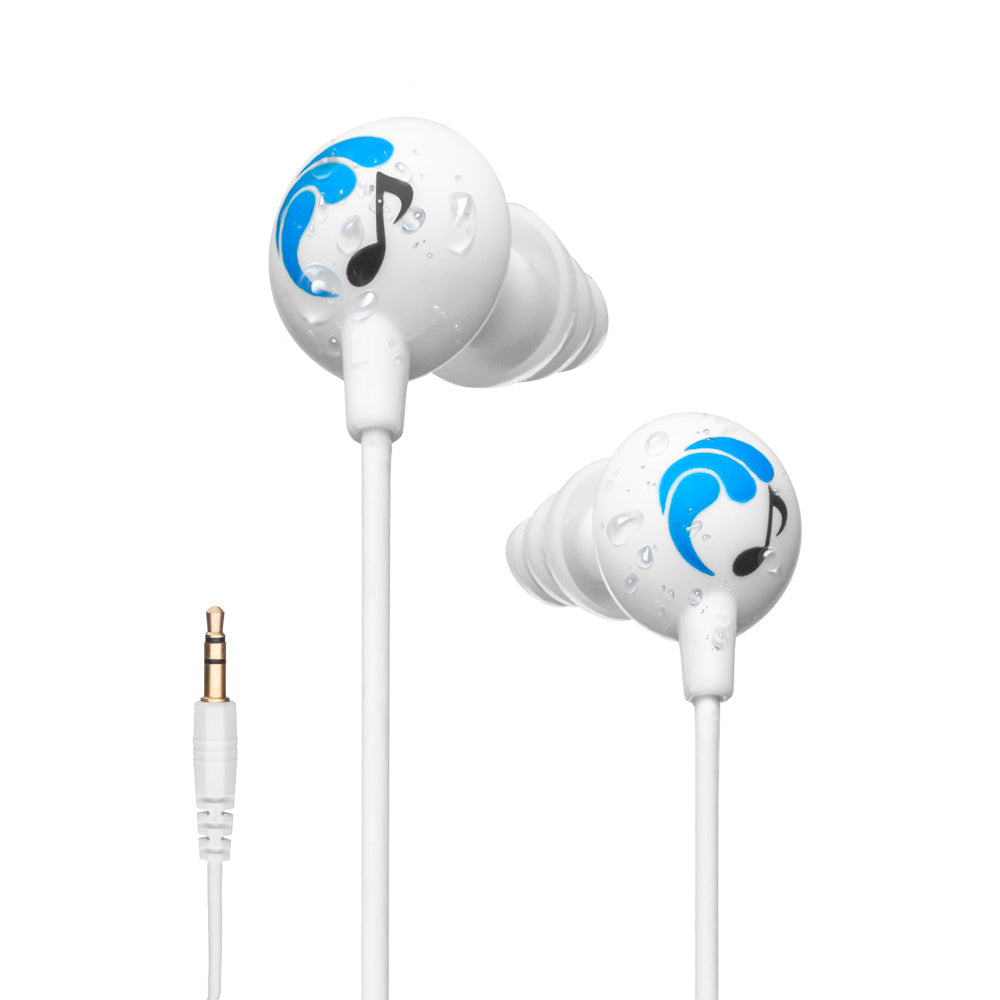
Then there is the fit problem, which the Swimbuds line exists to solve. Swimbuds Sport ship with as many as eleven different eartip shapes and sizes. That seems excessive until you understand the underlying rule: underwater, the seal is the sound. A watertight fit is not a comfort feature; it is the difference between hearing music and hearing water. For swimmers who dislike eartips altogether, the company added Swimbuds Bone Conduction, which rest on the temples and transmit sound through the cheekbones, leaving the ear canal open.
Around these sit the accessories that complete the promise printed across the company's storefront - "Everything You Need to Swim with Music": goggles, swim caps, replacement cables, lubricants, eartip kits, and the AquaGuard line of hair and skin care aimed at people who spend a lot of time in chlorine.
The audio is stored on the device, resulting in zero interruptions - unlike gear that relies on a stream that can vanish underwater.The core design principle
05 / The CustomerThe market the giants skip
Underwater Audio's buyers are not audiophiles arguing about soundstage on a forum. They are daily lap swimmers, Masters groups, triathletes training for the swim leg, and open-water athletes logging long distances - plus surfers, divers, and beachgoers. Products have been used by competitive swimmers up to the Olympic level, including Rebecca Soni. The company ships to the United States, Canada, and Australia, and its storefront supports well over 100 countries and currencies.
This is a focused niche by design. The broader swimming-headphone market is still relatively small - estimated in the low hundreds of millions of dollars and growing steadily as water-based fitness expands. It is precisely the kind of market a Sony or a Bose will not build a dedicated business around, which leaves room for a specialist that thinks about nothing else.
06 / The ModelA small, direct, unglamorous machine
Underwater Audio is direct-to-consumer hardware. It designs and waterproofs its devices and sells them mainly through its own Shopify store, supported by Klaviyo email, an AvantLink affiliate program, and on-site product reviews, with additional distribution on Amazon and Walmart. Revenue comes from device sales, bundles that pair a player with Swimbuds and accessories, and repeat purchases of consumables like eartips and swim-care products.
By the numbers available publicly, this is a compact operation - a team of roughly 20 people with estimated annual revenue near $668,000, and no disclosed outside funding. It is a reminder that not every company needs a raise or a hockey-stick chart to matter to the people who buy from it. Its competitors - H2O Audio, Shokz, Zygo, Sony, FINIS, and others - are often larger, but few are as singularly focused on the swimmer.
How Underwater Audio differs
07 / The ArcFifteen years, one obsession
There is a quiet discipline in the way Underwater Audio has stuck to one customer for a decade and a half. It survived the loss of its founding product by understanding that its real business was never the iPod - it was the swimmer, and the specific, physics-bound problem of getting sound to them underwater. Solve that better than anyone else bothers to, and a small company can hold a niche the big ones never come for.