A virtual insurer opens a coffee shop. The sentence has the pleasing awkwardness of an accountant buying a disco ball. In March 2021, Michael Chan was explaining why Bowtie, a company built to let people buy insurance online, had opened Bow Coffee in Wan Chai. Customers could sit down, order a drink and ask a member of staff about their policy. The business that had removed the sales agent from the transaction was putting a person back into the conversation.
Chan reached for a familiar comparison: “It is like the Apple Genius Bar at the Apple Stores.” The original cafe could answer questions, but licence restrictions prevented it from selling policies directly. That distinction made the place interesting. Someone could come through the door with a worry rather than a purchase in mind. The coffee gave the encounter an ordinary setting. A policy question no longer required an appointment with the full ceremonial weight of a financial decision.
That small, physical experiment offers a useful way into Chan’s career. His work is concerned with the machinery behind insurance: how products are designed, how customers reach them, and how much unnecessary effort sits between the two. But a machine can make a transaction easier without making a customer feel entirely comfortable. A chair, a cup and somebody willing to listen address a different part of the problem.
Two mathematicians, one unfinished job
Chan grew up in Hong Kong. His education took him to the University of Waterloo in Canada, where he graduated with a Bachelor of Mathematics in 2008. Fred Ngan, his future co-founder, was a Waterloo mathematics graduate from the year before. They first met in the United States while working as actuaries at global advisory firms. Their partnership began with experience inside the industry they would eventually attempt to change.
There is a particular usefulness to that background. Insurance asks people to pay today for a promise that may become important much later. An actuary has to think about the price of that promise and the obligations it creates. It is an occupation in which enthusiasm eventually has to sit down beside a spreadsheet. Chan became a Fellow of the Society of Actuaries and a Certified Financial Planner; he is also a member of the Actuarial Society of Hong Kong.
By the time Waterloo profiled the pair in 2019, each had roughly a decade of global insurance experience. They saw room to use technology to explain products more clearly and make buying them easier. The opportunity was partly a question of incentives. A simple, relatively inexpensive product can be useful to a buyer while offering little commission to the person expected to sell it. Changing the distribution system could change which products found an audience.
The partner disappeared. The ambition stayed.
Before Bowtie, Chan co-founded Coherent Capital Advisors and Seasonalife. These were earlier attempts to apply technology to financial services and insurance. The important turn came while he and Ngan were still building software for the industry. In 2017, they signed a memorandum of understanding with an insurer to design its digital front end. Then the insurer was sold, and the arrangement was terminated.
Ngan later described the decision they faced: seek another partner, or obtain their own insurance licence and take responsibility for the entire experience. Their software could depend on another company’s priorities, or they could build an institution with priorities of their own. The second route required capital, shareholders and regulatory approval. It also gave them a way to connect product design with what happened when an actual customer clicked through the screen.
The failed arrangement belongs in Chan’s story because it makes the change in scale intelligible. Bowtie was not simply another version of an insurance comparison tool. It would carry the obligations of an insurer. A founder could no longer hand over a clever interface and leave the rest to somebody else. The business would have to stand behind what that interface promised.
Mathematics
A choice begins
Responsibility follows
Permission to do the difficult part
On 20 December 2018, Bowtie announced Hong Kong’s first virtual insurance licence under the Insurance Authority’s Fast Track pilot scheme. It also announced a US$30 million Series A backed by Sun Life Hong Kong. Chan and Ngan had moved from helping other businesses use technology to running an insurance company themselves. The launch made their experiment public and gave it a regulated foundation.
The word “virtual” can sound wonderfully weightless. Insurance regulation is quite the opposite. Fast Track created a dedicated route for businesses using digital distribution without intermediaries, while retaining the prevailing requirements for solvency, capital and local assets. A new route to the customer came with familiar duties towards the policyholder. The founders had permission to change the delivery system, alongside the obligation to make the company behind it dependable.
At the licence announcement, Chan described Bowtie in a sentence that still explains much of his work: “Bowtie is all about delivering convenience to consumers through technology.” Convenience sounds modest beside the usual language of startup ambition. It is also unusually easy for a customer to judge. How much time did the process take? Could they understand what they were buying? Could they manage it themselves? Those questions turn a founder’s intention into an experience someone else can assess.
Convenience sounds modest. It is also unusually easy for a customer to judge.On Chan’s founding proposition
A founder willing to borrow a map
Chan’s public role today includes strategy and product development. Ngan’s includes partnerships, distribution and external affairs. Their partnership gives the story two distinct kinds of work: deciding what the product should be, and finding the relationships through which the company can grow. It is a more useful picture than the solitary founder posed heroically beside an empty whiteboard.
The relationships extend beyond the founding pair. In December 2020, Daisuke Iwase, co-founder of Japan’s digital life insurer Lifenet, joined Bowtie as a senior adviser. Chan acknowledged that digital insurers, including his own, had studied Lifenet. There was a working example to learn from. Building something new in Hong Kong did not require pretending that nobody elsewhere had encountered similar questions.
Bowtie’s advisers also include John Tsang, Hong Kong’s former financial secretary. Former financial-services and treasury secretary James Lau joined its board as an independent non-executive director. These connections matter for a business selling a long-term promise. Software expertise, experience of digital insurance and familiarity with financial institutions each bring a different view of the same enterprise. Chan’s company has made room for all three.
Its interest in explanation goes further. In 2024, Bowtie appointed the YouTuber Tommy Leung, known as Ming Jai, as a creative adviser to help its marketing and YouTube teams tell stories. Chan has his own author page on Bowtie’s Chinese-language blog, with pieces on term-life pricing and a higher coverage limit. An insurer needs customers to understand it. A price table has its uses; it rarely develops much of a conversational manner.
The numbers grow up
By July 2025, the financial scale had changed. Bowtie announced up to US$70 million in Series C funding led by Sun Life Hong Kong. Its May 2025 figures put annual recurring revenue above US$80 million. Sun Life remained a partner, while Bowtie retained its own leadership, brand and culture. The relationship that helped launch the company was still part of its next stage.
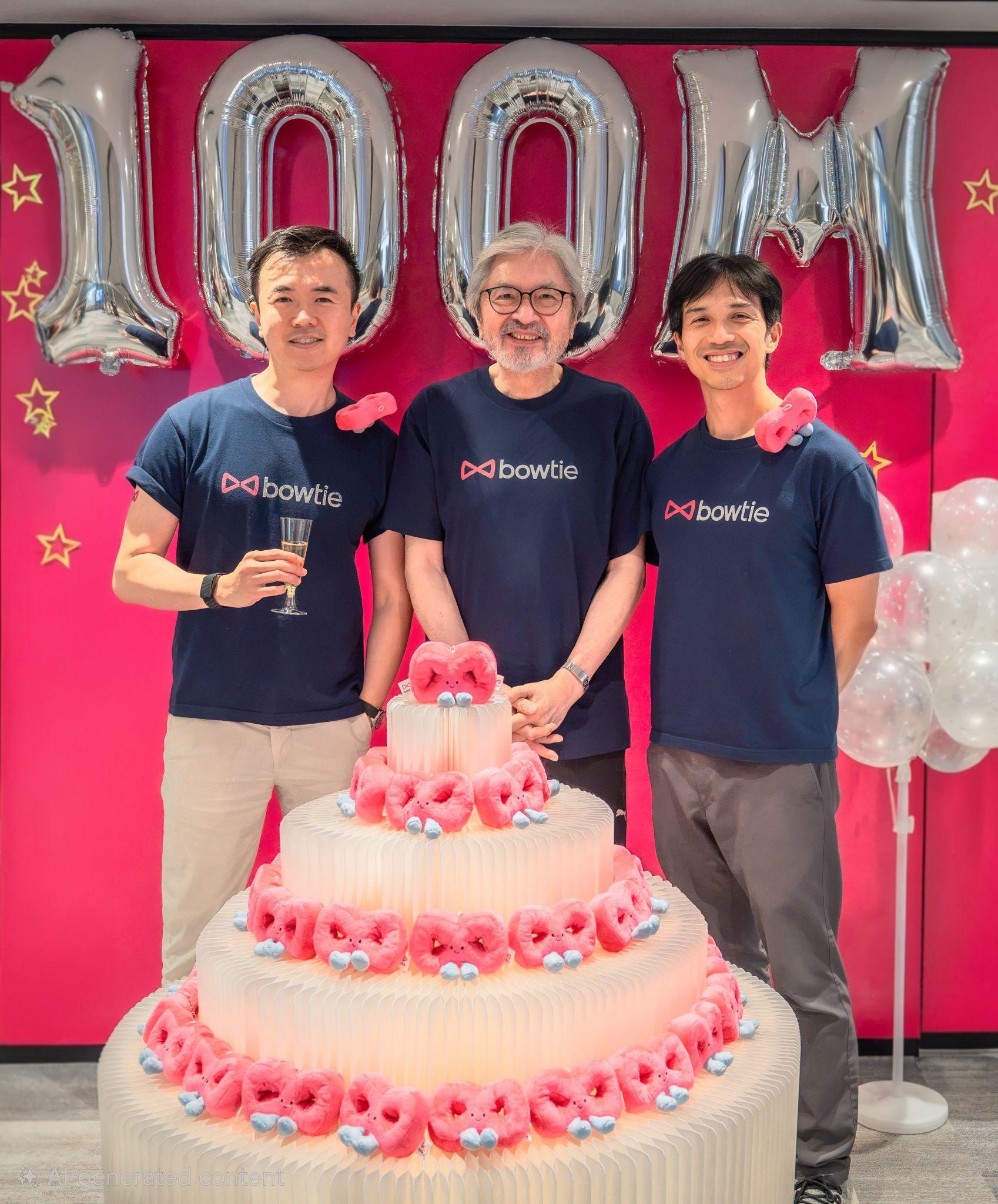
In July 2026, Bowtie announced that annual recurring revenue had crossed US$100 million. The celebration photograph is agreeably literal: Ngan, Tsang and Chan stand behind a cake beneath enormous silver “100M” balloons. Chan is on the right, wearing the same company T-shirt as the others. The actuarial calculation has acquired party decorations. Nobody appears to have asked the balloons to explain the revenue recognition policy.
The figures deserve their proper names. Recurring revenue is a measure of the continuing business, not a statement of profit. Bowtie’s August 2026 transparency update separately reported FY2025 insurance revenue of HK$511.8 million, compared with HK$227 million a year earlier. It also reported more than 150,000 customers and retention above 93%. These are company figures, and they describe several different aspects of scale. Reading them separately gives a clearer picture than allowing one large number to do every job.
For Chan, the recurring-revenue milestone makes the original distribution experiment substantial. People have chosen to use an insurer they can approach directly. Retention adds a further test: whether they continue that relationship. The early question about reaching customers has become a continuing question about serving them. Growth gives that question more weight, because more people now have an answer of their own.
Announced July 2026
August 2026 update
August 2026 update
The cloud gets a front door
On 25 February 2026, Bowtie inaugurated its new headquarters at 68 Johnston Road in Wan Chai. The company had secured a five-year lease for seven floors and the building’s naming rights. Bow Coffee occupied the ground and mezzanine levels, with offices above. The company that entered the market through a digital licence had made itself visible on a street.
The cafe idea had survived beyond the first experiment. At the flagship location, customers could seek information and support from the service team in an everyday setting. Its place in the headquarters makes the practical point quite clearly. A digital process and a face-to-face conversation can belong to the same business. Customers need not share a founder’s appetite for doing everything through a screen.
Chan also described the workplace as “a studio for collaboration rather than a place for routine administration”. The relocation announcement outlined flexible shared seating alongside designated areas for essential operational teams. It is a description of what he wants an office to do: bring colleagues together to work on problems. The building has a public job downstairs and a working job upstairs.
That is where the coffee shop becomes more than an amusing detail. At the beginning of this story, it looked like an eccentric accessory to a virtual insurer. At the new headquarters, it is part of the architecture. Chan’s pursuit of convenience has led through software, a licence, funding rounds and product decisions, then back to a place where somebody can simply ask a question. An algorithm can take a customer a long way. A front door gives them somewhere to arrive.