Meagan Ward’s route to the C-suite begins with an art-history degree, a job she did not love, and people building robots after hours. During the financial crisis, with career options hardly abundant, she went to work at a firm that insured and defended decisions made by directors and officers. The position taught her the cool usefulness of distance. It also clarified what she did not want. In the evenings, she joined a robot-building group. Many of its members worked at startups, and their work suggested a career that could accommodate two appetites she had assumed belonged in separate rooms: art and science.
That small collision of worlds became a map. Ward moved to a Y Combinator startup where the scarcity of hands meant abundance of experience. She did a little of everything, describing it later as a kind of rotational program. Somewhere in that shuffle, communications stopped being one task among many and became the task. It offered the same pleasure as interpreting a painting, except the canvas could be a young company, the audience impatient, and the frame still under construction.
The accidental apprenticeship
Ward’s early jobs gave her an unusually broad education in consequence. Directors-and-officers insurance is concerned with decisions after they have acquired lawyers. Startup work is concerned with decisions before anyone knows whether they will matter. At The Hatch Agency, she learned the public middle: technology launches, mergers, initial public offerings, and the reputational moments when a company’s chosen language meets everybody else’s interpretation.
She advanced through the agency and joined its leadership team. Then came Qventus, where she led communications for a company using artificial intelligence to improve complex operations. Each stop added another dialect: insurance, startups, public relations, AI, software. By 2019 she wanted to return to financial technology. Addepar, a platform that unifies investment data for advisers, family offices, banks and institutions, offered a particularly intricate translation problem.
- 2010Insurance after college, with an evening detour into robot building.
- 2011A Y Combinator startup becomes an informal rotation through the business.
- 2013-2018The Hatch Agency teaches launches, reputation and technology storytelling.
- 2018Ward leads communications at AI operations company Qventus.
- 2019She joins Addepar as head of communications.
- 2023After expanding her remit, she becomes Addepar’s CMO.
- 2026Bestow names Ward its first chief marketing officer.
The chronology is neat on a timeline. The useful part is the mess underneath. Ward did not set out from Berkeley with a fifteen-year plan to market financial infrastructure. She followed work that let her combine disciplines, then accumulated fluency in businesses whose value was not obvious at first glance. The roundabout route became an advantage. Enterprise technology rarely needs a slogan as much as it needs a patient interpreter.
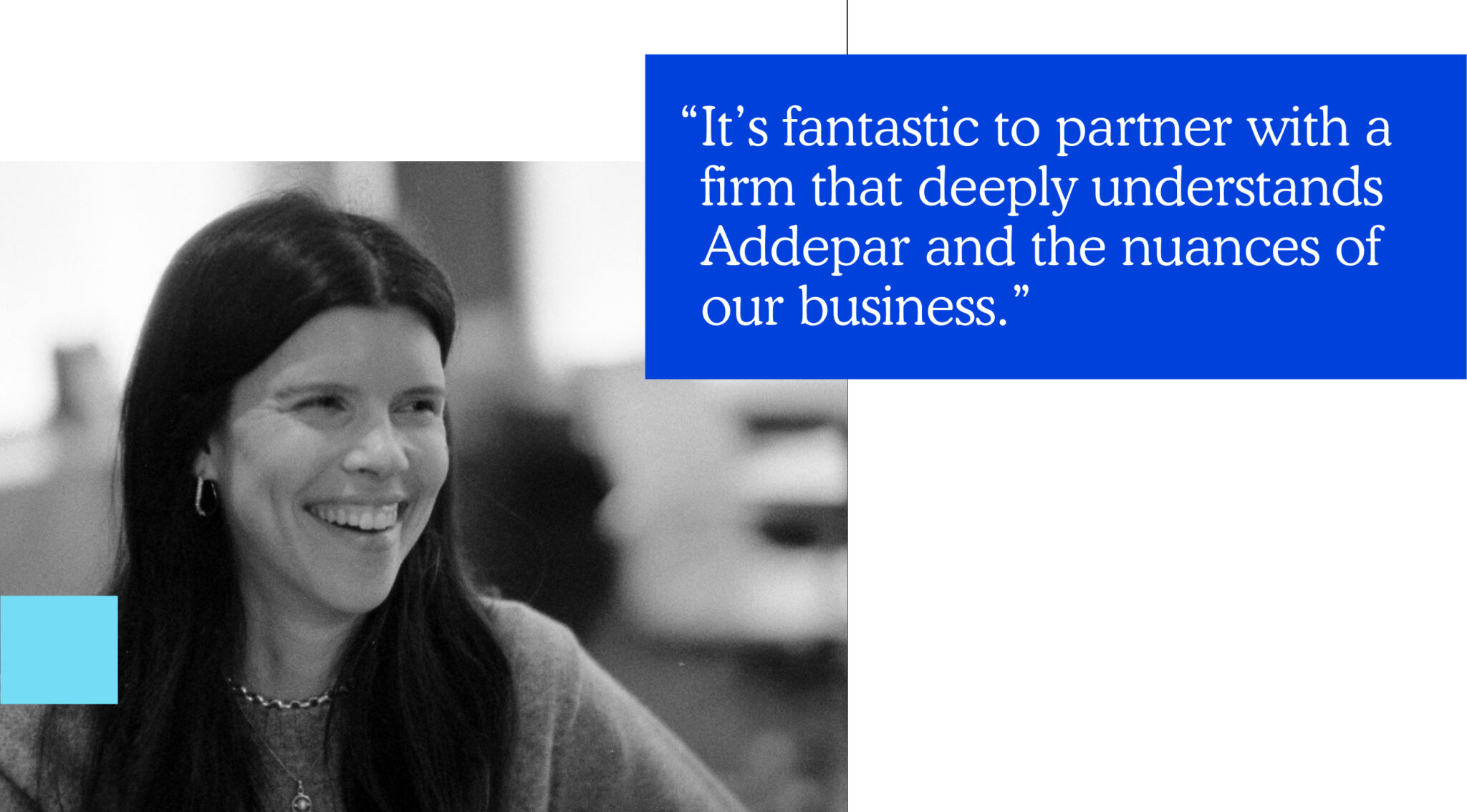
Storytelling is “the spring from which everything else flows.”Meagan Ward on communications and brand building
Learning to narrate scale
Ward entered Addepar when the company had about 200 employees and barely $1 trillion in client assets on its platform. She remembers working to secure its first Bloomberg coverage. Five years later, when she reflected on the journey, the staff was nearing 1,000, the platform served clients across 45 countries, and the assets figure had reached $6 trillion. Addepar had also passed 1,000 client firms. Numbers that large can become narcotic. They sound impressive while explaining almost nothing about what changed for the person using the product.
Her work was to give scale a plot. In 2023, she shared Addepar’s brand evolution and its “Altogether Better” positioning, language intended to hold a wider product set, more industry segments and a broader geography. The challenge was not merely to make a growing company appear consistent. It was to discover the consistency inside the growth, then express it in a form clients and colleagues could recognize.
Ward rose from director of communications through senior director and vice president, eventually adding marketing and becoming CMO in 2023. The promotions track an expanding theory of the job. Communications could shape the media narrative. Brand could connect the company’s DNA, vision and values. Marketing could execute campaigns and measure their return. Put together, those functions could touch an entire client lifecycle.
narrative + taste
systems + ROI
She describes the daily reality as context switching: communications, brand, marketing, other departments, company goals. It is less glamorous than the ceremonial unveiling of a campaign and more valuable. A narrative earns its keep when it travels intact through product decisions, sales conversations, client expectations and measurement. The CMO becomes part editor, part switchboard operator, part custodian of consequences.
The hardcover test
There is a revealingly analog detail in Ward’s portrait of herself. Asked what she would do with a free day and no meetings, she chose science fiction or fantasy. Books are stacked around her home. She has a particular fondness for hardcovers, not only for the stories but for the paper, illustrations and typography. She notices how the object carries the idea.
This is good taste, but it is also a useful marketing test. Complex software is intangible. Its operation hides behind interfaces and promises. A hardcover insists that presentation and substance meet in the hand. The paper cannot substitute for the writing, yet it changes the experience of the writing. Ward’s work asks a similar question of enterprise brands: does the form honor the difficult thing it contains?
Science fiction and fantasy offer another clue. Both genres build systems before they ask a reader to care about what happens inside them. The rules of the world need coherence, but rules alone are an almanac. People stay for desire, conflict and consequence. Financial technology has plenty of systems. Its marketers must locate the human stakes without disguising the machinery as magic.
“We have a lot of this game left to play.”Ward, looking beyond Addepar’s $6 trillion milestone
A new industry with old machinery
In 2026, Ward left Addepar after more than seven years and joined Bestow as its first chief marketing officer. The Dallas company builds technology for life insurers and annuity providers, covering work from digital new business through policy administration. Its language includes underwriting, distribution, customer experience and the policy lifecycle. These are essential systems with the conversational sparkle of a municipal valve catalogue. Ward’s assignment is to make their consequences visible.
The timing gives the role weight. Bestow closed a $120 million Series D in 2025, led by Goldman Sachs and Smith Point Capital, then expanded its product capabilities and partnerships. Its announcement gave Ward responsibility for all marketing and communications. The company’s own welcome added brand strategy, demand generation and go-to-market operations as it seeks to bring its cloud-native platform to more carriers.
She explained the attraction in three parts: the team, the platform and what she called “one of the biggest untapped opportunities in financial services.” The line is polished, as an appointment quote should be, but it also fits the career. Ward repeatedly chooses difficult categories at the moment when their technical value needs a public vocabulary. At Addepar, disparate investment data became a source of truth. At Bestow, legacy insurance processes are presented as a modernization problem with commercial and customer consequences.
Life insurance carries an unusual narrative burden. The product is built on long horizons, institutional trust and moments people would prefer not to imagine. The software beneath it must be reliable enough to disappear and clear enough to improve the experience around applications, underwriting, issuance and service. Marketing such a platform cannot rely on novelty alone. A carrier is not buying a clever demo. It is changing the machinery through which promises are made and kept.
What operators can borrow
Ward’s career offers a practical sequence for anyone explaining a complicated business. First, learn the mechanism. Her path moved through the industries themselves, not only the campaigns around them. Second, find the stakes. The value of unified data is better guidance; the value of modern policy systems is faster, clearer service. Third, build language sturdy enough to survive many users. A brand line, sales deck, product launch and executive interview should feel like relatives, not strangers seated together by accident.
Fourth, keep art and science in productive disagreement. Reputation without measurement becomes atmosphere. Measurement without imagination becomes a dashboard nobody loves. Ward’s description of balancing the two resists the false choice. The work requires taste and ROI, narrative stewardship and campaign execution, a feeling for typography and a tolerance for spreadsheets.
Finally, choose leaders who understand that story is an operating partnership. Ward cited Addepar CEO Eric Poirier’s respect for narratives as one reason she joined the company. That detail matters because a marketing function cannot manufacture coherence after leadership has finished making incoherent choices. The story flows from the product, the conduct and the ambitions of the business. Marketing gives it form and circulation.
The next blank page
Ward arrives at Bestow with a record of staying long enough to see the nouns change meaning. At Addepar, “platform,” “global,” and even “scale” described different realities in 2024 than they had in 2019. She learned to update the articulation without severing the company from its earlier self. That is the subtle work ahead. Bestow’s brand must be recognizable while its products, partnerships and audience expand.
The robot club now reads like a charming origin scene, though its real significance is less cinematic. It gave Ward permission to combine interests. Art could coexist with science. Interpretation could coexist with operations. A person could enter technology by following curiosity rather than a job-title blueprint. Fifteen years later, that combination has become her specialty.
Insurance infrastructure will never be a dragon, a distant planet or a beautifully bound novel. It does, however, contain systems, stakes and promises extending far into the future. Ward’s task is to help carriers see a different world, then show them the machinery that can make it credible. One suspects she will begin where she always does: with the difficult truth, carefully framed, and a story strong enough to carry it.