LuJean Smith's career began in a newsroom where the product arrived on paper. She was a staff writer for the student newspaper at Western Oregon University, then became the university's news and information specialist in 1991. Thirty-five years later, she sits in a C-suite trying to make generative, agentic and physical AI intelligible to companies with serious budgets and little patience for fog. The distance between those two jobs looks enormous. The craft at their center is almost suspiciously unchanged: find out what matters, ask the inconvenient question, and put the answer into words that travel.
Smith became GlobalLogic's Chief Marketing Officer in January 2026. Her remit is wide enough to keep a lesser calendar in a permanent state of apology: brand management, global and regional programs, channels, internal and external communications, events, messaging and content. The company sells digital engineering, which means the marketing department must explain both what engineers build and why executives should care. It is a translator's job disguised as a growth brief.
Act IA school closes. A pattern opens.
Before the corporate titles, Smith encountered a plot twist that would have been rejected from a tidy résumé. The private boarding school she attended closed at the end of her junior year. It was the school her four older brothers had graduated from and the place she had called home for nine months of each of three years. The juniors could transfer hours away or finish their requirements over the summer. Smith chose the latter.
There was no online portal to make the pivot feel frictionless. She took correspondence courses and completed two classes at a local community college. Her school staged a small August ceremony for the ten students who finished early. The next month, she was a college freshman. Years later, writing about the experience, she did not polish it into a tale of precocious triumph. She remembered the loss, the oddness and the need to create meaning when the expected rituals disappear. Her advice was practical: mark the achievement, keep perspective, face the future.
It is tempting to make every childhood disruption prophesy an adult career. Life is rarely that obedient. Still, Smith's professional record does show an appetite for places where the language, the organization or the market is changing underfoot. Universities gave way to engineering firms. Then came Siemens, financial institutions, GE's water business, research platforms, consulting companies and global technology services. Again and again, she arrived where complicated work needed an intelligible public face.
“What matters is identifying the problem you are trying to solve and then determining whether AI is the right way to solve it.”LuJean Smith
Act IIThe useful glamour of translation
Translation is not glamorous corporate language. This may be why it is so useful. In 2007, Smith was part of a Siemens team trying to explain the practical stakes of an intricate enterprise technology. The campaign used a satellite media tour filmed in New Orleans and reached more than 2.2 million viewers in 17 markets. The technology was complex. The communication device was concrete: put credible people in a real place and let the consequences become visible.
Five years later, as a global communications leader at GE, Smith offered advice on choosing a public-relations agency. She recommended beginning with an unfashionably basic exercise: determine what help you truly need. Do you have writers but lack media relations? Do you need technical specialists or people who can translate business solutions for a broad audience? She urged executives to ask tough questions, verify the day-to-day team and define budgets, expectations and working rhythms before signing. The counsel had very little sparkle and quite a lot of utility.
That instinct followed her to Lincoln Financial, where she said she wanted to find and tell compelling stories that demonstrated the organization's expertise. It followed her through Science Exchange, Accenture and Cognizant, where she eventually led marketing for a $5.6 billion business. Titles became larger. The sentence stayed sturdy: find, tell, demonstrate.
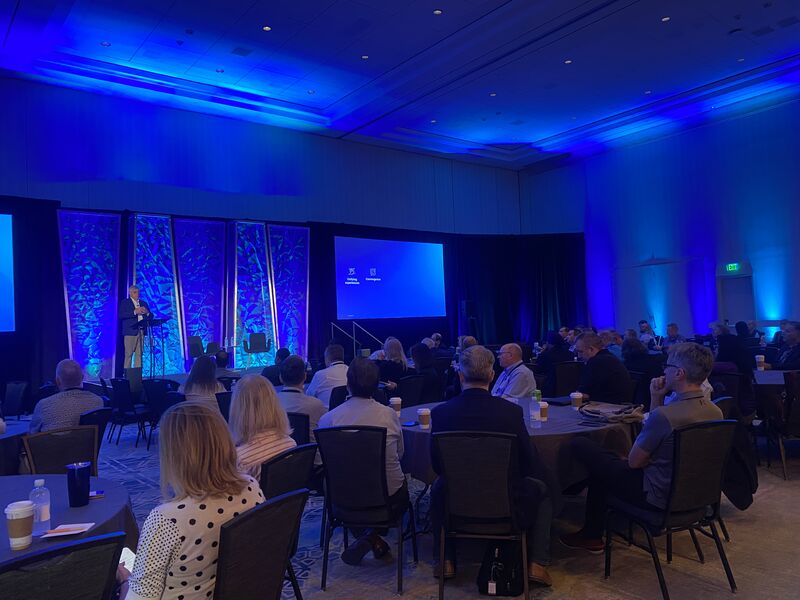
Her public praise tends to aim the spotlight sideways. After the 2024 conference, she wrote that everyone knows events are difficult, while few understand quite how difficult. Then she named the people who had put on their “events hats” and made the week happen. When she arrived at Algoworks in 2025 just as a new brand was launching, she joked about the miraculous timing, admitted it was not her work, and credited the cross-functional team. She compared her contribution to stepping in near the one-yard line to block. A CMO using a football metaphor to decline credit is not common enough to be called a genre.
Act IIIAI gets a job description
At GlobalLogic, Smith is now translating a technology that also translates, summarizes, drafts and occasionally speaks with more confidence than evidence. Her position is neither worshipful nor alarmist. She expects AI to become inseparable from marketing in the same way “digital marketing” became simply marketing. But she is impatient with a loose pile of clever tools. The opportunity, as she sees it, is to connect campaign planning, research, content, discovery, customer experience, analytics and reporting.
One experiment makes the promise tangible. Smith's marketing operations team has tested an AI agent that accepts high-level campaign details and, in about 20 minutes, produces a structure, draft social posts, draft emails and a list of content to develop. The machine clears away the first layer of manual work. The saved time belongs to channel choices, sharper approaches and the particular idea that competitors cannot copy by pressing the same button.
Here Smith draws a bright line. A person must check whether the message is effective, distinctive and genuinely reflects the company's point of view. AI can locate a gap faster. It cannot supply the expertise that makes filling that gap worthwhile. Her aim is not fewer marketers. It is fewer hours spent preventing marketers from doing strategy and creative work.
“AI helps us get there faster. It doesn't replace the expertise or the point of view that makes the content valuable.”LuJean Smith
The honest middleA dashboard should survive arithmetic
Smith's clearest break from the usual AI pageant appears in measurement. Asked in August whether GlobalLogic had quantified the gains, she answered: not yet. The team had improved its ability to produce campaigns and content, but honest attribution remained a work in progress. She recalled dashboards that double-counted influence until marketing appeared to touch billions of dollars in pipeline, more pipeline than the company actually possessed.
The anecdote is funny because the alternative is grim. A dashboard can turn fiction into a meeting invite. Smith wants the underlying models and data to be sound enough to show sales and executive teams what programs truly contribute to pipeline, revenue and the bottom line. She is not rejecting ambition. She is asking the numbers to carry their own luggage.
The person in the loopFeedback without the varnish
The human-in-the-loop principle has a personal analogue. Smith once wrote about her 12-year-old daughter struggling to accept tough feedback from a figure-skating coach. Smith admitted that graceful acceptance was not merely a teenage challenge. She had not played organized sports and learned coaching through management and leadership programs. Later, she personally hired an executive coach she had met at a women's networking event.
The point was not executive self-improvement as a luxury accessory. Coaching, in Smith's account, offered clarity about where she needed to improve and which plans required adjustment. Her willingness to say that publicly matters. Corporate biographies prefer a smooth ascent; Smith's own writing leaves the scaffolding visible. Progress involved questions, correction and the occasional piece of advice one would rather not hear.
That makes her current insistence on human review feel less like a defensive slogan and more like a practiced method. Judgment improves when it can be challenged. A distinct voice survives when someone is responsible for it. A team gets better when credit moves outward and feedback can move inward.
The job in front of Smith is large. GlobalLogic's experts are spread across Japan, Vietnam, Europe, the United States, Latin America and India. She wants people in those markets to take global roles, not remain confined to regional lanes. She wants more concise expert video without squandering the audience's trust. She wants content designed for traditional search and for discovery through AI systems. She wants marketing to help customers find useful information, not merely push information toward them.
All of this can sound like a catalog of systems until one remembers the student writer at Western Oregon University. Smith earned a bachelor's degree in humanities and a master's degree that combined English, writing and graphic art. Language, ideas and visual form were neighbors from the start. Technology has since replaced the paper, accelerated the draft and complicated the distribution. The responsibility remains wonderfully old-fashioned: decide what is true, decide what matters, and make it clear.