Blake Buisson spent twelve years climbing inside one of Silicon Valley's most recognizable professional networks. Then he stepped off the ladder. His next company, by his own calculation, was roughly one percent the size of the one he had left. The buyers spoke a different language. The product lived deep in software delivery. And the role, chief marketing officer, was one he had never held before.
There are cleaner ways to plan a career. They are also easier to explain to relatives. Buisson's choice made sense by a less tidy measure: it promised a steep learning curve. After a long LinkedIn chapter that carried him from individual contributor to global vice president, he wanted a new set of muscles to ache.
He reduced the decision to four things: great people, genuinely interesting problems, a culture with room for agility and risk, and an industry different enough to make him a beginner again. In his phrasing, “simplicity is clarity.” The list is short because the wager was large.
“The career journey is long and non-linear.”Blake Buisson, reflecting on his move to CircleCI
A marketer's scatter plot
Years earlier, while thinking about the marketing funnel, Buisson offered an image that now looks suspiciously like autobiography. Buyers, he argued, do not move obediently from awareness to purchase in a straight line. He coached his team to see the journey “more as a scatter plot than as a line.” Dots accumulate. A pattern appears. The path only looks coherent after the fact.
The categories change. The translation job remains.
His career dots begin in strategy consulting at MarketBridge, where public records place him from 2007 to 2010. A marketing leadership role at Google followed. In 2012 he joined LinkedIn, initially in Talent Solutions marketing. Within a year he was leading the go-to-market work for a redesigned LinkedIn Recruiter homepage and its unveiling at ConnectIn. It was an early exercise in his recurring specialty: making a complicated product legible without shrinking its ambition.
LinkedIn gave him categories within categories. Recruiting software led to workplace learning. His name appears among the editorial contributors to LinkedIn Learning's 2020 and 2021 Workplace Learning Reports. In 2018, he and the broader LinkedIn Learning events, communications and sales crew shared a Best in Show award for their booth at the Association for Talent Development gathering. Marketing, in this telling, was never merely the copy on the wall. It was the wall, the research, the launch, the room and the team required to make all of them agree.
The supporting details suggest a marketer trained to look beyond the campaign dashboard. Buisson studied at the University of California, Berkeley, with a period at the UC Center in Rome among the activities on his public profile. From 2008 to 2010, overlapping his consulting years, he volunteered as a Big Brother. Later, at LinkedIn, his work sat close to the practical questions of how people find jobs, learn skills and make sense of a labor market changing underneath them. The products were commercial. The subject was stubbornly human.
That breadth matters because category marketing can become an argument conducted entirely among insiders. Recruiting teams know why recruiting systems matter. Developers know why a failed build ruins an afternoon. Finance leaders know how quickly a new jurisdiction can complicate a clean spreadsheet. The marketer's work begins at the edge of that knowledge, where urgency is real but vocabulary is uneven. Buisson's progression through LinkedIn gave him years of practice at that edge, first around hiring and later across learning, research and corporate narrative.
The beginner in the executive room
By the end of that long tenure, Buisson was global vice president of product marketing and corporate marketing for Talent Solutions, LinkedIn's largest business unit. CircleCI credited him with helping launch LinkedIn's first AI agent. It was a senior job in a familiar institution, with the resources and institutional memory that familiarity brings.
CircleCI offered the inverse. Continuous integration and continuous delivery are essential to modern software teams and nearly invisible to everyone else. Buisson admitted that much of his own go-to-market network might not even have heard of CI/CD. This is a bracing sentence for a new CMO to publish. It is also a useful one. A leader who knows where the fog begins can organize the work of clearing it.
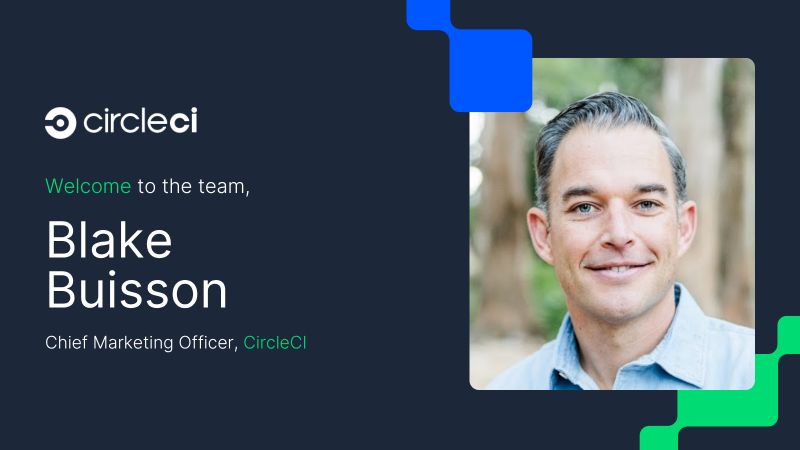
CircleCI appointed him in May 2025 to oversee marketing, join the executive team and report to chief executive Jim Rose. The timing gave him a sharp story problem. AI tools were making code faster to produce, but testing and validation still belonged to a slower era. More code did not automatically mean more trusted software. Speed upstream could create congestion downstream.
That tension became the framing for Chunk, CircleCI's autonomous validation agent. Buisson described the launch as his new team's first milestone moment together. The product promised to work on flaky tests, broken builds and inefficient pipelines while developers slept. The language was concrete because the problem was concrete: code generation had accelerated, while confidence had not.
A technical category becomes easier to understand when the marketer names the tradeoff people already feel. At CircleCI, it was faster code versus slower validation.
His public reflection on that period was unusually generous to the people around him. He wrote that his team's kindness and grace helped him climb the learning curve. Former colleagues had already described the complementary side of that exchange. One recommendation said Buisson quickly spotted people's core strengths and gave them room to shine. Another emphasized the standards and energy he brought to the work. The common picture is not of charisma floating above a team, but of attention applied inside it.
There is a small operational lesson in that exchange. Entering a new category creates two temptations for an executive: perform instant expertise, or retreat into a long private study. Buisson's account points toward a third route. Name the gap, rely on the team's fluency, and contribute the pattern recognition earned elsewhere. The executive remains accountable without pretending to have arrived fully translated. In technical markets, where customers can detect decorative knowledge at twenty paces, the humility is useful. So is the deadline.
Another difficult translation
In August 2026, the scatter plot acquired another dot. Anrok announced Buisson as its first chief marketing officer. He would own marketing end to end. CircleCI had asked him to explain the hidden machinery of software delivery. Anrok asks him to explain another system that businesses notice most acutely when it goes wrong: sales tax and value-added tax across borders.
Anrok connects billing, payment and employee systems so companies can monitor, calculate, file and remit taxes across jurisdictions. It is software for obligations that multiply as a company grows. Remote hiring can create exposure in a new place. A digital product can cross a border without a truck, while the tax rules arrive carrying several suitcases. The product turns those triggers into infrastructure.
- Joins LinkedIn and begins a 12-year rise through Talent Solutions, LinkedIn Learning, product marketing and corporate marketing.
- Becomes CircleCI's chief marketing officer and enters the language of CI/CD, developer tools and autonomous validation.
- Becomes Anrok's first chief marketing officer, responsible for telling the story of intelligent global tax infrastructure.
The move is new, so its results belong to the future tense. The fit, however, is visible. Anrok sells into a market where clarity has economic value. Its customers need to understand where they have obligations, why those obligations appeared and what happens next. Buisson has spent his career organizing similarly crowded rooms: buyer, product, category, evidence, team.
A straight-line career rewards the accumulation of answers. A scatter-plot career also rewards the quality of questions. Which parts of an old playbook still travel? Where does the new category resist familiar language? What does the buyer already understand, and which invisible system needs to be drawn?
Buisson's recent choices do not reject experience. They test whether experience remains useful after the scenery changes. LinkedIn supplied scale, multiple product surfaces and twelve years of institutional depth. CircleCI supplied compression, technical unfamiliarity and a first CMO seat. Anrok now supplies a company-wide marketing mandate in a category where the details are literally jurisdictional.
A long tenure built the vocabulary. Unfamiliar categories test whether the thinking can travel.The pattern across Buisson's public career
Clarity without the costume
Technology marketing often dresses complexity in borrowed grandeur. Buisson's better instinct is plainer. “Simplicity is clarity” is not permission to make everything simple. It is a reminder to decide what matters. His four-part career filter worked because it ignored decorative criteria. His CircleCI framing worked because it found the bottleneck. His scatter plot worked because it admitted that real buyers behave more like people than diagrams.
The Wildean joke is that the professional network executive escaped the network only to discover that every new category was connected. Recruiting depends on software. Software depends on delivery systems. Global software creates global tax obligations. The dots refuse to stay in their assigned departments.
So the compelling part of Buisson's story is neither the corporate ladder nor the title at its top. It is the decision to become newly useful. First by learning a language, then by translating it, then by leaving before fluency hardened into a costume. At Anrok, the scatter plot continues. The line, one suspects, would have bored him.