A wall is supposed to stay put. At the Digital Water Pavilion in Zaragoza, that would have spoiled the point. Its walls were falling water, controlled by computers, capable of displaying patterns and making openings. Matteo Lai was on the design team. Before he became the co-founder and chief executive of Empatica, he helped make a building whose boundaries could change around the people using it.
There is a pleasing inconvenience in beginning his story here. A water pavilion does not fit neatly into the abbreviated biography of a technology executive. It requires plumbing. It requires architecture. It requires accepting that a door might be wherever the system decides to put one. Lai’s subsequent career, moving between design, software and wearable objects, becomes more intelligible with that improbable building in view.
He is now based in Cambridge, Massachusetts. Empatica has offices in Boston, Milan and Seoul. The scale and setting have changed considerably since Zaragoza. Still, a thread runs through the work: the relationship between a person and an object capable of responding.
A door wherever you need one
The pavilion was built for Expo Zaragoza 2008, an exhibition organized around water. Its architecture treated that theme as construction material. Digitally controlled droplets formed curtains that could carry writing or images, while gaps in the water offered access. The boundary of the building doubled as a display.
The engineering gave the visual trick its substance. Closely spaced valves opened and closed under computer control, producing patterns in falling water. A screen ordinarily holds its pixels still. These pixels were headed for the ground. Timing determined what visitors could see, and where they could pass through.
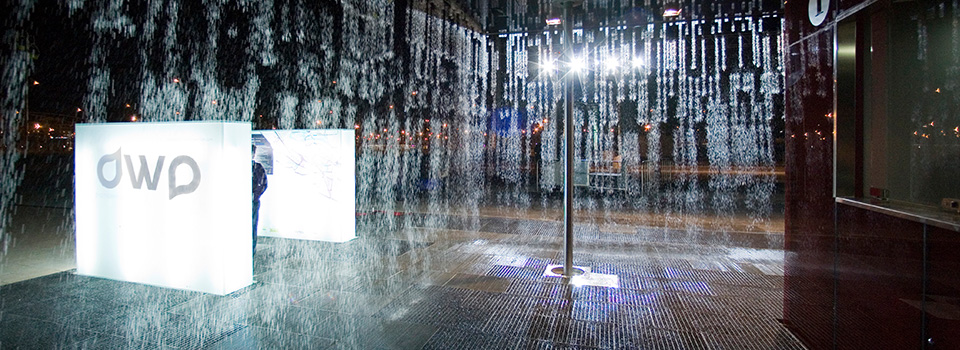
Lai worked alongside Carlo Ratti and Walter Nicolino; the wider collaboration included Arup and Agence Ter. The pavilion’s roof could move vertically and lower to the ground. Fixed service spaces sat within a structure designed to alter its apparent limits. For all its spectacle, this was a practical exercise in coordinating software, physical mechanisms and public space.
That makes it a useful early chapter. The architect had to consider an entire encounter: arrival, movement, access, shelter, departure. A visitor would experience the result without needing to understand the valves. Good plumbing is often at its most impressive when nobody asks about it.
The floor plan gets smaller
Lai’s training crossed architecture, engineering and innovation management. He holds a double MSc in Architecture from the polytechnics of Milan and Turin, and studied innovation management at Alta Scuola Politecnica. His professional life also included the design venture Taaac and a co-founding role at Shicon. The path into Empatica contained several attempts at making and organizing things.
In 2011, he founded Empatica with Simone Tognetti and Maurizio Garbarino. They had met through their studies at the Politecnico di Milano. In 2014, the company combined with Physio, and MIT professor Rosalind Picard joined the venture. The cast matters: Lai’s design background sat beside Tognetti’s work in artificial intelligence, Garbarino’s software expertise and Picard’s research.
Long before these partnerships, there had been another form of preparation. As a child, Lai drew his plans on paper before building with Lego. Many children build first and negotiate with gravity afterwards. He apparently gave the drawings an earlier appointment. It is a small, specific detail that makes the architectural education less surprising.
The trouble was in the strap
Drawings eventually meet wrists, and wrists decline to be standardized. In June 2015, Lai signed a public update announcing that Embrace deliveries would be delayed. Testing had exposed problems with the fit of the original band. Empatica was changing the design from its initial adjustable magnetic arrangement to interchangeable bands.
The consequences reached beyond appearance. Fit affected how the sensors performed during movement and prolonged use. The revised arrangement also offered different styles and the possibility of replacing a band as sizing needs changed. A detail around the edge of the object had become a decision about the whole product.
The update described repeated trips to the factory in Korea, new prototypes and further testing. Lai estimated an additional eight to eleven weeks for early supporters. He put his name beneath the explanation. The glamorous part of product development had acquired a shipment schedule and a queue of people waiting for answers.
This episode supplies something a polished photograph cannot: an actual choice, with a cost attached. The company revised the object and accepted a later delivery. Anyone can admire a finished design. Explaining a delay requires standing beside the unfinished one.
“Cutting edge technology and good design need to go together.”
Matteo Lai
A company needs more than a drawing
Embrace subsequently received a Red Dot Product Design award in 2016. Its slim metal case and choice of leather or elastic bands received attention from the jury. The award credits Empatica as manufacturer and Montreal’s Pearl Studios as designer. Those credits place Lai’s design interests within a collaboration that also involved a dedicated product design studio.
They also make Lai’s role more interesting. A chief executive has to create the conditions in which different disciplines can agree on an object. Materials, electronics, software, manufacturing and appearance all have claims on it. Each can be reasonable. Their requirements can still collide over something as ordinary as a strap.
Early supporters had already supplied another form of backing. The Embrace crowdfunding campaign reached its $100,000 target on its first day. That money arrived with an audience attached: people who had ordered an object, followed its progress and expected it to arrive. The later manufacturing updates had very particular readers.
The business needed relationships beyond the design table. Lai was selected as an Endeavor Entrepreneur at the network’s Boston panel in 2016. Endeavor Italy connected him with mentors and investors; Endeavor Catalyst invested in April 2017. The network supplied a further set of people around an enterprise that was already operating across borders.
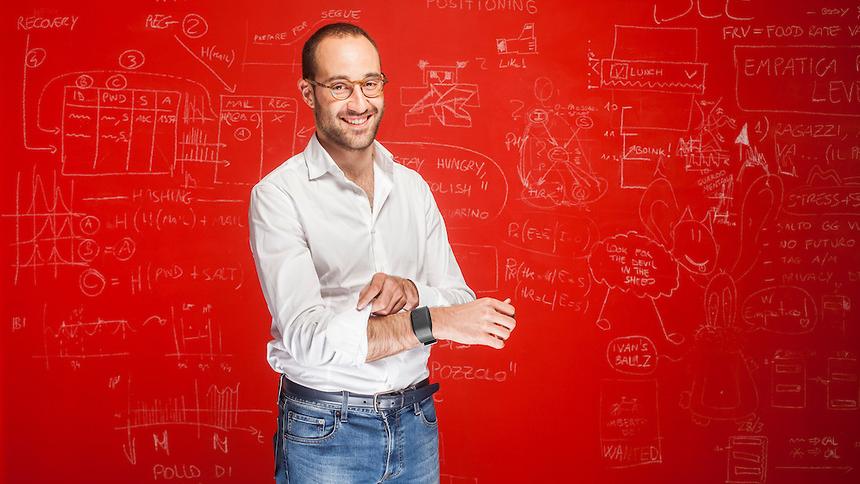
The early Milan office gave those collaborations a physical setting. Empatica occupied a loft in the former Riva Calzoni industrial complex, where turbines had once been built. Glass partitions carried notes and yellow sticky notes; red-painted walls became writing surfaces for diagrams. The background in Lai’s photograph is a working surface. There is something apt about an architect helping run a business in which the walls are still available for revision.
In November 2022, Empatica announced Series B financing led by Sanofi Ventures and RA Capital Management, with Black Opal Ventures participating. The announcement named the investors without disclosing a round amount. That is enough to mark the chapter: Lai was running a business that needed capital, partners and an organization capable of sustaining its work.
Today the company describes a team of more than 100 people across three continents, serving more than 3,000 institutional clients in over 40 countries. Those company figures give a sense of how far the job has travelled from a founder’s initial drawing. A growing organization becomes another complicated thing to design.
Twenty-four rings, then a rainforest
In 2022, Empatica’s technology acquired a rather different enclosure. Cocoon was a circular wooden sculpture, seven metres across and three metres tall, containing 24 rings and 12,000 LEDs. Visitors could walk through it. Multiple EmbracePlus devices supplied input that changed its light and sound in real time.
Presented at the LIFE ITSELF event in San Diego, the installation made individual participation visible as a collective experience. It used a smartphone app to connect the wearables to the sculpture. A person could contribute to the work while standing inside it. The object on the wrist and the space around it were suddenly parts of the same composition.

By May 2026, the company had announced another art collaboration, this time with Dataland in Los Angeles, founded by Refik Anadol and Efsun Erkılıç. Empatica customized EmbracePlus for the museum. Its input would help the installation change as people moved through the experience.
Dataland’s Machine Dreams: Rainforest combines environmental information from rainforest ecosystems with visitor input. Its connected galleries use those streams to alter images, sound, scent and space. The visitor enters a work that is still taking shape. The arrangement puts participation into the machinery of the exhibition.
Lai’s own account of visiting the museum contains a wonderfully ungrand observation: “It’s always a strange feeling to see people wearing a product we built.” Years of development had become something other people put on and carried into a room. The founder could now watch his company’s work enter someone else’s creative plan.
For an architect who helped create responsive water walls, this is a curious return. Zaragoza made a boundary adjustable. Cocoon made a sculpture responsive. Dataland connected wearable objects to an evolving interior. The projects belong to different teams and different moments. Put beside one another, they show how often Lai’s work has crossed between an object and the space it occupies.
An island still belongs on the map
His working geography retains another point. In a 2021 interview, Lai spoke warmly about Sardinia as a place for remote work, pointing to digital infrastructure, coworking, local companies and the island’s food, climate and culture. A professional base in the Boston area had not removed that connection.
It is a fitting last detail for someone whose career has moved through several kinds of building. First the planned Lego project, then the pavilion, then a company making objects small enough to wear. Each adds people who have their own preferences, movements and ideas. The drawing gets its real test when they arrive. At Zaragoza, even the wall had to make room.
Follow the drawings
Projects, public profiles and conversations.
- Empatica website ↗
- Matteo Lai on LinkedIn ↗
- Matteo Lai on X ↗
- Matteo Lai on Facebook ↗
- Digital Water Pavilion project archive ↗
- The 2007 pavilion announcement in MIT News ↗
- Lai’s 2015 manufacturing update ↗
- The making of Cocoon ↗
- Machine Dreams: Rainforest ↗
- Watch: Lai and Garbarino at the 2016 Polimi alumni convention ↗
- Watch: the Digital Water Pavilion ↗