Rosalind Picard had a measurement she could not explain. A student had borrowed two wrist sensors to study his younger brother, who had autism. One wrist produced an enormous skin-conductance response; the other did not. Picard tried to reproduce it in her laboratory. She couldn’t. Then the student’s diary supplied the detail the instruments lacked: his brother had experienced a seizure at that moment.
- A stress-research sensor opened a route into epilepsy monitoring.
- EpiMonitor pairs a wearable with caregiver alerts and a paid subscription.
- Researchers buy continuous data collection and the software around it.
- The PKG Health acquisition brought Parkinson’s expertise into the platform.
“It was such a big response, I didn’t believe it was real.”
Rosalind Picard / MIT News, 2016
There is a useful business lesson hiding in that sentence. The promising observation initially looked like an error. Empatica’s story begins with the patience to investigate it.

The diary changed the question
The technology came from affective computing, the study of how machines can recognize and respond to human emotion. Picard’s MIT group measured electrodermal activity: small changes in how skin conducts electricity, linked to the sympathetic nervous system. A sensor developed to study stress had revealed a potential medical application.
Commercial priorities complicated the route. Affectiva, a company Picard co-founded, moved toward emotion-analysis software for market research. She established Physiio to pursue the medical technology. In 2014 it merged with an Italian wearable startup co-founded by Matteo Lai and Simone Tognetti. Empatica’s Italian roots date to 2011; the combined US company came later.
The founding team mixed unusually compatible skills. Lai, now CEO, trained as an architect and engineer. Tognetti became CTO; Picard became chief scientist. Co-founder Maurizio Garbarino is chief software architect. Hardware, algorithms and medical evidence would all have to agree before a useful product could emerge.
A watch with 1,500 pages behind it
Empatica’s early research wristband, the E4, gave scientists access to physiological signals outside the laboratory. Embrace took a narrower public-facing job: recognizing patterns associated with convulsive seizures and alerting another person. The company began its FDA filing work in mid-2016. Its final package reached 1,500 pages. Clearance arrived on January 26, 2018.
A small object on the wrist. A substantial argument behind it.
That paperwork helps explain Empatica’s place in the market. A pleasant watch face does little for a researcher who needs defensible measurements or a family depending on an alert. Empatica competes through specified medical uses, accessible data and the machinery connecting a measurement to someone who can act on it.
The person at the other end
Today EpiMonitor combines EmbracePlus with a smartphone app. It looks for patterns associated with generalized tonic-clonic seizures in adults and children aged six and older. When a likely event is detected, the app initiates calls and text messages to designated caregivers. US buyers need a prescription.
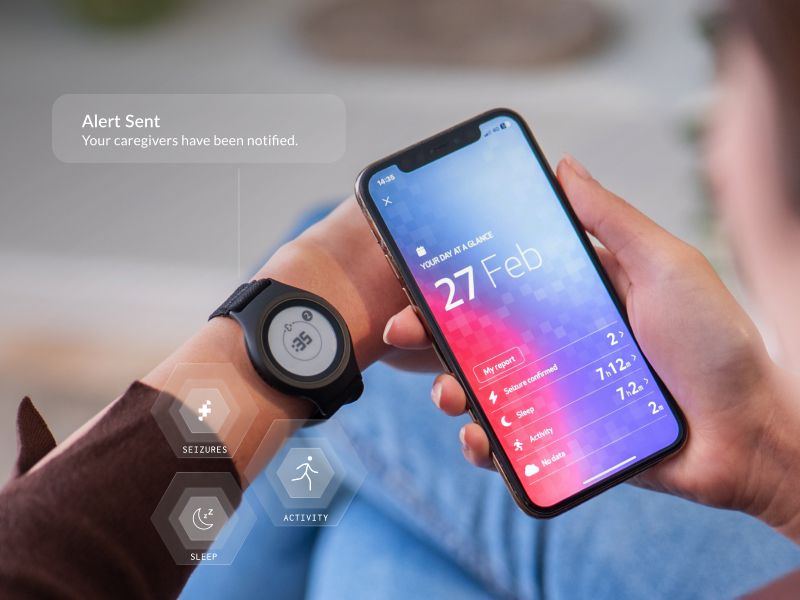
The economics are equally concrete. The device is listed at $399. Following an April 20, 2026 increase, the US Basic subscription costs $17.40 monthly or $191.40 annually. With the annual option, the first year totals $590.40 before shipping and taxes. Empatica cited rising operating and infrastructure costs for the increase.
The dependencies deserve equal attention. Detection is not prediction; forecasting remains a research project. EpiMonitor does not detect every seizure type, and alerts go to caregivers rather than emergency services. A compatible phone, connectivity and an active subscription are part of the working system. False alarms remain possible. Choosing it requires matching the person’s seizures and care arrangements to its intended use.
Alternatives make different bargains. NightWatch+ uses an upper-arm sensor and an alarm station during sleep, without a mobile phone or subscription. Its indications differ. Comparing these systems means comparing the situation in which help must arrive, as well as the hardware.
The business between appointments
Empatica’s other customers are pharmaceutical sponsors, contract research organizations, universities and clinicians. They need observations that occasional visits and patient recollection can miss. Its Health Monitoring Platform joins wearable devices, phone apps, cloud processing and study portals. Staff can review data and wearing time; researchers can obtain raw signals for their own analyses.
- 01WearableRecords signals
- 02Phone appTransfers data
- 03CloudProcesses & stores
- 04Study portalSupports review
Research synchronization follows its own workflow; this diagram does not describe seizure-alert timing.
EmbracePlus combines optical pulse sensing, skin conductance, temperature and movement sensors. EmbraceMini, introduced in June 2025, concentrates on movement and ambient light. It weighs 15 grams. On September 23, 2026, Empatica added Mini to its academic research plan. The choice reflects a sensible principle: select measurements for the question being studied, then choose the device.
Empatica reports deployment in more than 120 industry-sponsored trials. Its institutional business combines equipment, software access and study support, with pricing arranged through quotations. A Series B announced in November 2022 was led by Sanofi Ventures and RA Capital Management, with Black Opal Ventures participating. The announcement disclosed no amount.

Buying the evidence, extending the view
In October 2025, Empatica announced its acquisition of PKG Health. The attraction was specific: movement-disorder algorithms already studied in more than 70 peer-reviewed publications and used across over 150 hospitals and clinical sites. Empatica could combine that expertise with its wearable and cloud system rather than begin Parkinson’s monitoring from scratch.
European certification followed in January 2026; FDA clearance for the Parkinson’s platform was announced in August. Patients wear EmbraceMini, a phone app transfers data, and clinicians receive PKG reports to support treatment decisions. Monitoring helps describe symptoms over time; clinicians still interpret what they mean.
The lesson readers can borrow is practical: preserve surprising observations, test them against independent evidence and design the entire route to a decision. A sensor can record something remarkable. Its value depends on whether the right person can use that information when it matters.
Follow the signal
Explore the products, research and people behind the wristbands.