Most medical apps begin with convenience. BeCareLink began with the cost of not knowing. In December 2014, Dr. Beth Deutch died after a disease was diagnosed late and changes in her condition went undetected. Her husband, technology entrepreneur Larry Rubin, and her sister, neurologist Charisse Litchman, turned the loss into a specific product question: what if a patient did not have to wait for the next specialist visit to measure whether something had changed?
They founded BeCareLink in 2017. Rubin brought experience in artificial intelligence and telecommunications. Litchman brought 25 years of clinical neurology, work with pharmaceutical trials and the blunt knowledge that even trained specialists can score the same exam differently. Together they began translating pieces of the neurologic examination into activities that a person could perform with a smartphone at home.
The result looks cheerful: little prompts to walk, remember, tap, look or hold still. Underneath is a much less playful ambition. BeCareLink wants to produce quantitative, repeatable measures of gait, tremor, cognition, vision, coordination and sensation, then show how those measures move over time. The company is not trying to squeeze an entire neurologist into a handset. It is trying to rescue the useful signal that disappears during the weeks or months between appointments.
A clinic visit is a snapshot. The product is a strip of film.
BeCareLink's first public wedge was multiple sclerosis. BeCare MS Link combines standardized questionnaires with 13 short activities covering walking, motor control, cerebellar function, memory, vision and sensation. A user can repeat the sequence monthly or when something feels different. Results become charts and reports that can be shared with a clinician. The app also supports an estimate of the Expanded Disability Status Scale, a familiar but labor-intensive measure in MS research and care, though the company has drawn regulatory limits around how its proprietary scoring is used.
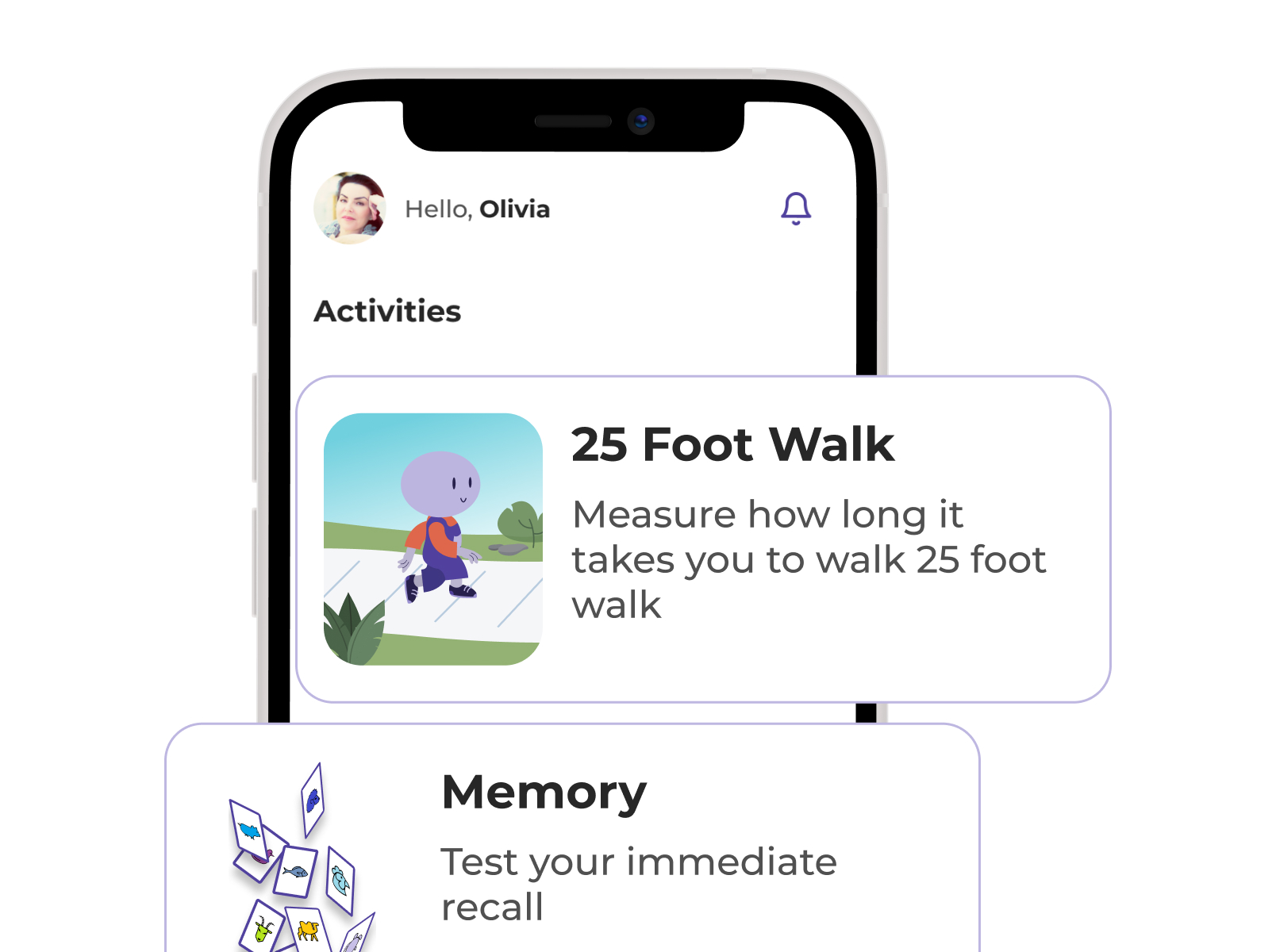
The company then widened the doorway. BeCare Neuro Link offers a general neurologic screen and compares performance with population norms. BeCare Parkinson's focuses on tremor, walking, motor skills and cognition. BeCare Headache combines symptom tracking and standard headache questionnaires with a neurologic assessment. A Camp Lejeune product is aimed at people concerned about neurologic harm after contaminated-water exposure.
That range makes BeCareLink look like a collection of apps, but the more useful way to see it is one assessment engine with several clinical front doors. The repeated elements - structured tasks, phone sensors, questionnaires, longitudinal charts and shareable reports - can travel across conditions. The disease-specific interpretation cannot. That is why the company works with neurologists and advisers rather than pretending a generic wellness score is enough.
From kitchen table to clinical conversation
Who pays for a trend line?
Patients are the entry point. The apps are free to download, an important choice for a company whose mission is access. The paid consumer layer is unusually legible: detailed assessment reports cost $4.99 a month or $49.99 a year, with unlimited report generation. A user can print or send a report to a healthcare professional. This is less a paywall around testing than a small subscription around interpretation and portability.
Clinicians are the second customer. BeCareLink markets a physician portal that can collect assessments before an appointment, document trends and help providers fit remote monitoring into clinical and billing workflows. The pitch is practical: do the repeatable tasks before the scarce expert time begins. A primary-care doctor may gain structured information without attempting a full specialist exam; a neurologist may see whether a wobble is a one-day complaint or a three-month pattern.
Pharmaceutical companies, contract research organizations and academic teams form the third side. Neurology trials are vulnerable to subjective scoring, differences between raters, burdensome site visits and slow recruitment. BeCareLink sells a virtual-trial solution built around remote outcome measures. In May 2023, the company says it recruited 100 people with MS for a trial in one week by reaching its existing user base. PharmStars also reported that the app was used in a Biogen post-marketing study. Enterprise pricing is private.
One platform, three reasons to care
This hybrid model is the clever part worth copying. A free patient tool can create utility and distribution. The same user relationship can make a trial easier to recruit. The same assessment layer can feed a clinician report. Each buyer values a different output, but the underlying work is shared. It also creates a hard governance problem: health data, consent and research recruitment must remain clear to the person doing the tapping.
What failed first was the old pathway
There is no public tale of a dramatic startup pivot here. The original failure happened before the company: a diagnosis arrived late, access was poor and clinical changes were missed. That experience changed the founders' unit of attention. Instead of treating the office visit as the center of care, they focused on the quiet interval around it. The company kept the clinician's judgment but moved some measurement into the home.
The distinction matters. BeCareLink's manuals say the apps do not diagnose, give medical opinions or replace professional advice. A phone test can reveal an outlier or a direction of travel. It cannot order an MRI, examine reflexes with a hammer, reconcile medication effects or respond to an emergency. BeCareLink is most credible when it describes itself as a monitoring and conversation tool, not an oracle.
Its culture follows that division of labor. This is a physician-led product company, not a wellness brand with a medical adviser added for decoration. Litchman trained at Yale and Cornell-New York Hospital, taught at Yale, ran a neurology practice and monitored pharmaceutical trials. Rubin is a serial entrepreneur and co-inventor of a neural-network technique for detecting object orientation. Medical advisers contribute subspecialty knowledge; engineers turn the resulting protocols into tasks ordinary people can understand. The public-facing tone is patient advocacy, but the internal problem is measurement science.
That pairing also explains why the app sometimes feels more literal than magical. Timed walking is still timed walking. Immediate recall is still immediate recall. The invention lies in packaging the tasks consistently, collecting them frequently and interpreting the pattern with software. For a tiny team, restraint is an operating advantage. Each new disease module can borrow the platform while forcing a fresh clinical question: which functions matter here, how should they be tested, and what claim does the evidence permit?
Steal this
Find an expert ritual, separate repeatable measurement from expert judgment, and move only the repeatable part onto a device customers already own.
Watch this
The loop breaks if users cannot perform tasks consistently, devices vary too much, reports miss the clinical workflow or the product outruns its evidence.
The moat is not AI. It is credible repetition.
BeCareLink competes with the obvious alternative - the in-person exam - and with remote measurement companies such as Sway Medical, Rune Labs, Koneksa, Neurotrack and Linus Health. Some specialize in balance, some in disease-specific digital biomarkers, some in cognition. BeCareLink's position is broader: physician-designed self-assessments across several neurologic functions, packaged for patients but connected to clinician and research use.
Its proof points are accumulating rather than final. Investigators connected with Yale and Weill Cornell have compared app-derived measures with traditional assessments. A 2023 paper examined AI classification of MS disability. In 2025 the company presented an analysis involving more than 380 app users at the American Academy of Neurology. It won MedCity INVEST's PharmaTech pitch contest in 2022 and a Netty Award in 2024. Those are signals of traction, not substitutes for clinical evidence across every product and population.
The reported audience has grown from more than 2,500 MS users in an earlier PharmStars profile to more than 25,000 users across Neuro, MS and Parkinson's by December 2025. Headache added another, potentially larger, market. The team remains small - the supplied company record counts seven employees, while LinkedIn places it in the 11-to-50 band - and funding totals, revenue and valuation are not publicly disclosed.
A small company can use that breadth to learn faster, but it can also spread validation work thin. A memory activity inside an MS product is not automatically a validated Alzheimer's screen. A tremor task for Parkinson's does not answer every question about movement disorders. The reusable software is the economical part; the evidence must be earned condition by condition. That is the hidden cost of a multi-app platform, and it is why awards and download counts are supporting actors rather than the plot.
That leaves BeCareLink in an interesting middle: beyond a single-condition experiment, short of becoming clinical infrastructure. Its next test is not whether someone can finish a memory game. It is whether the resulting measure remains stable across phones and homes, whether a clinician notices it, whether a trial sponsor accepts it and whether an abnormal change leads to better timing in actual care.
The company was born from a terrible gap in information. Its product thesis is that smaller, more frequent observations can narrow that gap. Under the right conditions - validated tasks, capable users, compatible devices, clear consent and a clinician ready to interpret the record - that is useful. Without those conditions, it is another chart glowing on a phone. BeCareLink's opportunity is to make sure the chart travels.