Breaking
Beacon Biosignals upsizes Series B past $97M - cumulative funding tops $132M FDA clears Dreem 3S as first sleep wearable allowed to update its own AI Backers include GV, General Catalyst, S32, Samsung Next Founded 2019 - Boston, with offices in NY, Cleveland & Paris Six electrodes, one headband, millions of hours of sleep EEG Beacon Biosignals upsizes Series B past $97M - cumulative funding tops $132M FDA clears Dreem 3S as first sleep wearable allowed to update its own AI Backers include GV, General Catalyst, S32, Samsung Next Founded 2019 - Boston, with offices in NY, Cleveland & Paris Six electrodes, one headband, millions of hours of sleep EEG
Beacon Biosignals brand image
Neurotechnology · Boston, MA

Beacon Biosignals

The company turning a single night of sleep into something close to a brain scan - no lab, no wires, no technician hovering in the dark.

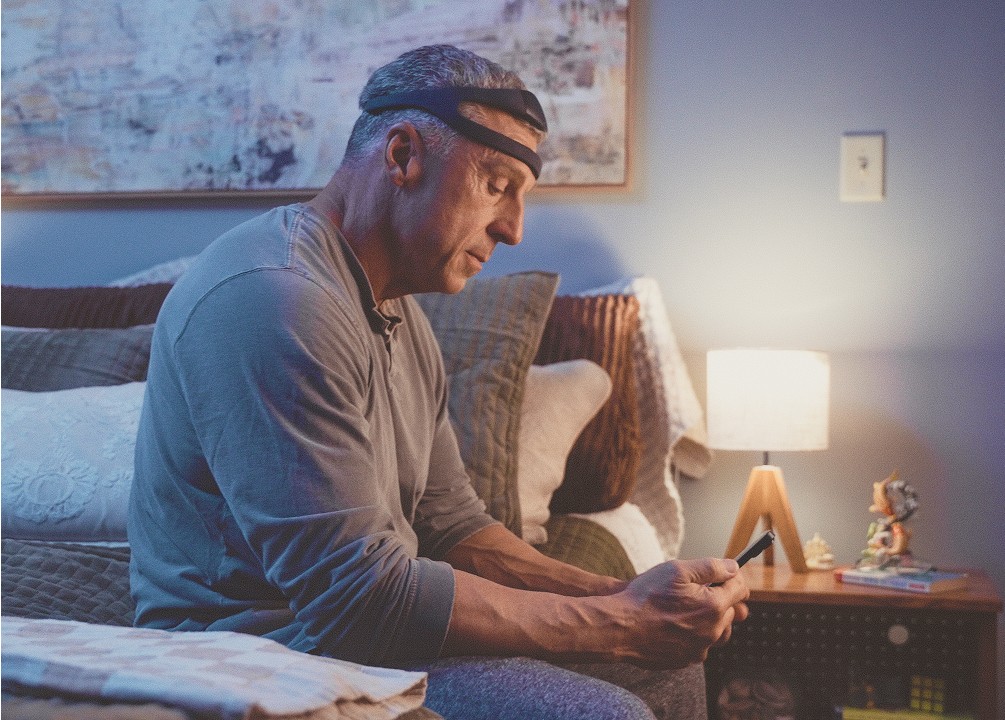
// Photographed in its natural habitat: a headband that thinks it's a sleep lab.

$132M+Total Raised
2019Founded
~130People
6Electrodes
The Scene

Right now, somebody is asleep - and being read

Somewhere tonight, a person clicks a soft band around their head, turns off the light, and goes to sleep. They are not in a hospital. There are no wires taped to their scalp, no stranger watching a monitor down the hall. By morning, six electrodes have quietly recorded the electrical weather of their brain, hour after hour, and an algorithm has already scored it into the stages of sleep that used to take a technician all night to mark by hand.

That is Beacon Biosignals on an ordinary Tuesday. The Boston company builds the headband, the AI that reads it, and the data pipes that carry the signal from a bedroom to a drug trial. It calls the brain measurable. For most of medical history, the brain has been the organ that refused to be measured at home.

Cardiologists got the wearable revolution years ago. The brain - the most complicated object we know of - was still waiting for its turn.
The Problem They Saw

The brain is loud. We mostly weren't listening.

Here is the awkward truth Beacon was built around: neurology and psychiatry run some of the slowest, priciest, and most failure-prone drug trials in medicine, and they often do it half-blind. The gold standard for reading brain activity during sleep - in-lab polysomnography - means a patient sleeps in an unfamiliar room, glued to sensors, watched all night. It is expensive, it scales badly, and one strange night in a lab rarely looks like a normal week at home.

So the richest signal we have about brain health, the EEG, stayed locked inside specialist clinics. Trials enrolled small, measured rarely, and waited years to learn whether a drug moved anything. The data existed. It just wasn't going anywhere useful.

A night in a sleep lab tells you how someone sleeps in a sleep lab. Which is not, it turns out, how anyone actually sleeps.The case for measuring the brain at home
The Founders' Bet

An MD-PhD, a code architect, and a hunch about sleep

In 2019, neuroscientist Jacob Donoghue - an MD from Harvard, a neuroscience PhD from MIT - teamed with software architect Jarrett Revels and clinician-scientists Brandon Westover and Sydney Cash. Their wager was almost stubbornly simple: if you could record clean EEG outside the clinic and teach a model to read it as well as a human expert, you could turn the brain into something you measure routinely instead of rarely.

The unglamorous part of the bet was infrastructure. Brain signals are messy, enormous, and stored in a zoo of incompatible formats. Beacon's answer was to treat data plumbing as a first-class product - and then, in a move that still surprises people, to open-source the file format underneath its own commercial engine.

They open-sourced the foundation of the building they were trying to sell. Confidence, or a very long game. Possibly both.
The Product

A headband that moonlights as a sleep lab

The flagship is Waveband - the device formerly known as Dreem 3S. It's a dry-EEG headband with six electrodes and a motion sensor, cleared by the FDA to stage sleep with accuracy the agency deemed equivalent to in-lab polysomnography. A person wears it at home. The machine learning does the all-night marking that used to need a trained human.

Around the device sits the rest of the platform: Analytics Suites that pull neurobiomarkers out of raw signal, a Datastore built on one of the largest annotated EEG collections anywhere, and Beacon HQ to run the studies end to end. Hardware, AI, and operations - sold not to sleepers, but to the companies trying to develop brain drugs.

Waveband

FDA-cleared dry-EEG headband. Six electrodes, an accelerometer, automated AASM sleep staging at home.

Analytics Suites

AI models that score architecture and surface neurobiomarkers from raw EEG for trials and diagnostics.

Datastore

A vast annotated EEG dataset - the training fuel that makes the algorithms worth trusting.

Beacon HQ

The software layer for running EEG-based clinical studies, soup to nuts.

The clever trick isn't the headband. It's that the headband is the cheap, boring part of a much larger machine.Why Beacon sells to pharma, not to pillows
The Milestones

Five years, in receipts

2019

Founded in Boston

Four founders set out to make brain activity measurable outside the clinic.

SEP 2023

FDA clears Dreem 3S

510(k) clearance for AI-assisted at-home sleep monitoring, deemed equivalent to in-lab polysomnography.

DEC 2024

A first for sleep wearables

FDA authorizes a Predetermined Change Control Plan - the device can update its own algorithm without a new submission.

JUN 2025

Dreem 3S becomes Waveband

A rebrand that keeps the FDA clearance and loses the older name.

NOV 2025

$86M Series B

A syndicate including GV, General Catalyst, S32 and Innoviva backs the scale-up.

APR 2026

Series B upsized past $97M

Samsung Next and others join; cumulative funding tops $132M.

The Proof

Money is one signal. Pharma signing up is another.

Investors are easy to excite. Drug companies betting their trial timelines on your device are harder. Beacon has both. Gate Neurosciences ran a Phase 2 depression program supported by the headband and analytics. UCB and Longboard Pharmaceuticals collaborated on sleep disturbances in Lennox-Gastaut Syndrome. The LGS Foundation joined the HEADFIRST trial studying sleep EEG in children with developmental disorders.

The capital tells its own escalating story - a Series B that started large and got larger.

Beacon's funding climb

USD, cumulative milestones · source: company & press announcements
Series B
$86M
B upsized
$97M+
Cumulative
$132M+

Bars scaled to the $132M cumulative figure. Numbers approximate per public announcements.

You can fund a science project. You cannot, for very long, fund one that pharma keeps declining to use.The difference between a raise and a business
The Mission

Make brain health measurable, scalable, and actionable

That's the line CEO Jacob Donoghue keeps coming back to, and it's less of a slogan than a to-do list. Measurable: get clean EEG out of the lab. Scalable: let one model read thousands of nights instead of one technician reading one. Actionable: feed the result into the trials and clinics where a brain drug lives or dies.

"This milestone reflects strong momentum behind our vision to make brain health measurable, scalable, and actionable."Jacob Donoghue, CEO & Co-Founder
Why It Matters Tomorrow

The brain, finally, on the same shelf as the heart

Picture the next decade going Beacon's way. Brain measurement becomes routine instead of rare. A psychiatrist adjusts a medication based on a week of real sleep data, not a single uneasy night in a lab. A trial that took five years to read out takes two. The organ that always refused to be measured at home becomes, quietly, just another thing you can track.

None of that is guaranteed. Regulators move carefully, pharma collaborations can stall, and reading the brain reliably is genuinely hard. But the direction is set, and the receipts are accumulating.

So return to that bedroom. Someone clicks the band around their head and goes to sleep. The difference is what happens to the night. It used to vanish by morning. Now it gets read, scored, and sent somewhere it can change a diagnosis or a drug. Beacon Biosignals didn't invent sleep. It just stopped letting it go to waste.

Eight hours of brain activity used to disappear every single night. Beacon decided that was a terrible thing to throw away.The whole idea, in one sentence
Footnotes & Curiosities

Things worth knowing

Spread the signal

// Share Beacon Biosignals

LinkedIn Twitter / X Facebook Instagram Copy URL
Website LinkedIn Twitter / X GitHub Newsroom Open Source Videos & Demos CEO Profile