Profile / Brain Health / Neurotech
Jacob Donoghue
A doctor who decided the squiggly lines everyone ignored were worth a company. Now an AI reads them.
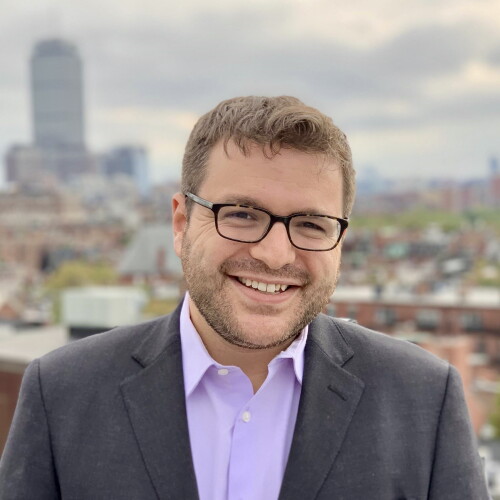
The physician-scientist who looked at a 100-year-old test and saw the future.
A doctor who decided the squiggly lines everyone ignored were worth a company. Now an AI reads them.
The physician-scientist who looked at a 100-year-old test and saw the future.
The electroencephalogram turns one hundred next year. Jacob Donoghue thinks its first century was a warm-up.
Start in a Boston office at 80 Revere Street, where roughly 130 people are doing something quietly radical: teaching a machine to read brains. Not scan them. Read them - the way a cardiologist reads a heartbeat. The raw material is the EEG, an old technology that for most of the twentieth century produced one thing reliably: squiggly lines on rolling paper that only a handful of specialists could interpret. Donoghue's wager, placed in 2019 and funded ever since, is that those squiggles were never the problem. The reader was.
He runs Beacon Biosignals as co-founder and CEO. The pitch is deceptively plain - make brain function measurable and actionable at scale - and the method is to train artificial intelligence on millions of hours of real brainwave data until patterns of health and disease come into focus. Do that well, and you can hand drug developers a quantitative endpoint where they once had a clinician's hunch. You can flag a neurological signal before a patient ever notices a symptom.
Donoghue's resume reads like a dare to credential-counters. A BSc from Brown University. A PhD in neuroscience from MIT, where his doctoral work examined how neuroactive compounds reshape the electrical conversation between brain networks. An MD from Harvard Medical School, completed in 2021 through its Health Sciences and Technology program. Most people would have spent that training capital on a career. He spent it on a company.
That dual identity - physician at the bedside, scientist at the workbench - is the whole point. He has seen what the data fails to capture in a clinic, and he has seen what a clinic fails to capture in the data. Beacon sits in the gap between the two.
"By training AI on millions of hours of real-world brain data, we're beginning to map the signals of health and disease in ways that can accelerate drug development."
There is a particular kind of founder who builds a company around a thing everyone else has written off. Donoghue is that kind. The EEG was supposed to be eclipsed by flashier imaging - the MRI, the PET scan, the things that produce posters. Instead he treats it as a sleeping giant: cheap, non-invasive, recordable for hours, and sitting in hospital archives by the tens of thousands, waiting for someone with enough computing power and enough patience to make sense of it in aggregate.
The trick, as he tells it, is scale and diversity. Machine learning gets smart on large, heterogeneous datasets, so Beacon built partnerships with academic medical centers to aggregate enormous libraries of EEGs and overnight sleep studies. One brain recording is a curiosity. Tens of thousands, run through the right model, become a map.
Beacon's founding line is about sleep, and that is not an accident. Sleep is the most honest window into the brain we have - hours of uninterrupted electrical activity, nightly, from nearly everyone. Read it correctly and you learn about epilepsy, psychiatry, neurodegeneration, and the rare genetic disorders that announce themselves first in the brain's rhythms. Beacon's work spans neurological, psychiatric, and sleep disorders, including rare conditions like SYNGAP1, and it leans hard into the idea that diagnostics should be equitable, not reserved for those near a major hospital.
"Our mission is to make brain function measurable and actionable at scale."
A map of the brain is useless if you can only draw it in a hospital. So Beacon pushed the EEG out of the lab and onto people's heads. The company secured FDA clearance for a wearable headband that records brain activity at home, and in 2025 it acquired CleveMed's home sleep-testing technology to extend that reach. The arc is clear: take the signal that used to require a tangle of electrodes and a sleep lab, and make it something a person can wear in their own bed.
The strategy has convinced the people who pay for biology. Beacon now works with more than half of the world's top ten biopharmaceutical companies - Takeda and UCB among the named partners - using its analytics to sharpen clinical trials for central nervous system drugs. When a trial needs to prove a brain drug works, a clean quantitative readout from EEG can be the difference between a signal and a shrug.
Donoghue did not do this alone. He started Beacon with Jarrett Revels, the company's chief technology officer, a machine-learning engineer known at MIT for compiler work on modern ML frameworks. It is a telling pairing: the physician-scientist who knows what the brain is saying, and the engineer who can build the machine to listen at scale. The founding team folded together neuroscience, machine learning, academic research, pharmaceutical development, and product engineering - the full stack required to turn a waveform into a decision.
What does he want from all of it? Not just new therapies, though those are the near-term prize. The longer aim is a world where clinicians and patients can monitor brain health continuously and act before a crisis - where brain function is as routine to measure as blood pressure, and as ordinary to manage. It is an audacious goal dressed in a calm sentence, which is rather his style.
The numbers keep agreeing with him. An oversubscribed $27 million Series A in 2021, led by General Catalyst. An $86 million Series B in November 2025, led by Innoviva with GV, S32, Catalio Capital, Takeda, and others on the cap table - pushing total funding past $116 million. The money has a job: build the world's largest neurodiagnostic dataset and turn AI-driven biomarkers into clinical reality. For a company built on reading old technology more cleverly than anyone else, that is a fittingly ambitious receipt.
Neurology, psychiatry, and sleep medicine share an awkward secret: for decades they have leaned on subjective scales and clinician judgment where other specialties have hard numbers. A cardiologist has an ejection fraction. An oncologist has tumor measurements. The brain doctor, too often, has a questionnaire. That absence of quantitative endpoints is exactly the void Beacon set out to fill - computational diagnostics, objective safety tools, and trial endpoints that a regulator can trust. When Beacon raised its Series A, it framed the round around that unmet need directly, and brought in operators who understood the science. Andy Beck, the CEO of PathAI, joined as an angel investor, a nod from one AI-in-medicine builder to another, lifting Beacon's early total to roughly $30 million.
The founding itself was less a eureka than a thesis. Beacon was started by MD/PhDs and engineers out of Harvard and MIT, propelled by a single idea: a computing platform built to interrogate enormous brainwave datasets with throughput and capability the field had never had. That is the unglamorous truth behind a lot of breakthrough companies - not a flash of insight, but the patience to build infrastructure for a problem everyone else found too tedious to industrialize.
Donoghue is not shy about the bigger claim. On panels at the Precision Medicine World Conference and the World Medical Innovation Forum, he has pressed the question of whether the future of diagnostics is moving in silico - decided less by a human squinting at a tracing and more by models trained on data at a scale no human could hold in their head. He frames it carefully. The point is not to replace the clinician but to give the clinician a measuring instrument they have never had for the brain. Health equity threads through that argument too: if a reliable brain readout can be captured at home with a wearable and interpreted by software, then good diagnostics no longer depend on living near a major academic hospital.
It is a tidy through-line for a career that refused the obvious path. He could have practiced medicine. He could have stayed in the lab. Instead he took the bedside and the bench, fused them, and pointed the result at a technology the rest of the field had stopped looking at. The squiggles are still squiggles. The difference is that now something can finally read them at scale - and the doctor who insisted they mattered is still in the room.
Co-founds Beacon Biosignals with Jarrett Revels - a mission to decode brain data for neurological, psychiatric, and sleep disorders.
Completes his MD at Harvard Medical School. Beacon closes an oversubscribed $27M Series A led by General Catalyst.
Takes the stage at the Precision Medicine World Conference and the World Medical Innovation Forum to argue the case for AI diagnostics.
Beacon acquires CleveMed's home sleep-testing tech and raises an $86M Series B, pushing total funding past $116M.
The EEG was supposed to be obsolete. He turned it into a dataset, a headband, and a half-billion-dollar idea about the brain.