Consider the peculiar ambition of prescribing a phone. The same object that interrupts dinner and devours a quiet afternoon might also deliver a medical treatment. Click Therapeutics has spent years pursuing that possibility. Its wager begins with an observation: software changes what people do. The difficult part is making that change useful enough, measurable enough and reliable enough to belong in a clinician’s treatment plan.
- The treatment: smartphone exercises and behavioral interventions tested as medical devices.
- The evidence: FDA authorizations in depression, migraine and schizophrenia, with different results and indications.
- The business: pharmaceutical partnerships, licensing and an expanding responsibility for commercialization.
Founder David Benshoof Klein started Click in 2012 after recognizing smartphones’ influence on behavior and cognition. His background was in life-sciences investing, a useful preparation for a company whose products would need more than attractive interfaces. Click’s team spans clinicians, researchers, designers and engineers. The office values include “No Jerks,” a modest ambition that many workplaces somehow find difficult to fulfill.
A medicine with a memory task
Rejoyn makes the proposition concrete. Co-developed with Otsuka, it is a six-week prescription program for depression symptoms. Its exercises include the Emotional Faces Memory Task, which asks users to work with emotional expressions and memory. Brief therapeutic lessons accompany the training. The intended target is cognitive control of emotion: something a person practices, rather than something a person swallows.
The eligibility details matter. Rejoyn is cleared for adults aged 22 and older with major depressive disorder who are taking antidepressants, as an adjunct to clinician-managed outpatient care. It does not replace medication. Nor does it monitor patients and alert prescribers when their condition worsens. A treatment delivered through a phone still has a defined job.
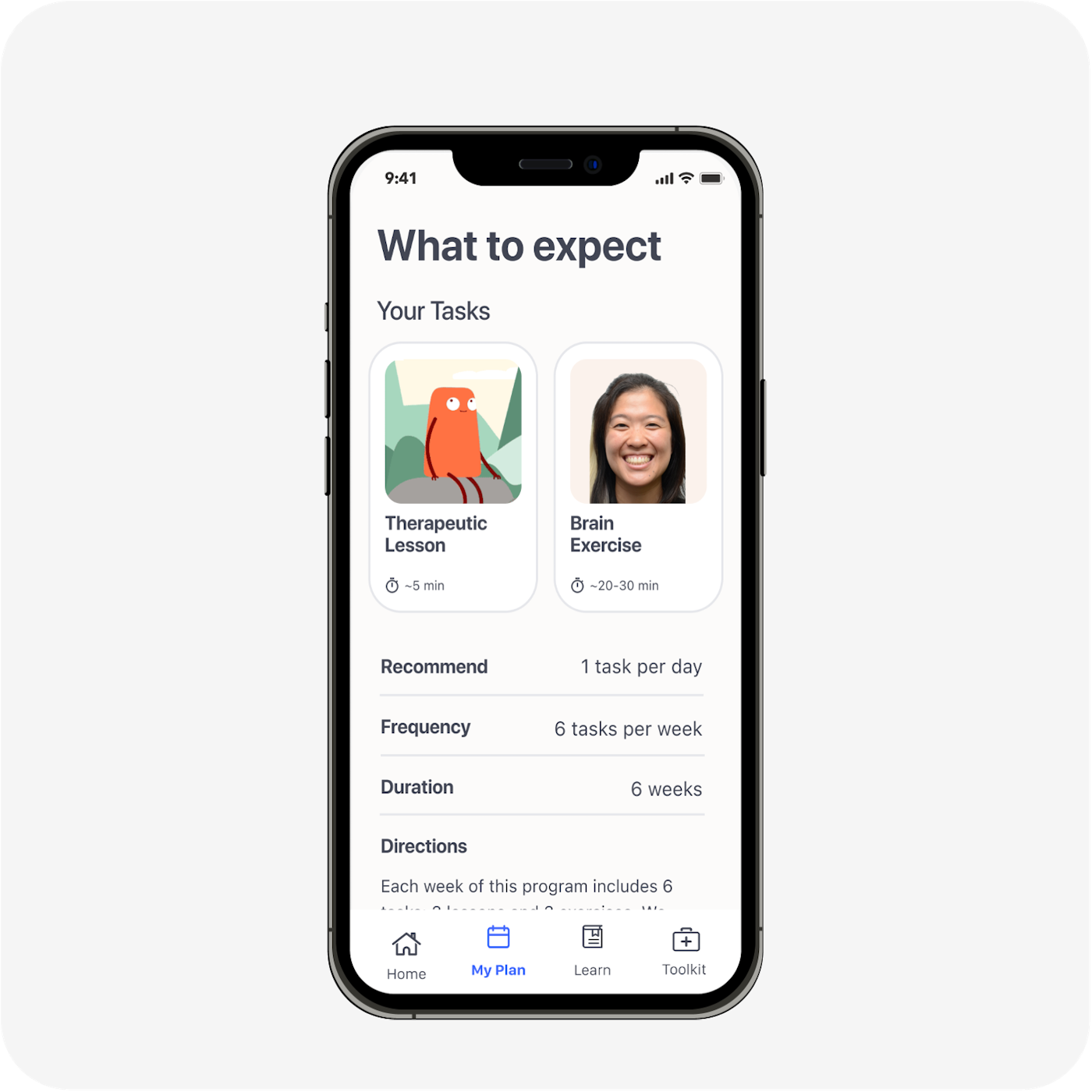
There is an awkward, useful wrinkle in the evidence. In the MIRAI trial’s primary modified intention-to-treat analysis, Rejoyn’s improvement over the sham app missed the conventional statistical-significance threshold: p=0.0568. The intention-to-treat analysis crossed it, at p=0.0211. Both favored Rejoyn. FDA clearance followed in March 2024. Anyone telling the story as an uncomplicated clinical victory has skipped its most instructive paragraph.
At launch, price was another experiment. TIME reported in October 2024 that Otsuka was offering Rejoyn for $50 out of pocket, with a $200 price intended for insurers once coverage began. Those historical prices explain the opening proposition, rather than today’s bill. They also expose the commercial puzzle: a treatment can be cleared, prescribed and downloadable while insurance coverage remains a separate negotiation.
One less day is an actual endpoint
Click’s migraine program offers another way to understand the company. CT-132 received FDA De Novo authorization in April 2025 for preventing episodic migraine in adults, alongside acute or preventive treatments. In the pivotal ReMMi-D trial, the additional reduction versus a sham app was 0.90 monthly migraine days after 12 weeks. That is the between-group difference, rather than the entire improvement experienced by participants.
A fraction of a day can sound unimpressive until the unit is a migraine. Still, an average is an average; it cannot promise an individual’s result. The achievement here is narrower and more useful than a grand claim about healthier screen time. Click tested a specific intervention against a comparator and measured the condition it intended to treat.
Its platform combines clinical science, software engineering and personalization. Engagement belongs in that system because exercises must actually be completed. Click’s early smoking-cessation app, Clickotine, illustrates the distinction. A 2017 publication reported encouraging self-reported quit rates among 416 participants, but the study had no randomized control group. It offered a reason to keep investigating, not permission to declare the problem solved.
The partner hands over the keys
The commercial story became especially interesting in April 2026. Boehringer Ingelheim invested $50 million in Click’s Series D and supplied additional dedicated commercial funding. It also transferred full product responsibility for CT-155, including commercial and marketing authorization rights, to Click. Originally, the 2020 partnership had placed worldwide commercialization with Boehringer. The developer was now taking the lead on delivery.
CT-155 addresses negative symptoms of schizophrenia, including difficulties with motivation and pleasure. In CONVOKE, symptom scores improved by 6.8 points with the treatment versus 4.2 with the digital control after 16 weeks. In July 2026, FDA cleared the device as Motivista for adults with clinically stable positive symptoms, adjunctive to outpatient care including antipsychotic therapy. Clearance establishes its authorized role; it does not tell us how widely it has been used.
This is expensive work conducted on a pharmaceutical timetable. Click raised a $52 million Series B in 2021; Dassault Systèmes supplied its Series C in 2025. Those are financing amounts, not itemized development costs. The 2026 reset also had a human cost: Behavioral Health Business reported layoffs affecting 27% of the workforce, while management described a transition from research toward commercial launch.
Borrow the distribution, prove the benefit
Click’s counterparties are as revealing as its apps. Otsuka helped develop Rejoyn. An Indivior agreement covers substance-use-disorder treatments, starting with opioid use disorder, and specifies upfront and development payments, potential milestones and double-digit sales royalties. Medidata brings clinical-trial capabilities. Patients use the treatments, clinicians prescribe them, and pharmaceutical companies help finance and distribute them.
Click SE, launched in 2024, pushes this arrangement further: develop software to add benefit to a specific drug. The company’s acquisition of Better Therapeutics’ assets points in the same direction. Click said it would adapt the diabetes treatment AspyreRx’s therapeutic core for further development, including obesity work, rather than self-commercialize AspyreRx as-is. The lesson for another builder is practical: acquire useful evidence, then decide whether the existing product fits your route to market.

A phone offers reach; a prescription adds conditions.

The boundary is part of the product
Click sits among digital-therapeutic developers such as Big Health and Akili, although different indications make their products poor substitutes for one another. Click’s particular proposition combines multiple treatment programs, a shared development platform and pharmaceutical collaborations. Its published mission is to “Provide patients everywhere access to safe and effective prescription digital therapeutics.” A phone offers reach; a prescription adds conditions.
Those conditions should travel with the story. Rejoyn requires a suitable patient and accompanying care. Migraine prevention software requires participation, and its trial average is no guarantee. Ultrahuman’s planned Migraine PowerPlug borrows from CT-132 technology, yet is explicitly a wellness and educational experience. Evidence belongs to the tested product and population. The distinction is what makes Click interesting: the company is trying to make software deserve a place in medicine, one bounded claim at a time.