Jeremiah Robison once drove home with $500,000 worth of computer memory in his trunk. Slide, the social networking company where he was chief technology officer, needed more capacity. A delivery would arrive too late. So he went to collect the hardware himself, then spent the return journey hoping traffic would spare him an exceptionally expensive accident. Silicon Valley has produced many theories of scaling. This one required a car.
The story is funny because the cargo makes the stakes visible. Usually, software hides its dependencies. People see photographs appear, messages arrive and accounts multiply; somewhere else, machines do the work. On that drive, the distance between a popular service and the equipment keeping it alive had become very short. Robison was transporting a business problem by road.
That collision between abstract instructions and stubborn objects runs through his career. He worked on handwriting recognition at Apple, mobile browsers at Openwave, social applications at Slide and wearable technology at Jawbone. In 2018 he founded CIONIC. The settings changed, but each brought software into contact with something it could neither ignore nor entirely control: a hand, a handset, a server, a garment.
Before the boardroom, the pool
Robison earned bachelor’s and master’s degrees in computer science at Stanford. Algorithms were an early interest. There was also water polo, a pursuit that makes a useful counterweight to the familiar picture of a computer scientist sitting alone with a keyboard. He competed for Stanford and was named to the All Pac-10 Academic team in 1995.
That season gives the sporting detail some texture. Stanford came in after consecutive national championships, with expectations of another. Instead, the team finished 17-11 and sixth nationally. The season included an 11-7 victory over California in the annual Big Splash rivalry. A respectable record can still disappoint when the previous standard was a championship. Competitive environments have a way of making the denominator matter.
The engineering education and the organized team sport occupied the same stretch of Robison’s life. It does not give us permission to turn every later management decision into a water polo metaphor. Still, it is an appealing detail. Before his job involved coordinating people from different technical disciplines, he had already spent time doing demanding work in a team, with an opponent making its own plans.
- APPLEReading a hand
- OPENWAVEThe web in a pocket
- SLIDESocial at scale
- JAWBONESoftware on the wrist
- CIONIC · 2018Computing meets clothing
Teaching a machine to read a hand
At Apple, Robison contributed to handwriting recognition for the Newton handheld computer. The task placed computing unusually close to ordinary human messiness. A typed character arrives as a reasonably clear instruction. A handwritten one asks the machine to interpret a gesture. People do not supply identical inputs simply because the software would find that convenient.
His later recollection of the work includes an easily overlooked detail: the early machine learning ran in assembly code. The phrase has a pleasing lack of glamour. Today, machine learning can sound like a service summoned from elsewhere. In that period, Robison was working close to the machine itself, where computational resources and implementation choices were difficult to wish away.
Openwave brought another set of constraints. Robison helped build an early HTML browser for mobile phones and led browser development. The browser software reached more than a billion handsets. That figure belongs to the browser’s distribution, rather than to a personal audience or a company he founded. It is nevertheless a reminder that much of the mobile internet existed before the devices that now dominate its history.
A browser on a phone has to negotiate between the abundance of the web and the limits of the thing in your hand. Small screens and embedded systems make priorities concrete. The work sits neatly beside the Newton on Robison’s career map: both projects asked how computing might fit into activities people were already doing, with hardware that imposed its own terms.
When the audience gets there first
Slide moved the problem to a different scale. Robison served as chief technology officer and was a founding member of its management team, working with Max Levchin. The company built social entertainment applications and was eventually acquired by Google. Here, the challenge included keeping large services working as people used them together.
In Robison’s telling, Levchin was someone from whom he wanted to learn entrepreneurship. That is a useful admission from an experienced technologist. Knowing how to construct a system and knowing how to build a company around it are related skills with different failure modes. A company needs decisions about people, money and timing as well as working code.
The memory-collection errand belongs in this chapter because it punctures the clean diagram. Demand had arrived, and the supporting machinery needed to catch up. A smooth user experience could depend on a decidedly unsmooth afternoon for the person responsible for infrastructure. The comic detail survives because the underlying problem remains familiar: success can create an emergency just as efficiently as failure.
There is a temptation to describe a technology career as a succession of launches. Robison’s route also contains maintenance, capacity and operating responsibility. Those are less photogenic subjects. They help explain how an engineer accumulates judgment: through the occasions when the thing already built must keep working while the world around it changes.
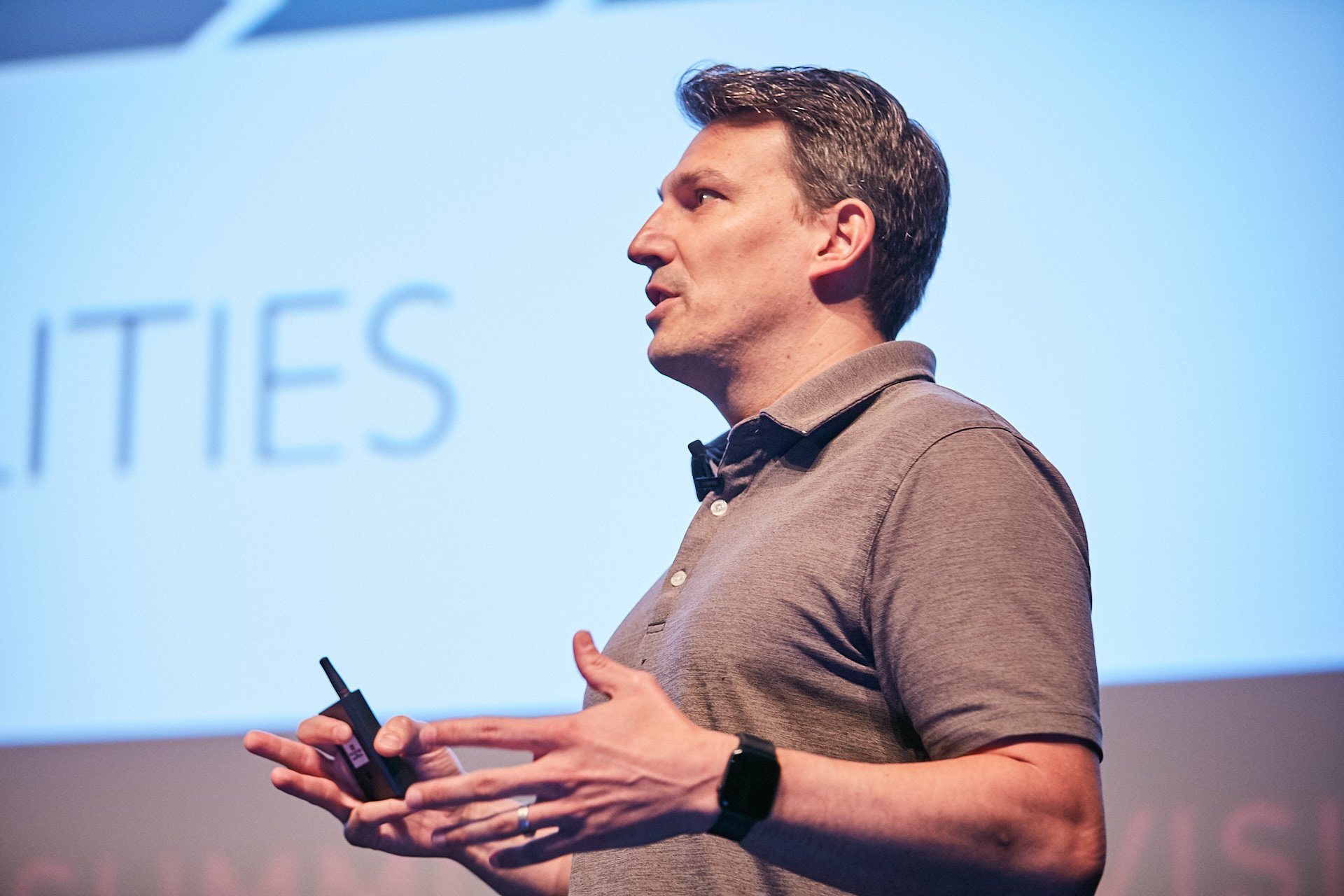
The computer leaves the desk
At Jawbone, Robison became vice president of software, overseeing software engineering and data science. His work included the infrastructure behind the UP wrist-worn tracker. He has described learning hardware during his time there and eventually taking responsibility across hardware and software. The computer had moved from the handset onto the person.
A wearable brings together disciplines that have separate vocabularies and separate calendars. Software can be revised after it ships. A physical component has to be selected, sourced and manufactured. A design has to make sense to the wearer before any of its technical virtues become useful. Put these concerns together and the product meeting gets crowded quite quickly.
Robison founded CIONIC with experience of that crowded meeting. The company’s work combines software, sensing and clothing. LDV Capital invested in 2018, when he was a one-person team with an early prototype. The gap between that starting point and a staffed company is easy to compress into a founder biography. In practice, the gap contains hiring, design decisions and the repeated conversion of an idea into something another person can use.
That beginning also puts his title in perspective. Founder and CEO can sound like a job performed principally through speeches and strategy. A one-person company has fewer opportunities for delegation. At the outset, the organization and the individual are almost the same size. The work of leadership includes changing that condition without losing the original purpose.
A design brief with seams
CIONIC’s collaboration with Yves Béhar’s fuseproject makes Robison’s product instincts visible. The brief involved something lightweight, adjustable and comfortable, with the visual language of athletic clothing. The design work extended beyond an attractive outer surface to the way the object would be worn and handled. A garment provides a remarkably direct test of whether its maker has understood everyday use.
The company’s hardware team makes the less visible side of that effort equally concrete. Mihai Ionescu’s responsibilities have included specifications, component costs, sourcing and manufacturing timelines. Product leader Domenico Pisaturo has worked on design and soft goods prototypes. The list reads like the contents of several businesses until one remembers that the customer receives a single object.
This is where Robison’s earlier chapters begin to connect. An embedded system, a large data service and a wearable each train attention on different weaknesses. Bringing those experiences into one company does not make the weaknesses disappear. It gives the founder a longer list of questions to ask before declaring the product finished.
The design partnership has also brought external recognition. In 2023, the Neural Sleeve received IDEA Gold for Digital Interaction. The same year, it received Dezeen’s Design Project of the Year award. Those are product and collaboration achievements; they belong to the teams involved. For a profile of Robison, their significance is that industrial design sits alongside software in the account of what his company has built.
A map of the work described by CIONIC and its design partner.
The speed he wants, the people he needs
Robison has a concise ambition for the relationship between software and hardware. “We want innovations to come at software speeds and software costs versus hardware speeds and hardware cost.” It is an aspiration, rather than a claim that physical products can now be updated without friction. Anyone who has waited for a component can appreciate the distinction.
His public work also includes conversation. In 2020, he launched the podcast Superpowering the Human Body, opening with colleague Brian Kolonick. The discussion addressed collaboration, the people who encounter problems in their daily work and the importance of understanding the whole user journey. The host’s role gives Robison room to ask questions instead of simply presenting answers.
He remains publicly engaged in that exchange. In September 2026, he appeared on Medtech Talk with Geoff Pardo, returning to his career history and the practical work of building CIONIC. The continuity is striking: a founder still explaining the route from algorithms to objects, and still talking about the people required to make that route usable.
The temptation with a varied career is to arrange it as evidence of inevitability. Robison’s own account is more interesting when allowed to retain its changes of direction. He wanted to learn from Levchin. At Jawbone, he learned hardware. With CIONIC, he began again with an early prototype. Experience supplied material for the next venture without supplying all the answers.
“Stay humble,
JEREMIAH ROBISON
stay working.”
His preferred maxim is small enough to survive contact with a difficult day: “Stay humble, stay working.” There is room inside it for ambition, but little room for resting on a résumé. Somewhere between the handwriting model and the garment pattern, Robison has kept finding another practical problem. He has already demonstrated a willingness to go and collect the parts.
Keep following the work
Explore Robison’s writing, conversations and product collaborations.