The unremarkable thing about walking is how little most of us notice it. We think about where to go. Our bodies attend to the lifting, balancing and landing. For someone with foot drop, that division of labour can collapse. A toe catches. A foot turns inward. The next few metres demand attention that everyone else spends deciding what to have for lunch.
Jeremiah Robison came to this problem as a technologist and a father. His daughter’s cerebral palsy made mobility equipment a family concern. His professional background included Apple and Jawbone; he had spent years around products that people expected to become smaller, smarter and easier to use. In 2018, he founded CIONIC. Walking became the first thing he wanted that expertise to help with.
- The product: a prescription leg sleeve that senses movement and delivers timed electrical stimulation.
- The difference: coordinated support across four muscle groups, with motor and sensory stimulation in Neural Sleeve 2.
- The evidence: encouraging short-term findings, with study size and design that deserve attention.
- The business: hardware, software and remote care sold together, with a way to return the device and stop future payments.
A wardrobe problem with a wiring diagram
The Neural Sleeve looks closer to sportswear than to a piece of laboratory equipment. That resemblance is deliberate. CIONIC worked with Yves Béhar’s fuseproject on a garment intended to be comfortable, adjustable and less stigmatizing. The design brief included a question that technology demonstrations often leave until last: can the person who needs this actually put it on?
Designer Jon Johannesson’s account describes more than 50 prototypes developed around one-handed donning and removal. A stroke survivor may have limited use of one side of the body. Sticky hydrogel electrodes must meet the correct muscles. A beautiful sleeve that requires two dexterous hands would be a rather expensive misunderstanding.
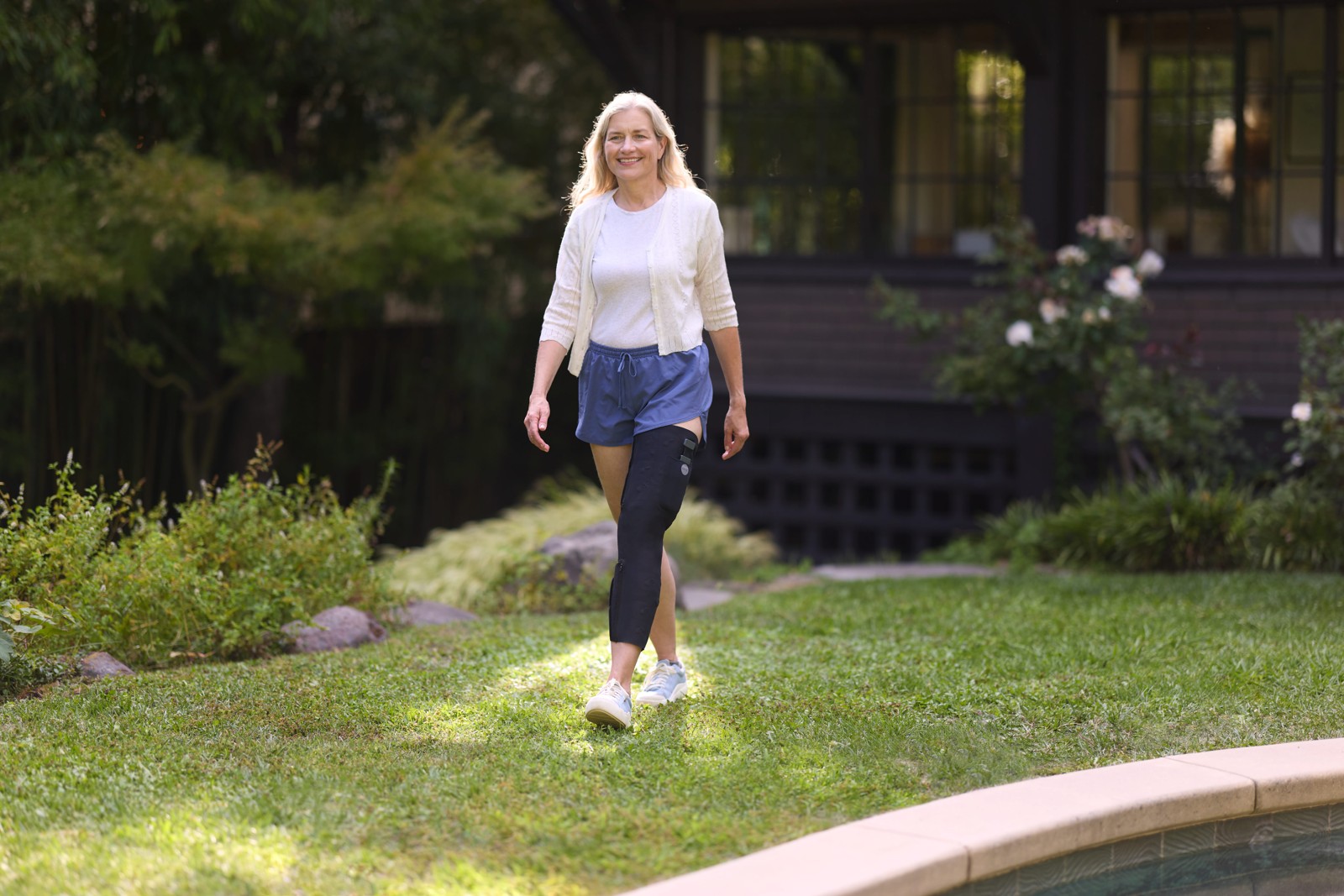
This is a useful way to understand the company. Its expertise spans software, sensing, stimulation and the less glamorous work of making something wearable. Those disciplines meet at the skin. Each depends on the others; no algorithm can compensate for a device left in a drawer.
The clever part is when
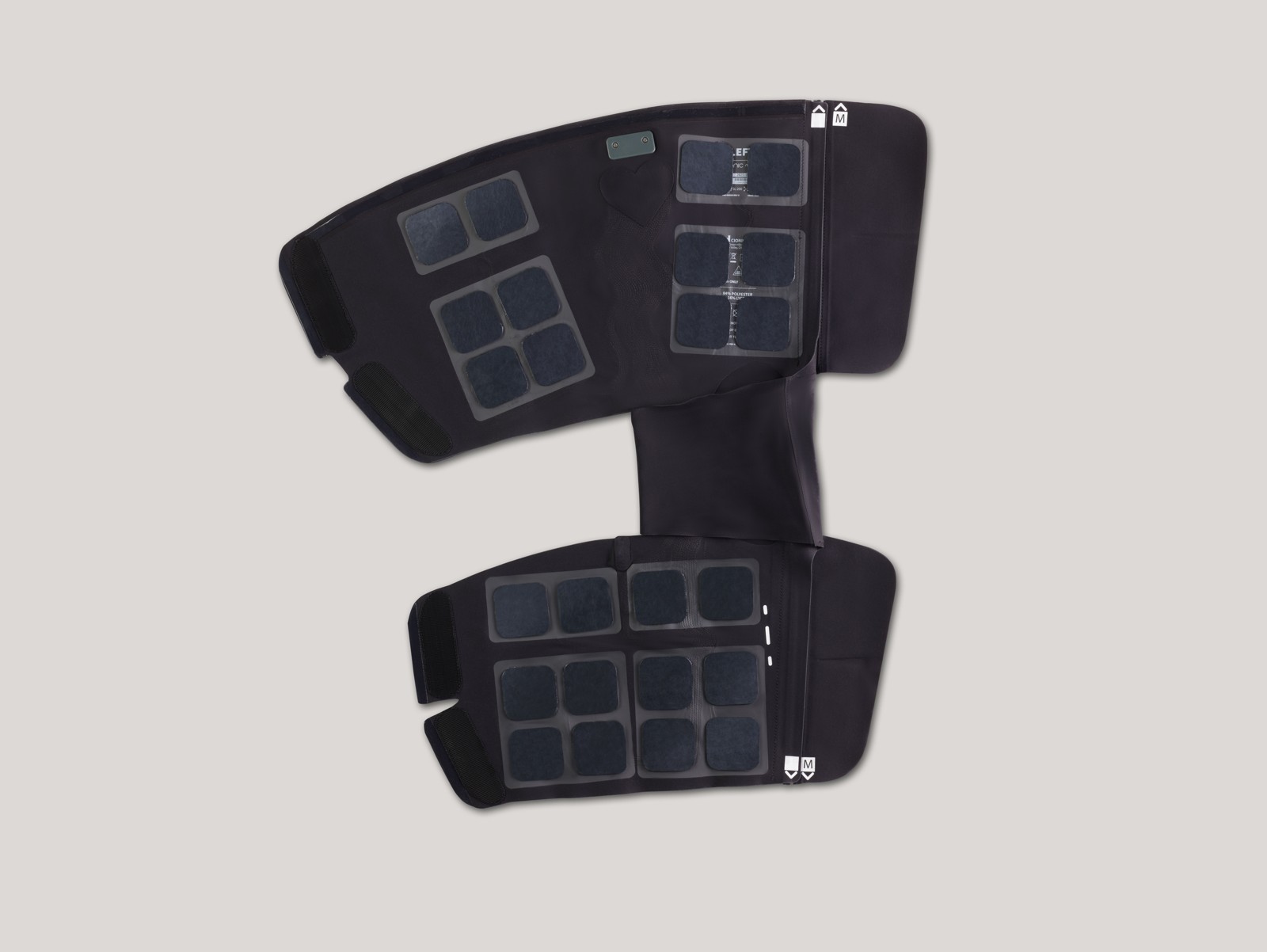
Electrical stimulation is not CIONIC’s invention. Functional electrical stimulation, or FES, uses electrical pulses to activate muscles. CIONIC’s work concerns how to personalize those pulses and coordinate them with movement. Sensors feed information about the leg’s position and motion into adaptive algorithms. Electrode arrays let the system adjust where stimulation is delivered.
Timing changes the meaning of the same action. Lifting the front of the foot during a step can help clear the ground. Supporting it as the heel lands serves a different purpose. The sleeve is designed to respond to the gait cycle, rather than simply produce contractions on a clock.
Neural Sleeve 2 supports the quadriceps, hamstrings, shin and calf. Its MultiStim system combines motor stimulation to activate movement with sensory stimulation aimed at relaxing spasms. The device works with an app and mobility specialists who help configure it. “AI” is the marketing shorthand; the practical question is whether the right muscles receive useful stimulation at the right moment.
CIONIC operates in an existing market. Bioness’s L300 Go offers lower-leg stimulation and an optional thigh cuff for knee assistance. An ankle-foot orthosis provides mechanical support. Therapy and other walking aids remain part of the picture. CIONIC’s proposition is a garment that integrates multiple muscle groups, adaptive control and remote care. Its early studies do not establish superiority over every alternative.
A small study deserves a full-sized explanation
The most informative numbers are smaller than the marketing numbers. A 2024 company-funded paper analyzed 32 people with foot drop in paired walking tests, with and without stimulation. Average ankle dorsiflexion at heel strike increased by 5.2 degrees; inward ankle rotation during swing decreased by 3.6 degrees. These are specific improvements in how a foot moves.
With stimulation versus without stimulation. Company-funded; no randomized comparison with a brace.
They are not measurements of a cured neurological condition. The study did not compare the sleeve with standard care in a randomized trial. It also did not collect gait speed or stride length. Four people allocated for testing lacked the endurance to complete the protocol; two were excluded because of equipment errors. These details locate the result in a real experiment, with real boundaries.
The newer spasticity evidence is preliminary, too. CIONIC’s July 2025 white paper describes seven people in a two-week home trial. Participants reported changes in the impact of spasticity on their lives. That is a useful signal for further investigation. Seven people over two weeks cannot settle questions about long-term benefit across diagnoses.
In its September 2026 update, the company reports three million hours of wear and 750 million stimulated steps. Those figures tell us the system has been used beyond a demonstration room. They do not, by themselves, tell us how much a particular person will benefit. Usage, immediate assistance and lasting therapeutic change are three different questions.
In September 2026, CIONIC announced TRANSFORM, a study designed to follow 1,000 adults over 12 months using quality-of-life surveys. That shifts attention from ankle angles to how people experience daily life. Early follow-up observations are preliminary; the planned thousand-person dataset is an ambition, not a completed result.
The bill arrives one month at a time
CIONIC sells a supported device rather than a sleeve alone. Its current published single-sleeve plan asks for $300 down, followed by $275 a month for 12 months. The arithmetic is $3,600 before applicable taxes. The bundle includes support, replacement electrodes and warranty repairs.
After year one: optional $125/month care, or a la carte supplies and warranty. Pricing may change.
If the device does not help enough, customers can return it and stop remaining payments. Payments for time already used are not refunded. After the first 12 monthly payments, customers can keep using the sleeve without the ongoing care subscription, buying supplies separately. The exit matters because the benefit is individual, while the bill is wonderfully precise.
Access remains uneven. CIONIC says it is not in-network with insurers; reimbursement is considered case by case. Its Lovell Government Services partnership offers a procurement route through federal healthcare for eligible veterans. The commercial product is currently for adults 22 and older. The family experience that inspired the company should not be mistaken for pediatric availability.
What changed was the brief
Helping a muscle contract addresses only part of some users’ difficulty. Spasticity can resist movement. Neural Sleeve 2 adds sensory stimulation to the motor assistance, making that resistance part of the product’s target. The FDA cleared the NS-200 on May 2, 2025; CIONIC publicly announced its launch that September.
That is a documented change in the product, rather than evidence of a dramatic founder conversion. The development path broadened from activating movement to combining activation with an attempt to reduce spasms. The company’s problem became more demanding as its product became more capable.
“I used to walk and have to take a break, and now I can just walk.”Jason · customer testimonial published by CIONIC
A testimonial makes the desired outcome legible. It is one person’s account, not a forecast. A prospective wearer still needs assessment, suitable fit, a prescription and configuration. Electrical stimulation depends on a responsive neuromuscular system; it cannot be assumed to work for every cause of walking difficulty.
There are practical limits as well as biological ones. The sleeve needs skin contact and care. People with contraindications identified in the device labeling, including certain implanted cardiac devices, need a different route. A clinician’s judgment belongs before an order, not after an optimistic headline.
The ordinary is the opportunity

Investors have financed that translation. CIONIC announced a $12.5 million Series A in 2022 and a $12 million extension led by L Catterton in 2023, bringing its announced Series A total to $25 million. Its public fact sheet puts cumulative funding at roughly $35 million. Capital buys development time; it does not remove the need to establish useful outcomes.
The lesson a reader can copy is practical. Start with a specific obstruction to daily life. Design the setup and support alongside the hardware. Measure the movement you claim to improve. Give people an exit when the product’s benefit does not justify its cost. These choices make sense well beyond medical devices, though a subscription needs to earn its place in the budget.
For CIONIC, the remaining questions will be answered through larger studies, continued use and access that more people can afford. Its appeal is already understandable: a person wants to get across a room, along a path or through an errand with less effort. That is a modest sentence. Building the machinery to make it true is a considerable job.
Follow the next step
Explore the device, hear users’ experiences and follow the company’s work.
CIONIC website ↗Neural Sleeve 2 ↗Company news & blog ↗Watch the product video ↗YouTube interviews & stories ↗LinkedIn ↗Twitter / X ↗Instagram ↗Facebook ↗