In 2011, Thomas Oxley had an idea, a medical education and no obvious invitation. The Australian neurologist was passing through New York after internal-medicine training in Melbourne. He had become absorbed by brain-computer interfaces, those improbable systems that translate neural activity into commands. The field’s standard route was direct: open the skull, place electrodes close to brain tissue, accept the formidable bargain. Oxley wondered whether anatomy had already built a side entrance.
Blood vessels reach every neighborhood of the brain. Doctors already knew how to navigate them with catheters and leave stents behind. What if electrodes could hitch a ride on one of those stents, settle in a vein beside the motor cortex and listen from there? It was the sort of question that sounds clean only after someone has endured the untidy business of asking it first.
Oxley began sending messages. He later estimated that he fired off about 200 cold emails that year while chasing fellowships, collaborators and a path for the idea. Roughly 190 produced silence. One reached Jeffrey Ling, a military neurologist working with the US Defense Advanced Research Projects Agency. Ling replied, invited him over and heard the pitch. Oxley returned to Australia with a challenge to turn his anatomical hunch into a research proposal.
“You have to throw yourself out into the world where you have no idea if anything is going to come back.”Thomas Oxley on the value of cold outreach
A fishing line in the dark
The cold-email story would be intolerable if it ended as a parable about inbox technique. It does not. Most of the work came after the reply. Back in Melbourne, neurologist Terry O’Brien walked Oxley into the University of Melbourne’s engineering department. There he met Tony Burkitt and David Grayden, researchers with experience in bionic eye and ear programs. Biomedical engineer Nicholas Opie joined the effort and became the builder to Oxley’s clinical premise. A team began to form across medicine, neuroscience and engineering.
DARPA supplied early funding. Australian research grants followed. The team had to discover whether a stent laced with electrodes could be delivered safely, stay put and record useful signals through a vessel wall. The name they chose was pleasingly economical: Stentrode, a marriage of stent and electrode. The device looked less like science fiction than a tiny piece of metallic mesh. This was part of its charm. Oxley’s radical move was to recombine objects medicine already understood.
Oxley kept training while the project developed. He completed neurology and stroke fellowships in Australia, earned a PhD in neural engineering at the University of Melbourne in 2016, then finished an endovascular neurosurgery fellowship at Mount Sinai in New York in 2017. His two professions met inside the same narrow tube. As an interventionist, he knew the practical choreography of passing devices through vessels. As a neural engineer, he could pursue what the signal meant once the device arrived.
The familiar machinery of a strange idea
Oxley often describes the technology by comparison. A Stentrode is delivered much as another vascular stent might be. A lead runs to a transmitter beneath the skin in the chest, a shape and location that recall a pacemaker. The system records population-level electrical activity near the motor cortex, and software learns patterns associated with attempted movement. Those patterns can be assigned to actions such as selecting an item on a screen.
This is not telepathy, and Oxley is careful about the distinction. A current brain-computer interface does not roam across a person’s private interior and transcribe whatever it finds. It samples a particular domain of activity for a defined task. “One myth for BCI is that it can read your thoughts,” he has said. The correction is scientifically important and commercially useful. A product that sounds like omniscience is difficult to trust. A product that recognizes an intended click is easier to understand.
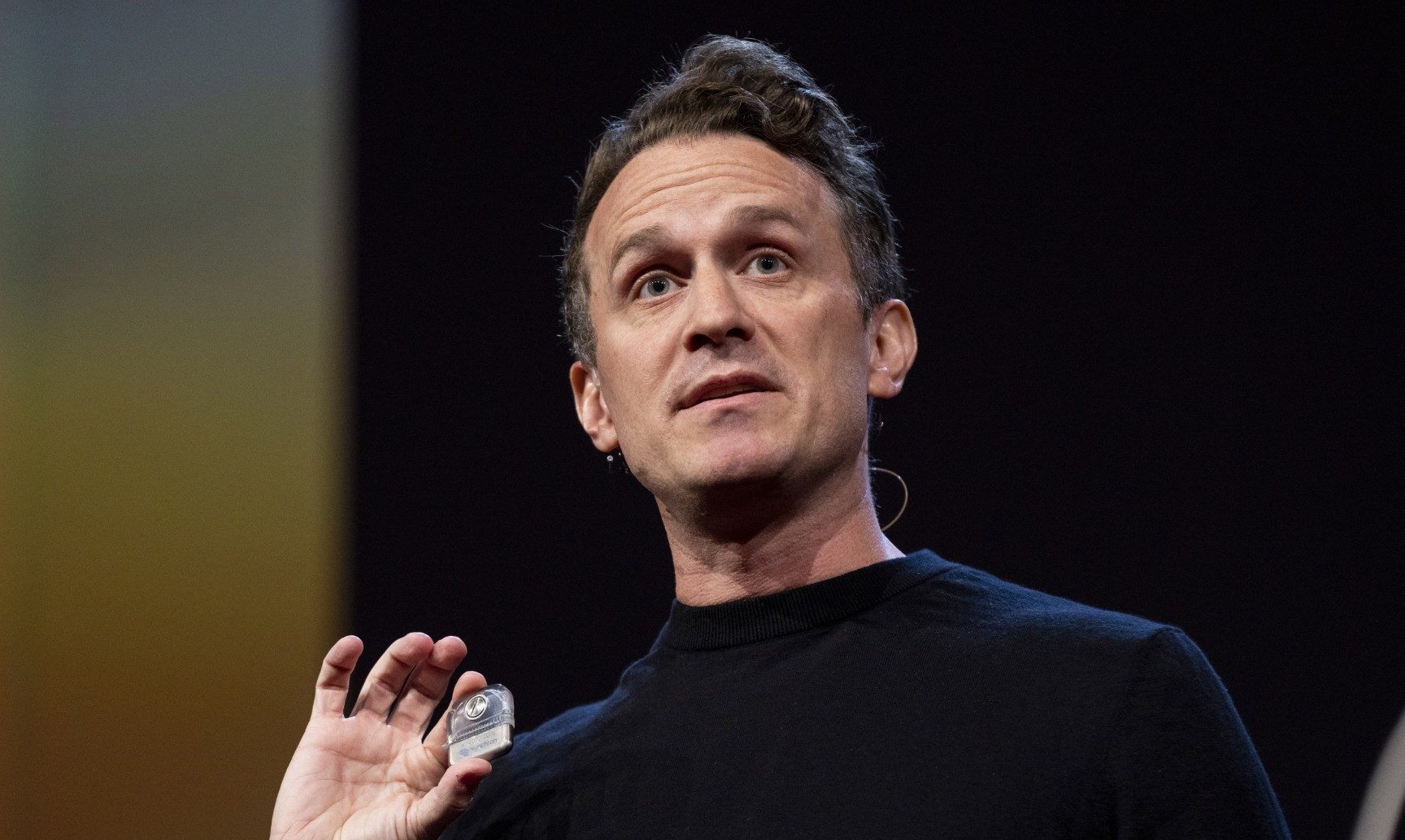
Synchron emerged from the research as the corporate vehicle for getting the system through human trials and, eventually, into ordinary clinical practice. The first human implants began in Australia in 2019. Early participants used the interface to carry out digital tasks at home. In 2022, Synchron announced its first US implant. By late 2023, it had enrolled six participants in the American COMMAND early-feasibility study, bringing the number implanted across the Australian and US programs to ten.
Those numbers are modest because implanted medical devices advance by evidence, not applause. Every stage asks a different question. Can the implant remain stable? Can it record a useful signal over time? Can a person learn the control scheme? Can the device be manufactured consistently? Can a procedure fit the routines of hospitals beyond the founding team? The answers have to survive regulators, clinicians, insurers and daily life.
The cursor is the point
Brain interfaces invite grand language. Oxley’s most persuasive examples are deliberately mundane: write a message, open an app, browse the news, reach family. These tasks lack the theatrical sparkle of a robot arm. They possess something more durable - relevance. A smartphone is now a bank, a library, a workplace and a room full of friends. Control of the screen can be a form of practical agency.
That emphasis shaped Synchron’s work with consumer platforms. In 2025 the company announced integration with Apple’s brain-computer interface Human Interface Device protocol. In a public demonstration, a participant navigated an iPad, opened apps and composed text through motor intent. The important detail was not merely that the system spoke to an Apple device. Neural input was being treated as a native input category, placed beside touch, voice and typing rather than bolted on as an exotic afterthought.
“The blood vessels are the natural highways into the brain.”Thomas Oxley’s shorthand for an endovascular interface
Artificial intelligence has entered the system too. Synchron has developed models intended to improve the translation from noisy neural activity to useful commands. Here again, Oxley’s job is to keep the ambition attached to the task. Better decoding matters when it reduces delay, understands context or makes selection more reliable. Intelligence earns its place by making the interface less laborious.
Fifteen years, measured properly
The DARPA reply helps turn a vascular-access idea into a funded research program.
Oxley completes his neural-engineering PhD; the team publishes chronic endovascular recording research.
Synchron begins first-in-human testing of its permanently implanted system in Australia.
The first US implant is announced, followed later that year by a $75 million Series C.
Native iPad control is demonstrated and Synchron raises a $200 million Series D.
Oxley says the company is pursuing approval in Australia, Canada and the United States.
In November 2025, Synchron raised a $200 million Series D, bringing its reported total funding to $345 million. The money was assigned to pivotal trials, commercial preparation, an expanding cognitive-AI group in New York and an engineering hub in San Diego. Large financing can create the illusion that the difficult part is finished. In medical devices, it usually means the next difficult part has become affordable.
Oxley’s aspiration now extends beyond proving that the route works. He wants to make the route scalable: a device that trained clinical teams can deliver, a system that connects with familiar electronics, and an interface whose benefits justify its procedure. He has also spoken about a future generation with more channels and broader access to brain signals. That future brings questions of consent, control and cognitive liberty. Synchron has placed those ideas in its public vocabulary, an acknowledgment that a neural interface needs an ethical architecture as surely as it needs a lead.
There is an agreeable irony in Oxley’s story. He is building a communication technology because he was once very good at communicating into silence. The 190 unanswered emails did not predict the value of the idea. Nor did the one reply guarantee it. The reply merely opened a door to years of disciplined work by a large team.
That is the less glamorous anatomy of invention. One person notices a route. Another can build the instrument. Others test materials, decode signals, run trials and ask whether the result belongs in the world. Oxley’s contribution is not a lone flash in a dark room. It is the persistence to connect those rooms, then keep the corridor open long enough for evidence to pass through.
The blood vessels were always there. The novelty lay in looking at them and seeing not only circulation, but access. Fifteen years on, the idea still has work ahead of it. Yet its central proposition has already traveled a considerable distance: from an unsolicited email, through a Melbourne laboratory, into a New York company, and onto the screen of an iPad. Quiet roads can carry consequential traffic.