The most revealing line in AudioEye’s annual report is not a revenue number. It is an admission: “automation alone cannot fix all accessibility issues.” For a software company that scans more than 2,000 times per second and says it delivers over one billion automated fixes every day, that sentence sounds almost impolite. It is also the business model. AudioEye sells the machine, the humans who clean up after the machine, and the record that the work keeps happening.
The problem is easy to underestimate. A website can look ordinary while behaving like a locked room. A menu may not open from a keyboard. A screen reader may announce a button as “unlabeled.” Pale text can disappear for someone with low vision. A checkout form can report an error without explaining where it occurred. These are not decorative flaws. They interrupt shopping, banking, applying, booking and learning.
The first idea was an internet you could hear
AudioEye did not begin as today’s compliance dashboard. Incorporated in 2005, the Tucson company grew from patented work on voice-driven browsing: converting media into accessible formats, publishing it in real time and letting users navigate without a mouse or visual display. Nathaniel Bradley, Sean Bradley, James Crawford and David Ide are identified as co-founders in public records. The early product names - Audio Internet, AudioEye Mobile, AudioEye Advertising - belong to a period when talking to a browser still sounded futuristic.
That original approach did not become the main thing customers now buy. The first failure was conceptual: an alternative voice interface could help a user reach content, but it did not repair the underlying web. As pages became more interactive and software teams shipped constantly, accessibility became less like translating a document and more like maintaining a city. The work had to live where websites were built, tested and changed.
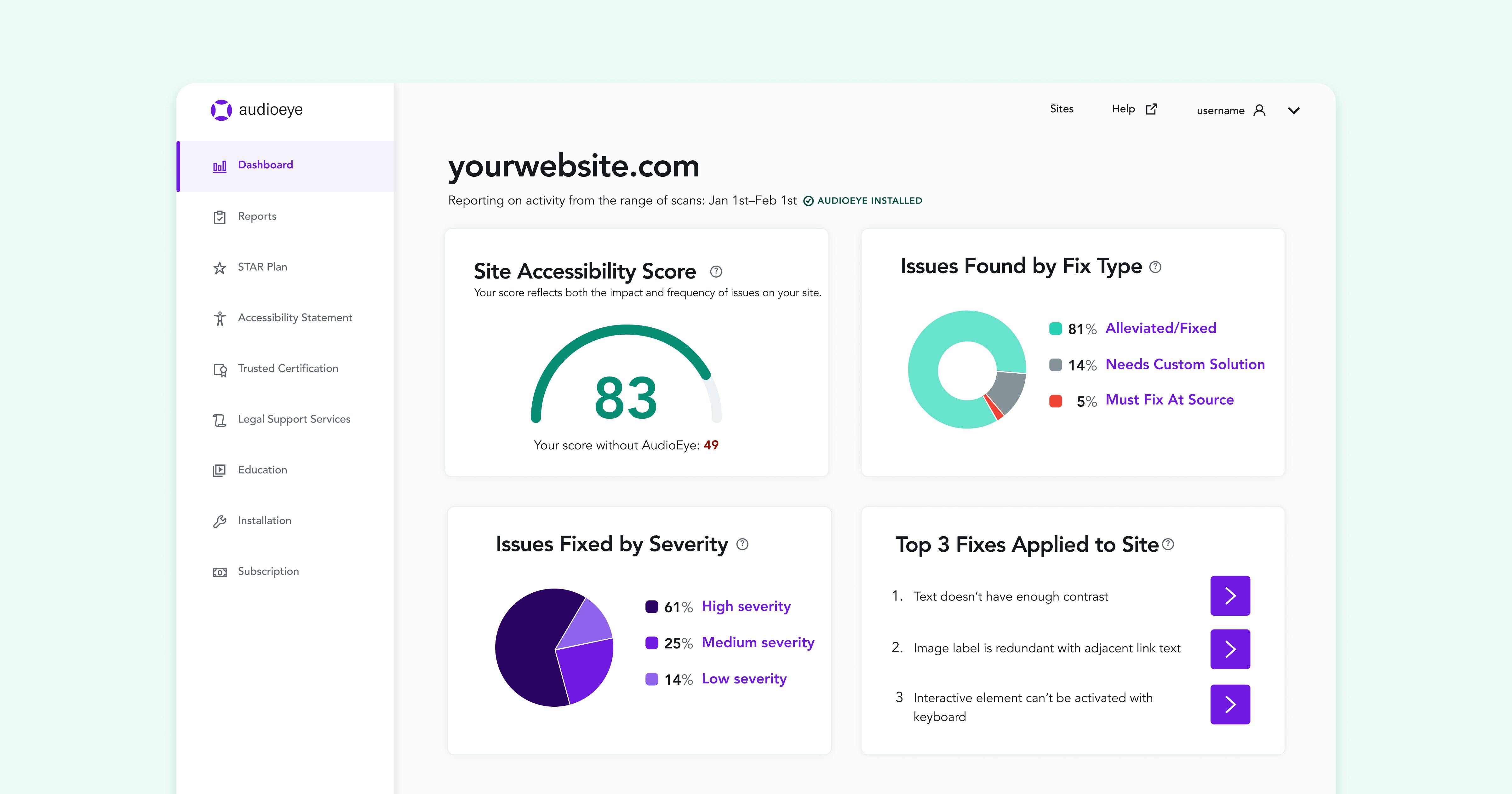
AudioEye’s modern answer is a loop. Its software monitors live pages and detects WCAG issues. Automated remediations handle patterns the system can resolve safely. Reports expose what remains. Developers can test earlier with an SDK in local workflows or CI pipelines. Certified experts and assistive-technology users audit the contextual problems, then write custom fixes or tell a customer what must change at the source. Monitoring starts over as the site evolves.
Scan live pages and pre-production code for WCAG failures.
Apply repeatable fixes while the site is being used.
Send context-heavy barriers to experts and disabled testers.
Report the work, monitor changes and document the program.
What changed their mind: the leftovers
Automation is good at rules with machine-readable evidence. Does an image lack alternative text? Is contrast below a threshold? Does a control miss an accessible name? But software struggles with meaning. It can see that alt text exists without knowing whether it is useful. It can flag structure without understanding whether a checkout is coherent when heard through a screen reader. AudioEye says its automated tools can address roughly half of detected issues. The leftovers forced the company toward a hybrid model.
“We recognize that automation alone cannot fix all accessibility issues.”AudioEye, 2025 annual report
That distinction matters in a market poisoned by easy promises. Automation-led widgets can be quick to install, but disability advocates and accessibility practitioners have long objected when a small script is marketed as total compliance. Traditional consulting sits at the other extreme: thoughtful audits and source-code recommendations, followed by a report that begins aging the next time the client ships. AudioEye’s pitch is that software supplies continuity while people supply judgment.
The company has tried to make disabled users part of that judgment rather than an audience imagined after the fact. Its A11iance and community work involves more than 40 people with disabilities testing customer websites and advising on usability. The number is modest beside 129,000 customers, but strategically important. Accessibility expertise without lived experience can turn into a tidy checklist that misses the actual task.
A compliance problem becomes a distribution business
AudioEye sells subscriptions two ways. Enterprise customers, including large brands and government agencies, buy custom programs through a sales team. Small and midsize businesses arrive through the marketplace, agencies, resellers and content-management platforms. In 2025, Partner and Marketplace produced $22.2 million in revenue; Enterprise produced $18.1 million. At year-end, the two channels represented about 58% and 42% of ARR, respectively.
Duda shows why the partner side scales. In 2020, AudioEye became a native option in Duda’s app store, letting agencies switch it on without wiring every installation themselves. The same logic applies to CMS integrations and resellers: make accessibility a line item inside a workflow businesses already use. The partner gets discounted or wholesale economics; AudioEye gets distribution. One catch deserves attention: a single customer and its affiliates accounted for about 13% of 2025 revenue.
Customers can choose automation, a self-managed program with developer tools and expert guidance, or a managed program with automated tools, custom fixes, audits and optional Assurance. Add-ons cover documents, mobile audits, VPAT reports, training, consulting and legal responses. Current prices are scoped rather than plainly posted. AudioEye’s own calculator illustrates a hypothetical do-it-yourself annual cost of $269,725, mostly developer time, but that is a sales scenario, not a universal invoice.
What did it cost?
The cleanest answer is not a subscription price. It is the cost of building the company AudioEye is now. When David Moradi and director Jamil Tahir joined in 2019, they later said it had low gross margins, deeply negative operating margins, negative cash flow and “a product in need of improvement.” By 2025, revenue had nearly quadrupled from that era, reaching $40.3 million. Adjusted EBITDA rose to $9.1 million. The reinvention also accumulated scars: AudioEye ended 2025 with a $103.4 million accumulated deficit and had not produced a full-year GAAP profit.
Paid in cash, seller notes and estimated contingent consideration for ADA Site Compliance in September 2024.
Q2 2026 GAAP net loss, even as adjusted EBITDA reached a record $3.0 million.
The 2024 purchase of ADA Site Compliance offers a smaller ledger. AudioEye paid about $7 million, including $3.4 million in cash at closing, seller notes and contingent consideration. The acquired company brought audits, customer relationships and a workforce that could be migrated onto AudioEye’s platform. In accounting terms, $5.1 million of the purchase allocation went to customer relationships. In strategy terms, AudioEye bought more people and distribution for a product whose advantage depends on both.
The bet now: more pages, less patience
Kelly Georgevich became CEO in May 2026 after nearly five years as CFO. Moradi moved to Executive Chairman and Chief Product Officer, keeping responsibility for product and AI strategy. The handoff came just after a next-generation platform combined automated detection, expert audits and custom fixes in one dashboard. By June, AudioEye reported $42.3 million in ARR, about 129,000 customers and its forty-second consecutive quarter of record revenue.
The market is helping. Government rules now specify web and mobile accessibility for many state and local services. The European Accessibility Act is enforceable. Private-sector ADA interpretation remains less uniform, but lawsuits keep accessibility on legal budgets. AI adds a fresh complication. AudioEye’s 2026 index scanned more than 165,000 pages and found interior pages carried 10% more issues than homepages. Search tools increasingly send users straight to those forgotten product, account and conversion pages.
AudioEye is not guaranteed to win that expansion. Better-funded platforms can build competing AI. Browsers and content systems could make more accessibility native. Enterprise buyers can choose Level Access, Deque, Siteimprove, other automation vendors, specialist consultants or their own engineering teams. AudioEye still carries debt, litigation expense and customer concentration. Its own filing warns that AI may make competitors faster, cheaper or more accurate.
Do not promise that automation erases the problem. Automate high-volume checks, show customers the unresolved queue, route ambiguous work to people with relevant experience, and monitor after launch. The evidence trail matters as much as the initial fix.
When the playbook does not work
AudioEye is most useful for organizations with active websites, recurring releases, limited in-house accessibility capacity and a need to document ongoing work. It is less convincing when a buyer wants a script to certify perfect compliance, when a product’s barriers live deep in native mobile or unusual interactions, or when a capable internal team can repair source components before they spread. Automation layered onto broken architecture can reduce symptoms without curing the system.
That is the company’s central tension and its best sales argument. AudioEye built scale by making accessibility easy to start, then built credibility by acknowledging that easy installation is only a start. The badge is visible. The valuable work is the loop behind it - scanning, fixing, listening, retesting and admitting what remains.