How Neurosoft Plans to Read Your Brain Without Cutting Into It
Neurosoft Bioelectronics built a stretchable brain interface up to 100,000 times softer than the metal grids surgeons use today - and put a 64-channel version on the cortex of epilepsy patients. Here is how an EPFL lab experiment became a $20 million bet on reading the brain without carving into it.
The human brain has roughly the consistency of soft tofu. The devices we use to listen to it are made of stiff metal and rigid plastic. For decades, neuroscientists and surgeons accepted that mismatch as the cost of doing business. Neurosoft Bioelectronics decided it was the business.
Founded in 2019 as a spinout of Switzerland's EPFL, the Geneva company builds soft, stretchable brain-computer interfaces - thin electrode sheets that lay across the surface of the cortex to record and stimulate neural activity, without penetrating brain tissue. The pitch is almost stubbornly simple: if you want a device to sit against the brain for a long time and read it clearly, make the device behave more like the brain. In 2026 the company closed a $7.5 million oversubscribed round that pushed its total funding past $20 million, and reported a record-setting trial of a 64-channel soft interface in human epilepsy patients.
The OriginAn internship, and a look at some very old technology
The company traces back to a summer internship. Nicolas Vachicouras, now CEO, was studying microengineering at EPFL when he joined Professor Stephanie Lacour's Laboratory for Soft Bioelectronic Interfaces. Working with the electrodes neuroscientists relied on to read the brain, he came away with a blunt impression: the technology looked outdated. He stayed for a PhD on the subject, and in 2019 co-founded Neurosoft with Ludovic Serex, now COO, and Florian Fallegger, now CTO - three EPFL researchers turning a materials-science thesis into a medical device.
That lineage still shapes the company. Neurosoft is based at Campus Biotech in Geneva, with a US subsidiary in New York, and its early years were funded largely by grants rather than venture money - a CHF 150,000 award from Venture Kick, backing from Switzerland's State Secretariat for Education, Research and Innovation. The team has since built up more than 25 patents and 25 peer-reviewed publications, the kind of paper trail that signals the science came first and the fundraising followed.

The BetSoft, not sharp
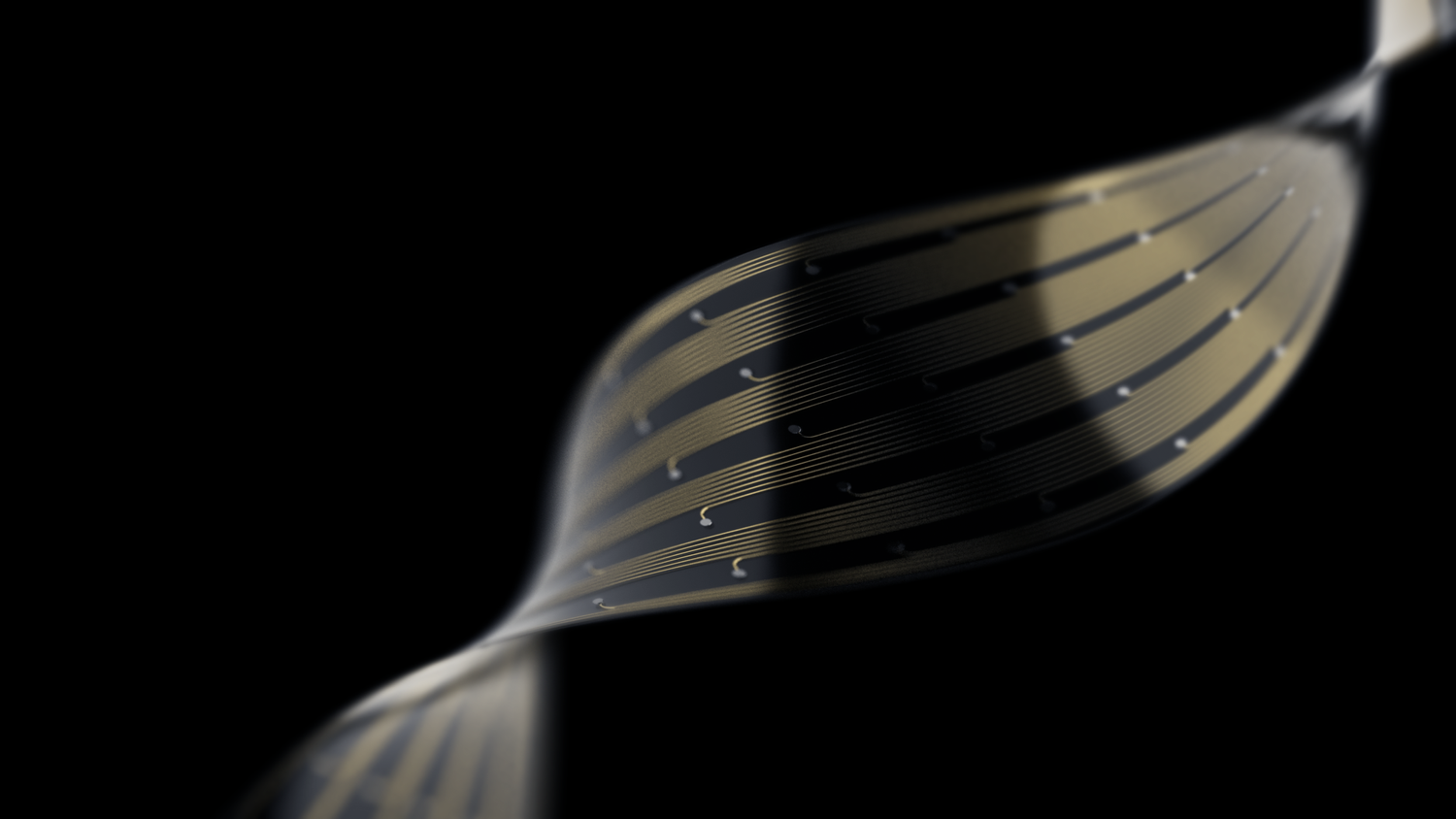
To understand why softness matters, it helps to know how the rest of the field is thinking. The most visible name in brain interfaces, Neuralink, threads flexible wires deep into brain tissue. Others, like Precision Neuroscience, work with thin films on the surface. Neurosoft sits in the surface camp but pushes the material science further: its electrodes are engineered to be up to 100,000 times softer than conventional implants and, by the company's account, up to 1,000 times more compliant than other flexible neural interfaces on the market.
The payoff is not just comfort. A softer sheet conforms more closely to the folds of the cortex, which means cleaner signal and less of the scarring and immune response that stiff implants can provoke over time. It can cover up to 30 times more cortex than state-of-the-art BCIs. And because the material is so pliable, it can be manufactured with semiconductor-grade processes to shrink the electrodes and pack them tighter - and, crucially, it plays nicely with an MRI scanner, without throwing off imaging artifacts.
Our soft electrode platform, paired with a streamlined regulatory pathway, gives us access to neural data at a quality and scale no other approach can safely match today.Nicolas Vachicouras, CEO & Co-Founder
The First JobFinding the tissue that causes seizures
Neurosoft did not start with telepathy or robotic limbs. Its lead application is drug-resistant epilepsy, one of the more grounded problems in neuroscience. When medication fails, surgeons sometimes remove the small patch of brain tissue causing seizures - but only if they can find it precisely. That requires reading faint electrical signatures, including high-frequency oscillations and fast ripples, that stiffer electrodes can smear or miss.
This is where a conformal, high-density soft grid earns its keep. In a feasibility study in Houston, the company recorded from four patients with a 32-channel device. It then doubled the channel count to 64 in a study at University Medical Center Utrecht - a record for a soft brain interface - reading the cortex with a sheet the team describes as thousands of times softer than the tissue it touches. A 12-patient validation study at Utrecht is planned next.
The flexibility can be especially useful for recording small epileptic activity, like high frequency oscillations.Prof. Maeike Zijlmans, UMC Utrecht
The Product LineOne material, four devices
Neurosoft treats its soft electrode as a platform, not a single product. That is the tell of a company that thinks the material is the moat.
SOFT ECoG
Soft, high-density subdural array for recording and stimulating the brain surface - used during surgery or implanted up to 30 days. Lead use: epilepsy mapping and tumor-resection monitoring.
MINDZ
A device soft enough to fold into extreme form factors and unfold without damage, so it can go in through a small burr hole instead of a full craniotomy to localize epileptic foci.
SOFT TINNIT
A fully implantable closed-loop system that targets and modulates specific brain regions to reduce severe tinnitus - a condition affecting an estimated 120 million people worldwide.
Synapsuit
A brain-computer interface paired with a lightweight soft exosuit to restore upper-limb movement, built with the Wyss Center, the Korea Electronics Technology Institute and Jang EUN FnC.
The tinnitus work is worth pausing on. In a proof-of-concept study, SOFT TINNIT produced a 28-point average drop on the Tinnitus Handicap Index - about four times the threshold considered clinically significant. For a condition with few good options, that is the kind of early number that turns a research device into a roadmap.
The BusinessData is the second product
Neurosoft is a B2B medical device company: it develops and manufactures the interfaces, runs them through clinical trials, and aims for regulatory clearance and sale to hospitals and neurosurgeons. The near-term customers are the epilepsy monitoring units and surgical teams at sites like UTHealth Houston and UMC Utrecht, with roughly 10 patients enrolled across two ongoing trials. The stated milestones are concrete: demonstrate minimally invasive deployment in humans, and reach US commercialization of the first brain interface.
There is a second, quieter thesis underneath. Because Neurosoft's electrodes can safely gather high-quality cortical data at scale, the company frames that data as a foundation in its own right - what Vachicouras calls a "cortical foundation model" for the next generation of brain interfaces. Whether that becomes a real asset or stays a talking point is one of the open questions worth watching.
That data is the foundation for improved clinical outcomes, and a cortical foundation model that will shape the next generation of brain interfaces.Nicolas Vachicouras, CEO & Co-Founder
The MoneyWho is backing a squishy implant
The 2026 round was led by Skybound Venture Capital, with Protocol Labs, IAG Capital Partners and Connecticut Innovations participating - a mix of deep-tech and neurotech-friendly investors. At $7.5 million it was oversubscribed, and it brought the company's running total past $20 million on top of its earlier grant funding. The financing is aimed squarely at the two milestones above rather than at a sprawling roadmap.
Spun out of EPFL
Vachicouras, Serex and Fallegger found Neurosoft out of EPFL's Laboratory for Soft Bioelectronic Interfaces, at Campus Biotech in Geneva.
Grants and early wins
Non-dilutive backing including Venture Kick (CHF 150,000) and SERI support to develop implantable electrodes.
First-in-human recordings
The soft stretchable electrode records human brain activity; a feasibility study runs in Houston.
Platform expands
The pipeline broadens to MINDZ, SOFT TINNIT and the Synapsuit BCI-exosuit collaboration.
Record trial + $7.5M
A 64-channel soft interface is tested in epilepsy patients at Utrecht, and the oversubscribed round takes total funding past $20 million.
The Reality CheckWhere the soft bet could slip
The honest version has caveats. Surface electrodes, however soft, read the cortex from the outside; they do not reach the deep structures that penetrating systems target, so Neurosoft's approach is a different tool, not a universal one. The clinical numbers, while promising, come from small early studies - a handful of patients, short implant windows. And medical-device timelines are long: a record in a research trial is a long way from a cleared, reimbursed product a hospital buys. Softness is a genuinely good bet for the problems Neurosoft has chosen. It is not a bet that pays off on every problem, and the company has been fairly disciplined about saying so.
What is copyable here, for anyone building in deep tech, is less about electrodes than about strategy: Neurosoft found a lane the loudest competitors were not racing in, anchored it in a boring-but-real clinical need, and paired the science with a regulatory path instead of a moonshot narrative. The brain is soft. Building for that fact, rather than around it, turned out to be a company.