In 2009, Nicolas Vachicouras arrived at EPFL with an unusually specific dream for a new undergraduate: engineer medical devices. He chose microengineering, then narrowed his attention to the place where electronics meet the nervous system. By the time most students are still collecting possibilities, he was arranging them. A laboratory project led toward neural interfaces. A summer internship at Aleva Neurotherapeutics showed him how implantable electrodes were tested in industry. A master’s project at Massachusetts Eye and Ear brought him into auditory brainstem implant work. A doctorate followed under EPFL professor Stéphanie Lacour, centered on soft microfabricated neural implants.
The line is almost suspiciously straight. Vachicouras insists it was deliberate. In a 2019 interview, fresh from his PhD, he described each decision as part of a strategy to learn enough science and industry to build a startup. The revealing detail is not that he had a grand idea. Plenty of young engineers do. It is that he treated coursework, internships and collaborators as parts of the same machine.
The machine he wanted to build, however, would be soft.
The mismatch that became a company
Traditional microelectronics comes from a world of flat wafers and obedient geometry. Neural tissue offers neither. It is soft, curved and always slightly in motion. Conventional electrode arrays can be many orders of magnitude stiffer than the surface they touch. Vachicouras’s doctoral work took aim at that mechanical mismatch: could thin-film conductors bend and stretch while keeping their electrical properties, then conform closely to complicated anatomy?
This was materials science with an entrepreneurial timer running in the background. Vachicouras and his future co-founders were learning how to deposit stretchable conductors, fabricate arrays with semiconductor processes and translate a laboratory device toward medical-grade manufacturing. The result looks less like the hardware of popular imagination and more like a delicate film. It can fold into a compact shape for deployment, then unfold over a larger surface.
Closer contact can yield richer signals but raises the engineering burden. Neurosoft’s bet sits on the surface: high-resolution access without penetrating tissue.
The crucial insight was not softness as a party trick. It was softness as architecture. A conformable interface could maintain close contact while reaching folds that stiff arrays struggle to cover. A device that tolerates folding could also change how it is deployed. And a fabrication process borrowed largely from the semiconductor industry offered a route to repeatable batches rather than heroic one-off assembly.
My state of mind is to be a ‘realistic optimistic’, but not naive.Nicolas Vachicouras, 2019
A founding team built before the company
Deep tech has a charming habit of turning old classmates into people who must jointly negotiate clean rooms, patents and payroll. Vachicouras met Ludovic Serex during their bachelor’s studies. They worked on projects together for years. Florian Fallegger later became a close collaborator in Lacour’s laboratory. The path from colleagues to founders was gradual: first shared research, then a contest, then a company.
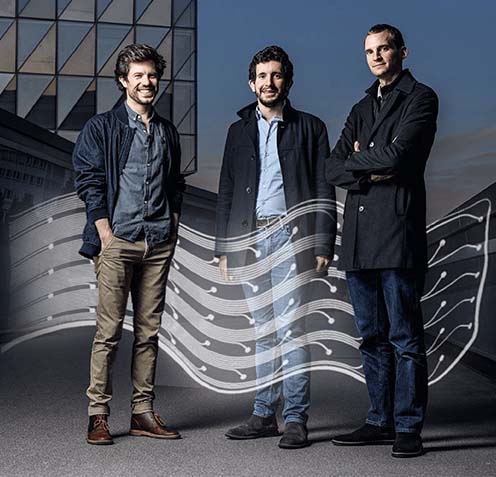
Vachicouras’s criterion for a co-founder was plain: someone you trust, whose capabilities and motivation you have already seen. Their history supplied the due diligence. It also supplied the affectionate evidence of his working style. Asked in 2019 what kept the team awake, Serex said Vachicouras might text late at night with a new opportunity for the startup. The joke contains a job description: scout, translate, persist.
The early competitions taught the team another discipline. A specialized electrode platform cannot survive on specialized explanations. After Neurosoft won both the main prize and audience prize at the 2019 IMAGINE IF! Lausanne competition, Vachicouras emphasized the value of describing a technical idea quickly to people outside the field. This is often treated as presentation polish. For a multidisciplinary company, it is closer to operating infrastructure. The engineer, clinician, regulator and investor must each understand enough to move together.
When the problem is clear, choose training and projects that make the next useful step more likely.
Shared work before incorporation can reveal more than a polished founder courtship.
Explaining complex technology simply is part of development, not decoration.
Regulation, fabrication and validation run on timelines that enthusiasm cannot compress.
From a thesis defense to human recordings
Vachicouras defended his doctorate in March 2019 at Campus Biotech in Geneva. His thesis title was admirably direct: “Soft microfabricated neural implants: a path towards translational implementation.” The last three words did a great deal of work. Translation would require medical-grade materials, reliable production, experienced regulatory guidance and clinical collaborators willing to evaluate a young company’s device.
Neurosoft Bioelectronics was incorporated in 2020 as an EPFL spin-off. In 2023, the company announced that its soft electrode technology had recorded from the surface of the human brain in three cases at UTHealth Houston and Memorial Hermann. By 2025, it reported testing a 256-electrode soft and stretchable interface in a human procedure. By the following year, the company said its interface had been used across studies involving ten participants in Houston and Utrecht.
The milestones sound neat when arranged in a sentence. The work between them is less photogenic. Vachicouras has spoken openly about manufacturing setups that can take months to establish and the need to ask experienced people for help with regulation. His optimism comes with spreadsheets. His 2019 formulation, “realistic optimistic,” may be the rare founder motto improved by its awkward grammar. It refuses both cynicism and fantasy.
Pick the field
Begins microengineering at EPFL with a focus on medical devices.
Make soft electronics translate
Doctoral research turns a materials problem into an implant platform.
Form the company
Neurosoft Bioelectronics emerges as an EPFL spin-off.
Clinical work, capital, data
Human recordings, a New York presence, new funding and a broader NeuroAI strategy.
Why New York, why now
Neurosoft kept its headquarters in Geneva and opened a second office in New York in 2026. Vachicouras’s explanation was notably free of skyline poetry. The United States is the company’s first intended commercial market. American capital has shown more appetite for implantable BCI companies than European capital. New York overlaps more comfortably with Geneva’s working day than California. It also puts Neurosoft near a growing group of neurotechnology companies and within reach of the broader Northeast corridor.
It is the founder’s method applied to geography: select the environment that compounds the work. Geneva offers research roots, technical infrastructure and a team built around Campus Biotech. New York offers market access, investors and a dense network of peers. The bridge matters more than choosing one city as a winner.
The strategy broadened at the same time. Neurosoft announced a partnership with Science Corp in February 2026. In May, it closed an oversubscribed $7.5 million financing led by Skybound Venture Capital, bringing reported funding above $20 million. The stated plan connected minimally invasive deployment and US commercialization with an expanding cortical-data effort. In July, the company hired Sam Hosovsky as vice president of NeuroAI.
The software above the soft hardware
There is a fashionable way to tell this story in which artificial intelligence suddenly arrives and makes everything modern. Vachicouras’s version is more grounded. Better models require better data. Better neural data depends on the quality, stability and scale of the interface collecting it. Neurosoft spent years on the physical layer before making a larger argument about cortical foundation models.
That sequencing may become the company’s most consequential bet. If its interfaces can gather high-quality recordings across more channels and more studies, the hardware becomes a source of differentiated data. The data supports models. The models, in turn, can improve decoding and make the interface more useful. A soft sheet made in a fabrication facility becomes the bottom layer of a software platform.
If you are lucky enough to know what you want to do early on, focus all your actions towards that goal from the beginning.Nicolas Vachicouras, 2019
Vachicouras has also learned to widen the frame without abandoning the original problem. Neurosoft began with particular applications in mind. By 2026, he was speaking about a broader BCI platform and the long-term value of decoding the brain. The surface-electrode approach occupies a middle ground in the industry: closer than external sensors, less invasive than penetrating arrays, and ambitious about signal quality. He does not expect a single company to own the field. The trade-offs are too varied, the market too young and the nervous system too complicated for one tidy answer.
The continuity is striking. The student who chose microengineering to work on medical devices became the doctoral researcher asking flexible conductors to survive strain. The researcher became a founder who chose trusted collaborators. The founder became an executive connecting Geneva manufacturing, American studies, New York capital and machine-learning talent. Each stage added a layer, but the central design principle remained: respect the thing you are trying to interface with.
For Neurosoft, that means electronics that yield rather than insist. For Vachicouras, it has meant something similar: hold firmly to the direction, stay flexible about the route, and keep enough realism in the optimism to survive the calendar.